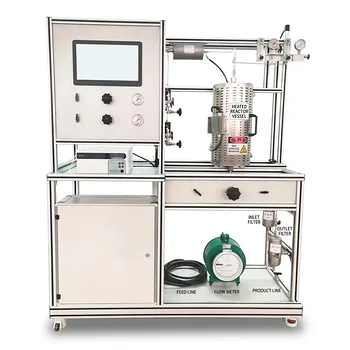
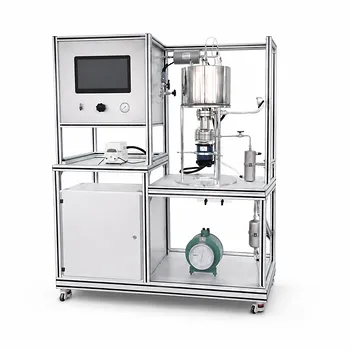
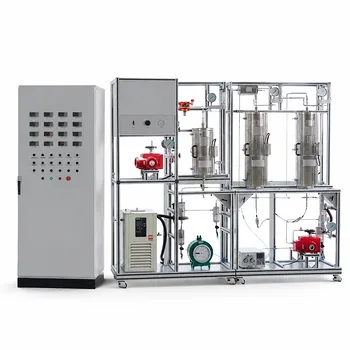
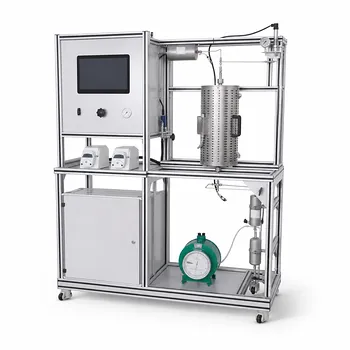
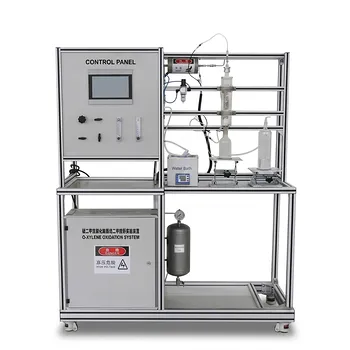
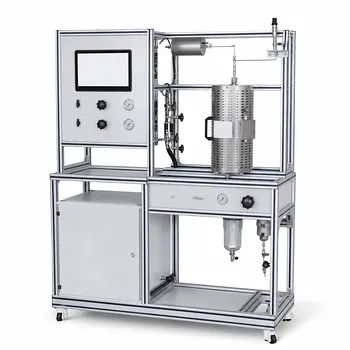
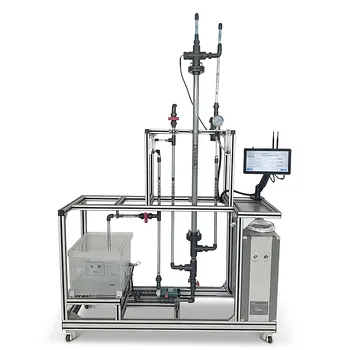
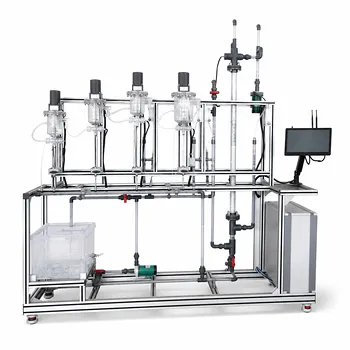
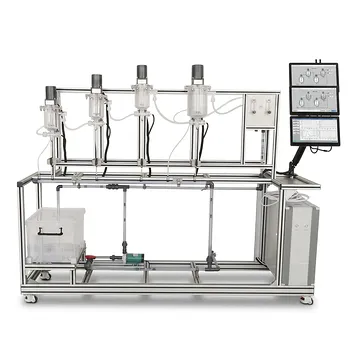
The integration of temperature-programmed reduction (TPR) and reaction analysis systems is the educational and research linchpin of a modern catalytic reactor pilot plant. It is critical because it allows students and engineers to perform in-situ activation of metal catalysts—transitioning them from their oxide precursors to their active metallic state—while simultaneously tracking gas consumption or desorption in real time. This seamless coupling of material preparation, kinetic characterisation, and performance assessment directly replicates industrial startup procedures and provides the only safe, controlled environment where the fundamental principles of catalysis can be learned from the molecular level up to the pilot scale.
The surface need is to justify the hardware investment, but the real value lies in creating an environment where the “why” and “how” of catalytic processes are inseparable. Without integrating TPR and reactor analysis, you risk training operators who can run a plant but cannot diagnose a catalyst, and researchers who can measure kinetics but cannot relate them to the active phase that actually drives the reaction.
The Fundamental Role of TPR in Catalytic Pilot Plants
What Temperature-Programmed Reduction Actually Reveals
TPR is a characterisation technique that measures hydrogen consumption as a catalyst sample is heated under a linear temperature ramp. For supported metal oxides like copper or nickel on silica, the resulting profile reveals the temperatures at which different metal species reduce—essentially a fingerprint of reducibility and metal-support interaction.
In a pilot-plant setting, this is not a separate bench-scale exercise. It is performed directly in the reactor bed using the same gas delivery and thermal control infrastructure that will later run the catalytic reaction. This integration teaches students that a catalyst is not a static component but a material that undergoes a dynamic transformation before it ever sees feed.
In-Situ Activation: The Safe Simulation of Industrial Startup
The primary reference highlights a profound, often-overlooked point: before any reaction cycle, a commercial catalyst must be activated under a programmed reducing atmosphere. Doing this incorrectly—too fast a ramp, an inappropriate gas mixture, or a runaway exotherm—can permanently sinter the metal and destroy the activity.
In the pilot plant, students programme the exact same heating rates and flow rates they would find in a refinery startup procedure. They observe the thermal trace, watch the hydrogen consumption spike, and learn to balance reaction exothermicity against furnace control. This transforms TPR from an abstract characterisation method into a hands-on lesson in process safety and operational procedure, all before any valuable chemicals are produced.
Characterising Metal-Support Interactions and Preparation Effects
Calcination temperature, loading method, and precursor choice all dictate the final dispersion of metal nanoparticles on the support. By running a TPR ramp after different pre-treatments, students can visualise how a high calcination temperature produces broader, higher-temperature reduction peaks—indicative of strong metal-support interactions and larger, less active particles.
This immediate feedback loop, enabled by the integrated system, teaches the critical lesson that catalyst preparation is not separable from reactor performance. A reaction rate measured on a poorly activated catalyst is meaningless, and integrated TPR prevents this error from ever being propagated.
Why Coupling TPR with Reaction Analysis is Non-Negotiable
Kinetic Insight: Connecting Reduction Profiles to Rate Equations
The kinetic reality captured by the supplementary references—that the reaction rate constant ( k ) follows an exponential relationship with temperature—demands ultra-stable thermal control. Integrated PID controllers and high-precision sensors on the pilot plant teach students to hold isothermal conditions within a fraction of a degree, because any fluctuation directly scrambles the data required to calculate activation energy.
More importantly, by first running a TPR to confirm that the active metal phase is fully reduced and stable, and then switching to a reaction mixture to measure steady-state conversion, students can correlate a specific reduction event with a specific catalytic performance. They learn that the hydrogen consumed at 250°C is not just a peak on a chart; it is the birth of the sites that will later oxidise carbon monoxide.
Real-Time Transient Analysis with Online FTIR and GC
When the pilot plant goes beyond steady-state measurement and incorporates online Fourier Transform Infrared spectroscopy or a rapid-sampling gas chromatograph, the educational value multiplies. As described in the supplementary references, transient response methods allow observation of surface intermediates during step changes in feed.
With integrated TPR/reaction capability, a typical laboratory session flows seamlessly: reduce the catalyst, hold at reaction temperature, then switch from an inert to a CO/O₂ stream while monitoring the IR signature of adsorbed carbonates and gas-phase CO₂. Students see reaction mechanisms unfold in real time, confirming that the active sites they just created through reduction are indeed participating in the catalytic cycle.
Demonstrating Process Intensification and Heat Integration
Heat-integrated reactors that recover the exothermic heat of reduction or reaction directly into the process—rather than discarding it to utilities—represent the industrial frontier. The pilot plant scaled for training can include this design, showing how the heat released during hydrogen consumption in TPR can pre-heat the feed for an endothermic downstream step.
Integrated temperature control and gas analysis make this possible: students can track the energy balance, measure the sensible heat loss, and calculate how much of the reaction enthalpy was converted into useful chemical work. This turns an abstract concept of “energy efficiency” into a measurable, optimisable parameter.
Bridging the Gap from Pilot Plant to Industrial Reality
Learning Industrial Startup and Safety Protocols Safely
A catalytic reactor startup is a high-consequence procedure. In the classroom pilot plant, the integration of TPR allows students to make controlled mistakes—ramping too quickly, misprogramming the purge gas, or overheating the bed—within a small-scale, instrumented environment that will trigger alarms but not catastrophic incidents.
They learn to read temperature profiles for hot spots, to manage the exotherm of reduction using diluents in the hydrogen stream, and to verify that the catalyst is fully reduced before the reactive feed is introduced. These are the precise protocols that prevent fires in industrial reformers and shift converters.
Economic Evaluation of Catalyst and Reactor Performance
The supplementary reference on Aspen ICARUS integration points toward a complete learning loop. After students have generated a TPR trace, determined reduction kinetics, and measured steady-state conversion, they can feed those operational parameters—utility consumption, cycle length, required furnace duty—into economic evaluation software.
This reveals the startling truth that the reduction ramp time is not just a chemistry variable; it is an Inside Battery Limits (ISBL) cost driver. A catalyst that requires a 12-hour, meticulously controlled activation will produce a very different capital expense profile than one that activates in 30 minutes. Integrated TPR/reaction analysis provides the hard data to make that trade-off visible and quantifiable for future project leaders.
Understanding the Trade-offs
Complexity vs. Fundamental Focus
An integrated system with TPR, online FTIR, multi-stage reactors, and economic software is incredibly powerful, but it can overwhelm. The risk is that students lose sight of the core chemical engineering principles—mass and energy balances, reaction order, and heat transfer—in a sea of analytical signals. A well-designed curriculum must scaffold the experience: first, use only the thermal conductivity detector to understand the TPR itself; then add the reactor analysis; then layer on economic evaluation.
The Oversimplification of Industrial Scale
No pilot plant, however sophisticated, can fully replicate the radial temperature gradients, pressure drops, and catalyst attrition of a full-scale reactor. The TPR trace on a few grams of catalyst in a thin bed is thermally uniform; a commercial reactor with 20-tonne catalyst charges will exhibit a distribution of reduction states across the cross-section. Instructors and researchers must explicitly teach this “scale-up gap” so that the seamless integration in the pilot plant does not produce unwarranted confidence.
How to Apply This to Your Pilot Plant Design
The integration of TPR and reaction analysis is not a box to tick; it’s a strategic decision about what you want your trainees and researchers to master. Choose your integration depth accordingly.
- If your primary focus is fundamental catalyst science: Invest in high-precision thermal mass flow controllers and a rapid online mass spectrometer. Prioritise the speed and resolution of the TPR ramp so students can deconvolute overlapping reduction peaks and calculate reduction kinetics with confidence.
- If your primary focus is process safety and industrial startup training: Build the pilot plant around a robust, multi-zone heated reactor with independent overtemperature protection. Programme the control software to require explicit confirmation of purge completion before hydrogen is admitted, and log every step for after-action review.
- If your primary focus is research that bridges surface science and pilot-scale operation: Integrate a Fourier Transform Infrared or Raman probe directly into the catalyst bed. Enable transient switching between reduction and reaction atmospheres so that surface intermediates observed during TPR-like ramps can be directly linked to catalytic turnover frequencies.
- If your primary focus is industry-readiness and economic evaluation: Ensure the pilot plant’s data historian exports directly into simulation and cost-estimation packages. The hydrogen bottle consumption, furnace power draw, and ramp duration from the TPR cycle must become inputs to an Aspen ICARUS model so that students see the connection between a reduction curve and a project’s net present value.
An integrated TPR and reaction analysis system does more than teach catalysis; it forces the mind to think in coupled systems, where the material, the reactor, and the economics are bound together from the very first millilitre of hydrogen consumed.
Summary Table:
| Integration Component | Core Function | Educational & Practical Value |
|---|---|---|
| Temperature-Programmed Reduction (TPR) | Measures H2 consumption during linear heating | Teaches catalyst activation, safety protocols, and metal-support interactions. |
| Reaction Analysis (FTIR/GC) | Monitors real-time product yields and intermediates | Correlates active catalyst phases directly with kinetic rate equations. |
| Process & Economic Integration | Tracks energy efficiency and utility usage | Connects pilot-scale data to industrial scale-up cost modeling. |
Empower Your Students and Researchers with LABPARK
Bridge the gap between molecular theory and industrial reality. LABPARK provides premium Educational and Vocational Unit Operations Pilot Plants in chemical engineering, bioprocess & biotech, and environmental & water treatment for universities, research institutes, and enterprises.
Our advanced, integrated catalytic reactor systems enable safe hands-on startup training, real-time kinetic analysis, and process optimization.
Contact us today to discuss how we can customize a pilot plant solution to fit your curriculum and research goals!
Related Products
- Fixed Bed Gas Solid Catalytic Reaction Educational Pilot Plant
- Micro-Scale Gas-Solid Catalytic Reaction Educational Pilot Plant
- Internal Circulation Gradient Free Catalytic Reaction Educational Pilot Plant
- Fluidized Bed Gas Solid Catalytic Reaction Educational Pilot Plant
- Multi Functional Catalytic Reaction and Reactor Evaluation Educational Unit Operations Pilot Plant
People Also Ask
- How do reactor pilot plants safely study gas-solid reactions? Master kinetics with thermal & flow control.
- How does the Mears criterion evaluate transport resistance? Key Guide to Intrinsic Kinetics
- Why is a multibed configuration necessary for exothermic reactions? Optimize your pilot plant trajectory.
- Fluidized vs. Fixed Bed Reactors: Comparing Heat & Complexity in Pilot Plants
- How is the friction factor determined for fixed-bed pilot plants? Select the best pressure drop correlation.