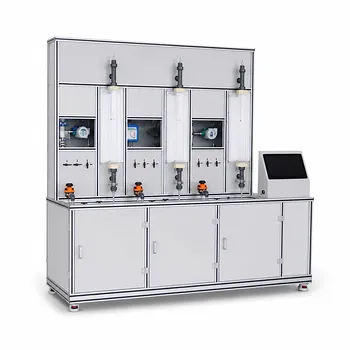
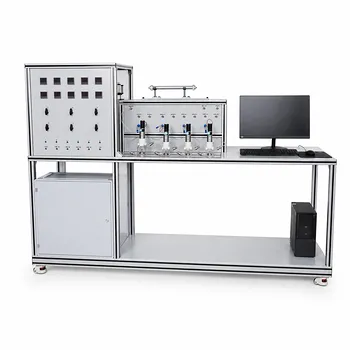
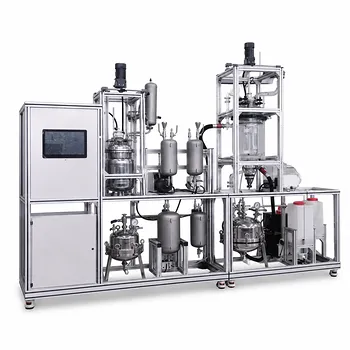
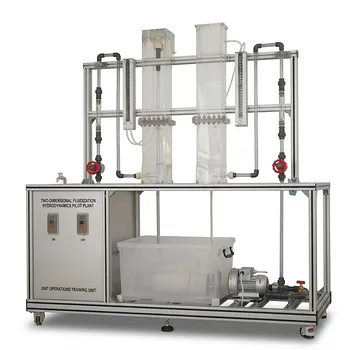
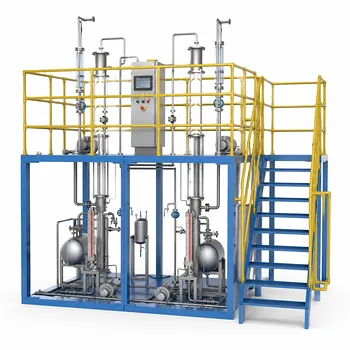
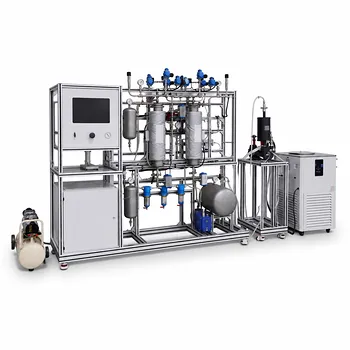
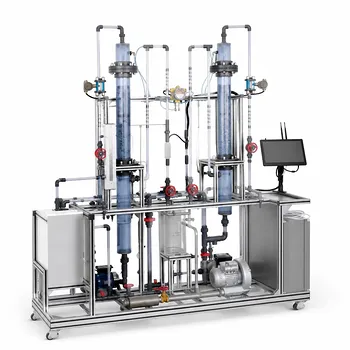
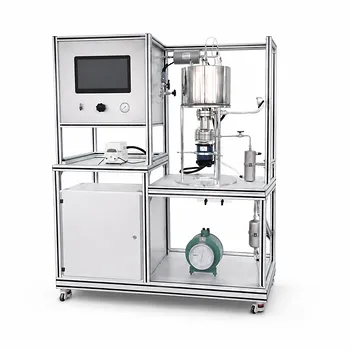
The secret to teaching reactor design lies in making the invisible dance between chemistry and physics visible. In a gas-liquid reactor pilot plant, students demonstrate the transition between diffusion-controlled and kinetic-controlled regimes by systematically varying agitation speed and gas flow rate. As they shift the effective diffusion time relative to the reaction time, they observe how the rate-limiting step flips from mass transfer to intrinsic kinetics. For a series-parallel reaction like A → B → C, this hands-on manipulation shows precisely why shifting the regime for each step can dramatically boost the yield of the intermediate product B.
In a series-parallel reaction, deliberately setting process conditions so the first step is diffusion-limited while the second remains kinetically controlled creates a “selectivity window” that students can measure, visualize, and connect directly to industrial reactor operation—turning abstract transport phenomena into tangible engineering insight.
The Two Regimes Every Reaction Engineer Must Master
Every gas-liquid reaction operates under a hidden tug-of-war between how fast molecules travel to each other and how fast they react once they meet. A pilot plant lets students pull the rope and feel the tension.
The Kinetic Regime: When Chemistry Dictates the Pace
In the kinetic-controlled regime, the intrinsic chemical reaction rate is much slower than the rate at which gas molecules dissolve and diffuse to the liquid bulk. The liquid becomes saturated with dissolved gas, and the reaction proceeds uniformly throughout the liquid volume.
Students identify this regime because agitation speed and gas flow rate have almost no effect on conversion. The system behaves like a homogeneous liquid-phase reactor—temperature becomes the dominant dial.
The Diffusion-Controlled Regime: When Transport Governs the Rate
When the reaction is extremely fast, the dissolved gas molecules are consumed almost instantly upon entering the liquid. The reaction zone shrinks to a thin diffusion film near the interface, and the overall rate is dictated by the physical mass transfer step.
In the pilot plant, increasing agitation speed sharply raises conversion because it enhances the volumetric mass transfer coefficient ($k_L a$). This regime teaches a crucial lesson: a reactor is only as fast as its slowest transport step.
How a Pilot Plant Turns Theory into a Lived Experience
A well-designed gas-liquid unit transforms regime shifts from equations into observable, repeatable events. The key is giving students control over the variables that separately influence mass transfer and kinetics.
Using Agitation and Flow to Manipulate the Control Step
By adjusting the stirrer speed in a stirred tank or the liquid recirculation rate in a falling film unit, students directly alter the liquid-side mass transfer coefficient ($k_L$) and the interfacial area ($a$).
At low speeds, $k_L a$ is small; a fast reaction becomes diffusion-starved. As agitation increases, $k_L a$ grows until it overtakes the reaction rate—suddenly the system flips into the kinetic regime, and further stirring yields no extra conversion. Students see this plateau in real-time data.
Measuring the Shift with Concentration and Rate Data
Paired measurements of inlet and outlet concentrations at different gas flow rates and agitation levels allow students to calculate the reaction factor or the Hatta number ($Ha$). When $Ha^2$ is much greater than 1, the reaction is fast and occurs in the film (diffusion-controlled). When $Ha^2$ is much less than 1, the reaction is slow and happens in the bulk (kinetic-controlled).
A falling film reactor provides a known, constant interfacial area, letting students decouple $k_L$ from $a$ and measure them precisely. This moves the exercise from “guessing” to rigorous parameter estimation.
The Series-Parallel Reaction: A Masterclass in Selectivity Engineering
The simple A → B → C network is the ultimate teaching tool. It reveals why every industrial gas-liquid reactor design must wrestle with mass transfer.
How Mass-Transfer Limitations Shape Selectivity
In a homogeneous (kinetic-controlled) scenario, the intermediate B is produced and then consumed according to the ratio of reaction rate constants. If B is the desired product, high conversion often destroys B.
Introduce mass-transfer limitation on the first step (A → B), however, and the concentration profile of dissolved A near the interface changes. The reaction zone occurs in the film, creating a steep gradient. This can suppress the secondary reaction (B → C) if the second step remains kinetically controlled and occurs in the bulk, where A concentration is low.
Creating the Optimal Window for Intermediate Product B
Students discover a counterintuitive result: running a reactor partially starved of gas can dramatically improve selectivity. They set conditions so that the effective diffusion time sits between the first reaction time (fast) and the second reaction time (slow).
In this diffusion-controlled first step, A reacts almost immediately in the liquid film, leaving little A to react with B in the bulk. The pilot plant becomes a selectivity optimizer—students vary agitation to shift the effective diffusion time and map the selectivity vs. conversion curve, finding the sweet spot where B yield peaks.
Understanding the Trade-offs and Experimental Pitfalls
This demonstration is powerful but not without nuance. A true educational experience must acknowledge the limitations students will encounter.
The Tug-of-War Between Rate and Flooding
Increasing agitation to escape the diffusion-controlled regime eventually hits hydrodynamic limits. Flooding or excessive entrainment can disrupt the reactor, adding noise to data. Students learn that a reactor’s operable window is finite.
The Illusion of Pure Regimes
Real systems rarely obey a single controlling mechanism. Temperature, pressure, and even reaction byproducts can shift the rate-determining step. Students may see a gradual transition rather than a sharp break, teaching them to interpret dimensionless groups like the Hatta number as continuous indicators, not binary switches.
Measurement Lag and Transient Effects
When adjusting agitation speed, concentration profiles do not instantly stabilize. Residence time distributions and liquid holdup dynamics can mask the true regime change. This forces students to design steady-state protocols and appreciate the role of transient mass balances in reactor operation.
Making the Right Choice for Your Educational Goal
The way you frame this pilot-plant exercise depends on the learning objective you want to amplify.
- If your primary focus is reaction kinetics: Use the kinetic-controlled regime as the baseline, then slowly reduce agitation until you observe the onset of mass-transfer limitation. Plot the rate constant from the kinetic regime against the apparent rate constant under mass-transfer limitation to quantify the transfer coefficient.
- If your primary focus is transport phenomena: Start in the fully diffusion-limited zone and increase agitation stepwise. Have students calculate $k_L a$ at each point and correlate it with power input, then identify the precise stirring speed where the process becomes insensitive to hydrodynamics.
- If your primary focus is industrial selectivity engineering: Center the entire session on the series-parallel reaction. Task students with finding the agitation setting that maximizes intermediate yield, then explain that optimum by calculating the characteristic times for each step. This bridges classroom theory with process optimization.
- If your primary focus is dimensionless analysis: Require students to compute the Hatta number and the reaction factor from experimental data under multiple operating conditions. Have them overlay their data on classic regime maps to visually affirm which zone they are operating in.
By letting students feel the transition from a mixer to a reactor in their own hands, a gas-liquid pilot plant transforms an intimidating set of partial differential equations into a memory anchored in experience. That is the essence of engineering education—not just knowing the regimes, but having touched them.
Summary Table:
| Regime | Rate-Limiting Step | Impact of Agitation & Flow | Key Metric / Indicator |
|---|---|---|---|
| Kinetic-Controlled | Intrinsic chemical reaction | Minimal impact on conversion; temperature dominates | Low Hatta Number ($Ha^2 \ll 1$) |
| Diffusion-Controlled | Physical mass transfer ($k_L a$) | Agitation directly increases conversion | High Hatta Number ($Ha^2 \gg 1$) |
Bring Chemical Engineering Theory to Life with LABPARK
Bridge the gap between textbook equations and hands-on industrial practice. LABPARK designs and manufactures state-of-the-art Educational and Vocational Unit Operations Pilot Plants in chemical engineering, bioprocess & biotech, and environmental & water treatment. Our systems empower universities, research institutes, and enterprises to train the next generation of engineers with real-world, scalable technology.
Ready to upgrade your laboratory with high-performance gas-liquid reactors and pilot units? Contact our experts today to request a quote or custom proposal!
Related Products
- Fixed Bed Gas Solid Catalytic Reaction Educational Pilot Plant
- Fluidized Bed Gas Solid Catalytic Reaction Educational Pilot Plant
- Fixed-Bed Chemical Reaction and Gas Dust Tar Removal Unit Operations Pilot Plant
- Micro-Scale Gas-Solid Catalytic Reaction Educational Pilot Plant
- Two Phase Flow Pattern Velocity Resistance Measurement Educational Pilot Plant
People Also Ask
- How do reactor pilot plants safely study gas-solid reactions? Master kinetics with thermal & flow control.
- How does the Mears criterion evaluate transport resistance? Key Guide to Intrinsic Kinetics
- Fluidized vs. Fixed Bed Reactors: Comparing Heat & Complexity in Pilot Plants
- Why is a multibed configuration necessary for exothermic reactions? Optimize your pilot plant trajectory.
- What are the differences between pseudohomogeneous and heterogeneous models in pilot plants?