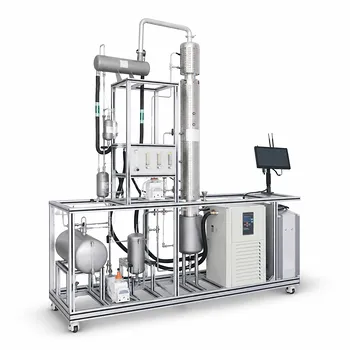
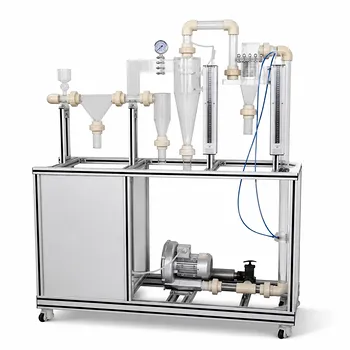
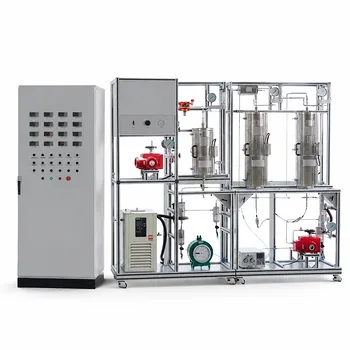
In chemical engineering education and research, the combination of CSTR and PFR models is used to simulate gas-liquid unit operations by decoupling the phases: the liquid phase is treated as a perfectly mixed CSTR (uniform concentration), while the gas phase is treated as a PFR (plug flow with no axial mixing). This hybrid approach provides students and researchers with a computationally tractable framework to solve mass balances, calculate interfacial material fluxes, and study gas absorption with chemical reactions—especially in bubble columns with diameters below 0.5 m. By applying these idealised flow patterns, one can quickly estimate conversion, look at the influence of backmixing, and bridge theory to pilot‑plant data.
At the heart of gas-liquid reaction modelling lies the need to simplify complex two‑phase hydrodynamics. The CSTR‑PFR combination isolates the mixing characteristics each phase really exhibits: the liquid is often well‑stirred, while the gas rises as a coherent plug. This pragmatic split lets you compute local mass‑transfer rates without solving full computational fluid dynamics, making it a cornerstone for both hands‑on laboratory education and process development research.
Why the Hybrid CSTR‑PFR Model Is the Go‑To Framework
The Rationale: Why Liquid Mixes, Gas Plugs
In a typical bubble column or aerated tank, the liquid phase is circulated vigorously by rising bubbles or mechanical agitation. Under moderate gas flow rates, the axial concentration of dissolved species becomes virtually independent of height—the CSTR assumption holds. Meanwhile, the gas bubbles rise as a coherent swarm, with little backmixing, so the gas‑phase composition changes progressively along the column height, resembling plug flow. This decoupling is not merely a convenience; it reflects the true hydrodynamic character that students measure with tracer tests and validate against the Péclet number.
Simplifying Mass Balances with Ideal Flow Assumptions
Treating the liquid as a CSTR means its mass balance reduces to an algebraic equation (no spatial derivatives). The gas‑phase PFR model adds a single axial dimension, giving an ordinary differential equation that can be integrated from inlet to outlet. The link between them is the interfacial mass flux—the transfer of gas into the liquid—computed from the local concentration driving force. Because the liquid concentration is uniform, the flux expression is simplified, and students can directly calculate how reaction kinetics and mass‑transfer rates affect the average absorption efficiency. This makes it possible to solve design equations by hand or with simple scripts, a powerful pedagogical tool.
Bringing the Model to Life in Education and Research
Measuring Deviation from Ideality with the Péclet Number
Real reactors never behave perfectly. The Péclet number (Pe) quantifies how close the flow is to plug flow (Pe → ∞) or perfect mixing (Pe → 0). In the hybrid model, researchers start by assuming the limiting case (Pe → ∞ for gas). Then, through residence‑time‑distribution (RTD) experiments on pilot‑plant columns, they measure the actual axial dispersion and fit a more general axial dispersion model. This teaches students that the PFR assumption is a starting point—one that can be systematically refined by measuring Pe and seeing how conversion changes when backmixing is introduced.
Frequency Response Analysis to Diagnose Mixing Behaviour
A powerful experimental technique used in educational pilot plants is sinusoidal tracer perturbation. By feeding a tracer with a varying frequency and recording the output’s amplitude ratio and phase lag, you can instantly distinguish a pure CSTR, a pure PFR, or intermediate mixing. A single CSTR shows a gentle drop in amplitude and a phase lag maxing out at -90°. A PFR (or a cascade of CSTRs) exhibits a far steeper drop and a phase lag that grows dramatically beyond -180°. This direct frequency‑response signature lets students verify whether their gas phase truly approaches plug flow and how sensitive the CSTR‑PFR assumption is to operating conditions.
Alternatives and the Cascade Analogy
While the CSTR‑PFR combination is common for bubble columns with small height‑to‑diameter ratios, other configurations demand different models. Packed towers often treat both phases as plug flow, requiring integration of the local reaction rate over the bed. For processes where a physical PFR is impractical, a cascade of 5–10 CSTRs approximates plug‑flow behaviour—its residence‑time distribution narrows and yields conversion performance nearly identical to a PFR. This cascade concept is a cornerstone of reactor design education, showing how backmixing vanishes as the number of stages increases.
Understanding the Trade‑offs and Limitations
When the Perfect Mixing Assumption Breaks Down
The CSTR assumption for the liquid is powerful but fragile. In tall columns or at low gas‑throughput, the liquid may develop composition gradients. Incomplete mixing creates a longer tail in the RTD curve, meaning the average liquid concentration is not truly uniform. In such cases, a dispersion model for the liquid—or even a series of CSTRs for the liquid phase—must replace the single‑tank approach. Students learn this by deliberately operating a pilot column outside the recommended range and measuring the resulting deviation in space‑time yield.
The Limits of Plug Flow for the Gas Phase
The PFR model for the gas holds well for columns with diameters under 0.5 m, where the bubble swarm stays coherent and backmixing is minimal. As column diameter increases, large‑scale circulation loops can entrain gas, creating significant axial dispersion. This pushes the effective Pe downward, and a plug flow‑with‑dispersion model becomes necessary. For fast, single‑pass absorption studies the PFR assumption is excellent; for detailed reactor scale‑up, one must measure Pe and possibly use a full axial dispersion model to avoid overestimating conversion.
Making the Right Choice for Your Reactor Simulation
- If your primary focus is hands‑on education and quick design estimates: Stick with the CSTR‑PFR hybrid. It lets you compute interfacial fluxes, understand the limiting steps, and run parametric studies without complex code.
- If your goal is high‑fidelity scale‑up from pilot data: Start with the CSTR‑PFR model but then measure the actual Péclet number. Use an axial dispersion model for the gas phase and, if needed, a cascade for the liquid to refine conversion predictions.
- If you are working with packed towers or very tall bubble columns: Abandon the CSTR assumption for the liquid; model both phases as plug flow or use a dispersion model for each phase, integrating the local reaction rates along the column.
- If you want to demonstrate the pure effect of backmixing in class: Run identical reactions on a CSTR‑PFR hybrid setup and then compare with a cascade of CSTRs; the volume‑to‑conversion trade‑off becomes instantly tangible.
Mastering the CSTR‑PFR combination is not about pretending reactors are perfect—it’s about building an intuition for flow patterns, knowing when simplifications work, and finally using that intuition to design, diagnose, and scale up real multiphase reactors.
Summary Table:
| Phase | Ideal Flow Model | Mixing Characteristics | Equation Type |
|---|---|---|---|
| Liquid Phase | CSTR (Continuous Stirred Tank) | Uniform concentration, vigorous mixing | Algebraic equation |
| Gas Phase | PFR (Plug Flow Reactor) | Coherent swarm, no axial backmixing | Ordinary Differential Equation (ODE) |
Bring Chemical Engineering Concepts to Life
Ready to bridge the gap between reactor theory and practical lab experience? LABPARK provides state-of-the-art Educational and Vocational Unit Operations Pilot Plants in chemical engineering, bioprocess & biotech, and environmental & water treatment. Designed specifically for universities, research institutes, and enterprises, our pilot plants enable students and researchers to analyze real-world CSTR, PFR, and multiphase flow dynamics.
Contact LABPARK today to discover how our pilot plants can enhance your engineering curriculum and research capabilities!
Related Products
- Multi Functional Catalytic Reaction and Reactor Evaluation Educational Unit Operations Pilot Plant
- Multi-Reactor Educational Pilot Plant for Reaction Engineering Unit Operations
- Gas Phase Mixing and Residence Time Distribution Determination Educational Unit Operations Pilot Plant
- Multi-Stage Stirred Tanks in Series Residence Time Distribution and Mixing Performance Determination Educational Pilot Plant
- Two-Dimensional Fluidization Hydrodynamics Educational Pilot Plant for Unit Operations Training
People Also Ask
- What reaction engineering principles are shown in a catalytic reactor pilot plant? SO2 Oxidation Guide
- Why is FTIR integration in catalytic pilot plants important? Real-Time Student Insights
- How to analyze active metal distribution & identify catalyst poisoning in pilot plants? Expert Diagnostic Guide
- How do temperature limits and WHSV influence catalytic reactor optimization? Scale-Up Guide
- What operational insights do catalyst pellet concentration profiles provide? Optimize Reactor Yield