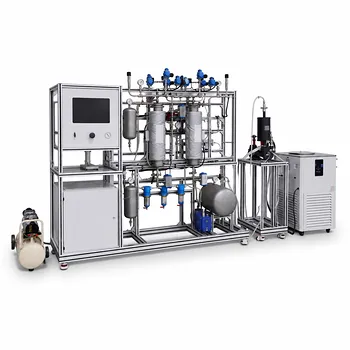
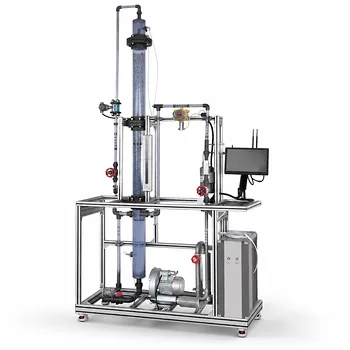
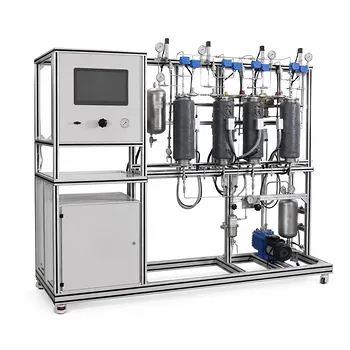
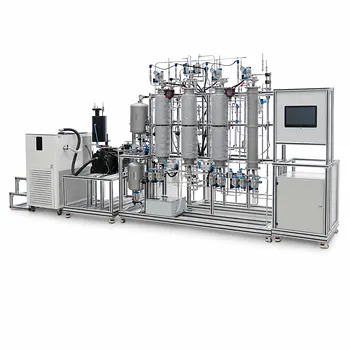
For educational pilot plants handling corrosive media like gaseous hydrochloric acid, material selection is not just an engineering decision—it’s a pedagogical one. Plain carbon steel is chemically unsuitable and dangerous. Instead, institutions should focus on three core material families: borosilicate glass, fluoropolymers like PTFE, and high-nickel alloys. Among these, borosilicate glass is often the gold standard for the column itself because it provides both outstanding acid resistance and the unique ability for students to visually observe flooding, channeling, and wetting phenomena—turning an abstract transport principle into a tangible learning experience.
The heart of an educational HCl absorption pilot plant should almost always be a borosilicate glass column. It marries chemical safety with unparalleled visibility. However, the final selection must be a system-level decision, not a single-component one. Glass is brittle and must be integrated with other inert materials like PTFE for seals and pumps, and its use must be governed by strict safety protocols to account for its fragility. No single material solves everything—the goal is a carefully matched material ecosystem that teaches safely and effectively.
Why Standard Materials Fail Spectacularly
A common mistake in pilot-plant design is to underestimate the aggressiveness of even dilute acids. Corrosive gases like HCl demand a fundamentally different approach to material selection.
The Carbon Steel Trap
Standard carbon steel is completely unacceptable. It reacts rapidly with hydrochloric acid, leading to wall thinning, product contamination, and a high risk of catastrophic leakage. Even trace amounts of moisture in a gas stream will initiate severe rust and pitting, rendering the plant unsafe within a single experiment.
The Stainless Steel Misconception
Many assume stainless steel 304 or 316 is a universal solution. For HCl, it is not. Stainless steel relies on a passive chromium oxide layer that is aggressively attacked by halides. Stress corrosion cracking and pitting can occur rapidly, especially in the heat-affected zones of welds. Using stainless steel in an HCl absorption column is a dangerous gamble that ignores basic material compatibility.
The Three Pillars of Material Selection for Educational HCl Service
Selection must be evaluated against a trifecta of requirements: chemical inertness, educational transparency, and system-level safety.
1. Chemical Inertness as a Non-Negotiable Baseline
The primary material must not react with gaseous or aqueous HCl, any potential scrubbing solutions, or the byproducts of absorption. It must also withstand the operating temperature, which can rise due to the exothermic dissolution of HCl in water. Any material degradation introduces toxic leaks and invalidates experimental data.
2. Educational Utility as a Design Goal
In a teaching environment, the plant is a textbook brought to life. Students need to see what’s happening inside the column. Transparent materials allow direct visualization of hydrodynamic phenomena like bubble flow, frothing, and liquid distribution. This transforms a black-box chemical process into an intuitive understanding of mass transfer fundamentals.
3. System-Level Safety Integration
A pilot plant is more than a column. It includes piping, gaskets, valves, pumps, and storage tanks. All wetted components must share compatible corrosion resistance. A single inappropriate seal or pump head can fail, releasing corrosive fluids. The entire system must be designed with secondary containment, pressure relief, and emergency gas scrubbing.
A Closer Look at the Viable Material Candidates
No single material dominates every application. Each has a distinct role in a well-architected educational pilot plant for HCl.
Borosilicate Glass: The Educational Gold Standard
For the absorption column itself, borosilicate glass is the unmatched choice. It is chemically inert to hydrochloric acid, offers zero corrosion, and provides flawless transparency. Students can visually calibrate a packed bed’s wetting, diagnose flooding, and measure bubble sizes. The primary reference confirms this dual role: safely containing the process fluid while serving as a window into real fluid dynamics.
Fluoropolymers (PTFE, PFA): The Inert Workhorse
For components where glass is impractical—pump internals, valve seats, gaskets, and transfer tubing—fluoropolymers are essential. PTFE is virtually immune to HCl and almost all other chemicals. It provides chemical safety at joints and in moving parts. However, it is opaque and mechanically soft, so it should be used strategically where transparency is not required and where its cold-flow properties can be managed.
High-Nickel Alloys (Hastelloy C): When Metal Is Mandatory
In rare cases where a metal part cannot be avoided—such as a high-pressure pump head or a sensor housing—a high-nickel alloy like Hastelloy C is one of the few metallic options with sufficient HCl resistance. It is extremely costly and opaque, so its use should be confined to small, non-visual components where glass or polymers cannot provide the necessary structural strength.
The Hidden Trade-Offs: Pitfalls and Incompatibilities
Material selection is often sabotaged by overlooking the “unhappy paths.” Even a glass column can fail if the surrounding system is not carefully curated.
Chemical Incompatibilities You Must Avoid
While glass resists HCl, it is dangerously incompatible with hydrogen fluoride and hot concentrated alkali solutions. If your curriculum ever plans to use caustic cleaning agents or switch to experiments involving fluorides, a glass column becomes a safety hazard. Similarly, standard EPDM or Viton seals may degrade when exposed to HCl or certain solvents, requiring careful elastomer selection. A compatibility matrix for every chemical in your process, including cleaning agents, is mandatory.
The Fragility and Structural Risk of Glass
Some safety standards recommend reserving glass construction only for cases where no other suitable materials exist, precisely because glass is brittle. A sudden thermal shock, impact, or improper assembly can cause a catastrophic shatter. This risk can be managed, not eliminated. You must incorporate transparent polycarbonate safety shields, implement strict operating procedures, and train students to inspect for hairline cracks. The educational benefit of visualization is enormous, but it demands a corresponding investment in safety infrastructure.
Cost and Lead Times Cannot Be Ignored
A full borosilicate glass plant with PTFE internals and Hastelloy sensors is a premium investment. Setting up a safe system requires budgeting not just for the glass column, but for robust steel support frames, guards, and leak detection. Justifying this cost is easy when you link it directly to unique learning outcomes—but it must be planned from the start, not treated as an afterthought.
Building a Safe and Effective Learning Ecosystem Around the Material
Once the material strategy is defined, the surrounding plant must reinforce safety. This means integrating gas sensors with automatic shutdown valves, exhaust scrubbing, and pressure-relief systems. It also means designing the plant with a corrosion allowance mindset: even resistant materials have a finite life, and you need a leak-containment system. For training, the plant must include transparent sections where safe, but always within a protective enclosure that prevents direct contact.
Making the Right Choice for Your Educational Goals
Your final material selection should be a direct function of your teaching and research priorities. Apply the following logic to your specific context:
- If your primary focus is visualizing transport phenomena: Design the core absorption column in borosilicate glass with PTFE internals and gaskets. Invest in heavy-duty protective shields and dedicate a section of your lab to a defined safety zone. This will deliver the richest student experience.
- If your absolute priority is maximum chemical flexibility (e.g., a multi-purpose skid that may run chlorinated solvents or strong bases): Consider a PTFE-lined or high-nickel alloy pressure vessel with a safety-rated, externally mounted camera or vision port. Sacrifice some direct visibility for broader chemical compatibility.
- If budget constraints are extreme and a glass column seems out of reach: A much smaller-scale borosilicate column operated at ambient conditions can still demonstrate key principles. Scale down the system rather than compromising on the core material. Never substitute with an opaque metal like stainless steel for HCl service—that creates a dangerous and educationally sterile plant.
- If your curriculum plans to evolve into fluorine chemistry: Do not invest in a glass-centric plant. Instead, design from the outset with PTFE and specialty alloys, and explore augmented reality or camera-based visualization to compensate for lost transparency.
Ultimately, the best material choice is the one that safely and vividly connects theory to reality. In the specific case of HCl absorption, a well-engineered borosilicate glass column with a chemically compatible polymer periphery stands as the definitive way to equip students with an intuitive, memorable, and safe understanding of industrial-scale gas-liquid processing.
Summary Table:
| Material | Key Advantages | Best Use Case | Limitations |
|---|---|---|---|
| Borosilicate Glass | Exceptional HCl resistance, full transparency. | Column body, visual piping. | Fragile, incompatible with HF. |
| PTFE / PFA | Universal chemical inertness. | Gaskets, seals, valve seats, pump internals. | Opaque, mechanically soft. |
| High-Nickel Alloys | High structural strength, excellent resistance. | Sensor housings, high-pressure parts. | Expensive, opaque. |
Design Safe & Visual Labs with LABPARK
Building a gas absorption pilot plant requires balancing rigorous safety with educational value. LABPARK offers premium Educational and Vocational Unit Operations Pilot Plants in chemical engineering, bioprocess & biotech, and environmental & water treatment for universities, research institutes, and enterprises.
Ensure your students and researchers work with the safest, most durable material configurations. Contact us today to discuss your custom pilot plant requirements!
Related Products
- Dual-Mode Gas Absorption and Desorption Unit Operations Training Pilot Plant
- Carbon Dioxide Absorption and Desorption Educational Pilot Plant for Carbon Capture Studies
- Absorption and Desorption Educational Unit Operations Pilot Plant
- Carbon Dioxide Adsorption and Capture Educational Unit Operations Pilot Plant
- Multi-Component Gas Pressure Swing Adsorption Pilot Plant for Unit Operations Education
People Also Ask
- How do two-film & penetration theories apply to gas absorption pilot plant teaching? Key pedagogical insights.
- How is the direction and driving force of mass transfer determined in a gas absorption unit operations pilot plant?
- How does partial pressure behavior influence gas absorption pilot plants? Master Mass Transfer
- How to model chemical absorption as physical absorption? The pilot plant simplification criterion.
- Why does increasing flow fail to enhance absorption in fast chemical reactions? Pilot Plant Insights