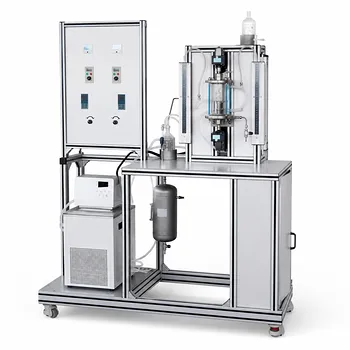
The selection of a gas-liquid reactor for a unit operations pilot plant begins with a single dimensionless parameter: the Hatta number. This number quantifies whether the chemical reaction is so fast that it finishes within the mass transfer film, or so slow that it requires the entire bulk liquid volume. For fast reactions ($\sqrt{M} > 3$), the instructor must prioritize high interfacial area in devices like packed columns or spray towers; for slow reactions ($\sqrt{M} < 0.3$), the priority becomes liquid holdup, best provided by bubble columns or stirred tanks.
The key to teaching reactor selection is to show students how kinetics dictate the location of the reaction zone. Fast, mass-transfer-limited systems demand maximum gas-liquid contact area; slow, kinetics-limited systems demand maximum liquid residence time. A well-designed pilot plant makes this principle tangible by allowing direct comparison of reactor types under the same chemical system.
The Principle: Why Kinetics Dictate Reactor Geometry
The Hatta number is the compass for reactor selection. It compares the rate of chemical consumption in the liquid film to the rate of physical mass transfer through that film. When instructors ground their selection on this number, they turn the reactor choice into a predictable, teachable consequence of the reaction itself.
Defining the Reaction Regime with the Hatta Number
The Hatta number ($Ha$, or $\sqrt{M}$) is defined as the ratio of the maximum reaction rate in the liquid film to the maximum mass transfer rate. It is typically calculated from the film theory parameter $M = \frac{D_L k_1}{k_L^2}$, where $D_L$ is the diffusivity, $k_1$ the reaction rate constant, and $k_L$ the mass transfer coefficient.
A value $\sqrt{M} < 0.3$ signals a slow reaction. Here, the reaction is so sluggish that the reactant easily diffuses into the bulk liquid before any significant conversion takes place. The reaction zone is the entire liquid volume. In this regime, conversion scales with liquid holdup, not with interfacial area.
A value $\sqrt{M} > 3$ signals a fast, or instantaneous, reaction. The reactant is consumed almost completely inside the thin mass transfer film adjacent to the interface. The bulk liquid concentration is essentially zero. In this regime, the rate of absorption—and thus the overall reactor productivity—is directly proportional to the gas-liquid interfacial area.
How the Reaction Zone Drives Reactor Type
The location of the reaction zone dictates which geometric feature matters most. If the reaction happens in the film, you need to maximize the film surface. If it happens in the bulk, you need to maximize the bulk.
For film-controlled (fast) reactions, the reactor must create and constantly refresh enormous interfacial areas. Thin-film devices and small droplet dispersions become natural choices. For bulk-controlled (slow) reactions, the reactor must provide long liquid residence times with a sufficiently high liquid fraction.
Reactor Selection by Kinetic Regime
Once the Hatta number is known, the pilot plant’s reactor module can be chosen almost algorithmically. The following groups map the three fundamental regimes to the most instructive reactor types.
Reactors for Fast Reactions: Maximizing Contact Area
Packed columns are the workhorse for fast gas-liquid reactions. The structured or random packing spreads liquid into thin films over a large surface, creating a high and well-defined interfacial area throughout the column. They are ideal for $Ha \gg 1$ and also provide the best platform for measuring mass transfer coefficients because the interfacial area can be estimated from packing data.
Spray towers represent an alternative for very fast, mass-transfer-limited systems, especially when the gas contains particulates or when pressure drop must be kept extremely low. Liquid is atomized into droplets, generating a large initial surface area. However, because droplets coalesce rapidly, the active area decays quickly. This makes them best for simple, high-speed absorption tasks and a valuable teaching tool for illustrating the trade-off between initial area and maintenance of dispersion.
Reactors for Slow Reactions: Maximizing Liquid Holdup
Bubble columns are simple, economical vessels where gas is sparged from the bottom. They provide a large liquid volume fraction and reasonable mixing without mechanical agitation. For slow reactions ($Ha \ll 1$), they supply the long liquid residence times needed for the bulk reaction to proceed, while still delivering a modest interfacial area that is not the rate-limiting factor.
Stirred tank reactors (or stirred bubble columns) add mechanical agitation to the liquid phase. This offers two major advantages for educational settings: the stirred tank can handle highly exothermic reactions through jacketed cooling or coils, and it allows quantitative study of how mixing intensity (stirrer speed) affects gas dispersion and mass transfer rate. For a slow, kinetics-controlled reaction, the instructor can demonstrate that increasing stirrer speed does not boost conversion—a powerful validation of the theory.
Reactors for the Intermediate Regime
When $\sqrt{M}$ is approximately 1, neither liquid holdup nor interfacial area alone dominates. Here, plate columns (sieve trays, bubble caps) are exceptionally instructive. Liquid is held on each tray, providing a staged contact with fairly long residence time, while gas bubbles through the liquid to create a dynamic interfacial area. They allow the operator to directly see the interplay between mass transfer and reaction stages.
The Role of Pilot Plant Flexibility in Teaching
A truly educational pilot plant is not a single fixed reactor. It is a modular platform where students can swap reactor modules to run the same reaction under different hydrodynamic regimes.
Measuring the Deciding Parameters
Before selecting a reactor, students must measure the numbers that define the regime. Falling film reactors are designed to provide a constant, known interfacial area. By running a reaction in this environment, the instructor can guide students to extract the intrinsic reaction rate constant $k_1$ and the mass transfer coefficient $k_L$. With these values, they calculate the Hatta number and can then rationally choose a column, stirred tank, or bubble column for the larger pilot plant.
Comparing Contactors Head-to-Head
Modular pilot plants that offer both a packed column and a bubble column, for instance, let students observe that a fast reaction yields high conversion in the packed column but fails in the bubble column—and that the exact opposite occurs for a slow reaction. This direct, side-by-side measurement cements the concept that reactor choice is a consequence of kinetics, not an arbitrary design preference.
Understanding the Trade-offs
Even when the Hatta number clearly points to a certain reactor type, practical limitations and secondary factors matter. Pointing these out is essential to prevent students from treating the selection chart as a rigid law.
Pressure Drop and Operating Cost
Packed columns offer high area but come with significant gas-side pressure drop, especially at high liquid loads. Spray towers, by contrast, have minimal pressure drop but lose mass transfer area over column height. This creates a tension between capital and operating cost that goes beyond pure kinetics.
Solids Handling
If the gas or liquid contains suspended solids, packed columns become prone to plugging. In such cases, spray columns or plate columns with large openings become necessary, even if they are not the kinetically optimal choice. Teaching this constraint prepares students for real-world troubleshooting.
Scale-Up Uncertainty
While the Hatta number itself is scale-independent, the ability to reproduce interfacial area or mixing intensity at larger scales differs across reactor types. Bubble columns can exhibit significant scale-up effects due to changes in flow regime, while stirred tanks are more predictable. The pilot plant should be used to generate scale-up data, not just to run a single reaction.
Making the Right Choice for Your Teaching Goal
The reactor you place in your unit operations lab should serve the specific learning objective. Use the following guide to align kinetic principles with pedagogical purpose.
- If your primary focus is teaching reaction regime analysis: Choose a falling film reactor to measure $k_1$ and $k_L$ explicitly, and then let students calculate the Hatta number before deciding which of several interchangeable modules (packed column, bubble column, stirred tank) to use. This turns the lab into an exercise in diagnosis and design.
- If your primary focus is comparing mass transfer vs. kinetics control: Use a single reaction with a known Hatta number and run it in two contrasting reactors—a packed column and a bubble column. Students will directly see that conversion is unchanged by agitation in the kinetic regime, while it scales with area in the mass-transfer regime.
- If your primary focus is industrial versatility and trouble-shooting: Incorporate both a plate column and a spray column, and challenge students with a gas feed that contains solids or a liquid that has a high foaming tendency. The lesson becomes one of mechanical robustness versus kinetic elegance.
By rooting every decision in the Hatta number, instructors equip students with a predictive, scalable framework for reactor selection—one that transforms a catalog of equipment into a logical consequence of the chemistry itself.
Summary Table:
| Kinetic Regime | Hatta Number ($\sqrt{M}$) | Reactor Priority | Recommended Reactor Types |
|---|---|---|---|
| Fast / Instantaneous | $> 3$ | Maximize interfacial area | Packed columns, Spray towers |
| Intermediate | $\approx 1$ | Balance area & liquid holdup | Plate columns (sieve/bubble cap trays) |
| Slow | $< 0.3$ | Maximize liquid holdup & residence time | Bubble columns, Stirred tank reactors (CSTR) |
Elevate Your Chemical Engineering Lab with LABPARK
Equip your students and researchers with the tools they need to bridge theory and practice. LABPARK designs and manufactures high-quality Educational and Vocational Unit Operations Pilot Plants for universities, research institutes, and enterprises.
Our versatile, modular pilot plants span critical fields including:
- Chemical Engineering (including modular gas-liquid reactor systems)
- Bioprocess & Biotech
- Environmental & Water Treatment
Help your learners master real-world reactor selection and scale-up. Contact us today to discuss your curriculum needs and request a customized equipment proposal!
Related Products
- Dual-Drive Stirred Gas-Liquid Mass Transfer Coefficient Determination Pilot Plant
- Micro-Scale Gas-Solid Catalytic Reaction Educational Pilot Plant
- Fixed Bed Gas Solid Catalytic Reaction Educational Pilot Plant
- Fluidized Bed Gas Solid Catalytic Reaction Educational Pilot Plant
- Fixed-Bed Chemical Reaction and Gas Dust Tar Removal Unit Operations Pilot Plant
People Also Ask
- How does temperature affect mass transfer rates in chemical engineering educational pilot plants?
- How do pilot plants study gas solubility in polymer melts at high pressures? Key Mass Transfer Insights
- How does column packing affect absorption intensification, and how is it evaluated experimentally?
- Why Compare Membrane-Reservoir Models with Pilot Plant Data? Ensure Successful Process Scale-Up
- How does k_La affect hydrogenation scale-up? Critical insights for pilot reactors.