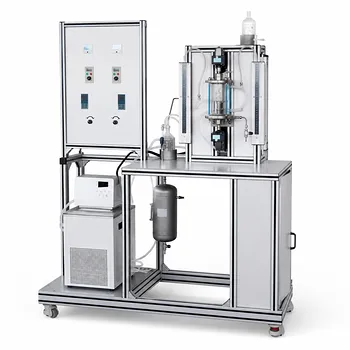
Gas permeability in glassy polymers is fundamentally evaluated as the product of its gas solubility and diffusion coefficient. In a unit operations pilot plant, this means running membrane permeation experiments under controlled conditions to separate these two contributions, while always accounting for the distinctive dual-mode sorption behavior that governs how penetrants inhabit the rigid polymer matrix.
Glassy polymers don’t follow simple solution-diffusion rules; their permeability is a moving target dictated by dual-mode sorption and the risk of plasticization. In pilot-plant evaluation, you must intentionally deconvolute solubility and diffusivity and then adjust your operating envelope to prevent the polymer from crossing into a rubbery state, which can permanently alter separation efficiency.
What Makes Glassy Polymer Permeability Unique
Why the Simple Solution-Diffusion Model Is Not Enough
In rubbery polymers, gas permeation often obeys a straightforward solution-diffusion mechanism: the gas dissolves on the high-pressure side, diffuses down a concentration gradient, and desorbs on the low-pressure side. The permeability coefficient P is simply the product of solubility S and diffusion coefficient D.
Glassy polymers complicate this picture. Their stiff chains create a non-equilibrium excess free volume containing both densely packed domains and microvoids. This structure gives rise to dual-mode sorption, where penetrant molecules can either dissolve in the dense polymer matrix (Henry’s law mode) or occupy pre-existing micro-cavities (Langmuir-type mode).
Dissecting Permeability: Solubility vs. Diffusivity
Evaluating permeability in a pilot plant therefore requires separating S and D. Typically, you’ll perform pressure-decay sorption experiments to measure solubility independently and time-lag measurements in a permeation cell to extract the diffusion coefficient. The product then gives the steady-state permeability.
Crucially, the dual-mode parameters—Henry’s law coefficient, Langmuir capacity constant, and Langmuir affinity constant—are fitted from sorption isotherms. These parameters directly feed into the dual-mode transport model, which describes how the total flux results from two populations of penetrant with different mobilities.
Key Factors That Determine Gas Transport in Pilot Plants
The Dominance of Dual-Mode Sorption
Under low to moderate pressures, the Langmuir-type sites trap gas molecules more efficiently than the Henry’s law mode. This often leads to a decreasing permeability with increasing feed pressure, as the micro-cavities saturate and stop contributing proportionally to flux.
In a pilot plant, you’ll see this as a permeability-pressure curve that drops and then levels off. If you’re designing a separation unit, failing to account for this nonlinear behavior will cause you to overestimate flux at higher operating pressures and undersize the membrane area.
The Plasticization Trigger
A glassy polymer is a trapped non-equilibrium solid. Highly soluble penetrants—CO₂, heavy hydrocarbons, or organic vapors—can plasticize the matrix. They swell the chains, increase segmental mobility, and gradually shift the polymer toward a rubbery state.
In practical terms, plasticization shows up as an upturn in the permeability-pressure curve. At first, the dual-mode effect depresses permeability; then, as plasticization sets in, diffusion becomes concentration-dependent and permeability reverses direction, rising with feed pressure. This is a critical red flag in pilot-plant trials, because the membrane’s selectivity almost always plummets once plasticization begins.
Temperature and Feed Composition Interactions
Outside the plasticization region, temperature is a powerful tuning knob. Diffusion is thermally activated, so rising temperature increases D, while solubility for most gases decreases slightly. The net effect depends on the activation energy of permeation. But if a feed mixture contains a plasticizing component, temperature also shifts the plasticization threshold. Running a pilot plant at various temperatures and compositions reveals the stability window where permeability remains predictable.
Understanding the Trade-offs
The Stability–Productivity Trade-off
High permeability often comes with high plasticization risk. Polymers with large free volume (like polyimides with bulky substituents or poly[1-(trimethylsilyl)-1-propyne]) deliver huge initial flux but are easily swollen by condensable gases. A pilot plant that prioritizes productivity without monitoring plasticization symptoms will report great short-term numbers and terrible long-term performance.
The Pressure–Complexity Trade-off
Increasing feed pressure raises the driving force for permeation, but in glassy polymers it also saturates Langmuir sites and amplifies plasticization. You have to map out the pressure-dependent permeability in the pilot plant and then decide whether to operate below the plasticization pressure—accepting lower flux but maintaining stable, predictable selectivity—or to manage the plasticized state with frequent regeneration, which adds operational complexity.
The Educational Measurement Pitfall
Pilot plants often use simplified analytical methods. For example, calculating permeability from a simple flow meter and pressure gauge without accounting for the time lag or the dual-mode isotherm will give highly misleading results. A common mistake is to assume Fick’s law with a constant diffusion coefficient, which yields an “apparent” permeability that cannot be extrapolated to different operating conditions. The proper evaluation must separate the sorption isotherm from the transport kinetics.
Making the Right Choice for Your Pilot-Plant Evaluation
Your approach to evaluating glassy polymer permeability must align with the pilot plant’s ultimate goal—whether that is screening materials, generating design data, or debugging a separation problem.
- If your primary focus is material screening with limited time: Run pressure-lag experiments at two pressures and temperatures to quickly map the dual-mode parameters and identify the plasticization pressure threshold.
- If your primary focus is generating reliable design data for scale-up: Perform full sorption and time-lag measurements over the entire expected pressure and temperature envelope, and fit the dual-mode transport model to capture the permeability-pressure inversion.
- If your primary focus is field troubleshooting of a separation unit: Measure the permeate composition and flux across a small pressure range and look for the characteristic signature of plasticization: selectivity loss and a permeability upturn with pressure. Then determine if you can operate safely below the plasticization threshold or need to switch to a more resistant material.
A pilot plant only yields trustworthy glassy polymer permeability data when you accept that simple steady-state equations are not enough—and instead deliberately isolate solubility from diffusivity while respecting the material’s sensitivity to its own operating environment.
Summary Table:
| Transport Factor | Impact on Permeability | Pilot-Plant Indicator |
|---|---|---|
| Dual-Mode Sorption | Permeability decreases as pressure rises due to Langmuir site saturation. | Permeability-pressure curve drops and levels off. |
| Plasticization | Matrix swells, increasing diffusion but severely reducing selectivity. | Characteristic upturn in the permeability-pressure curve. |
| Temperature | Increases diffusivity while decreasing solubility; alters plasticization limits. | Shifted stability window and temperature-dependent flux changes. |
Ready to advance your research and hands-on training in membrane separation? LABPARK provides state-of-the-art Educational and Vocational Unit Operations Pilot Plants in chemical engineering, bioprocess & biotech, and environmental & water treatment. Designed specifically for universities, research institutes, and enterprises, our robust systems empower you to accurately evaluate complex transport phenomena. Contact us today to find the ideal pilot-scale solution for your laboratory.
Related Products
- Packed Bed Absorption Educational Unit Operations Pilot Plant
- Fluid Friction Resistance Determination Educational Unit Operations Pilot Plant
- Bernoulli Equation Demonstration Unit Operations Pilot Plant
- Rising and Falling Film Evaporation Educational Unit Operations Pilot Plant
- Two-Dimensional Fluidization Hydrodynamics Educational Pilot Plant for Unit Operations Training
People Also Ask
- How Do Flow Regimes Transition in Packed Bed Pilot Plants? Key Scale-up Insights
- How does reactant concentration determine absorption column control? Gas-film vs. dual-film.
- How is the packing height of an absorption column calculated? Master HTU & NTU Concepts
- How does the wall effect impact packed-bed conversion? Essential pilot plant scale-up tips.
- How does static vs. operating holdup affect pilot plant calibration? Avoid Critical Scale-Up Errors