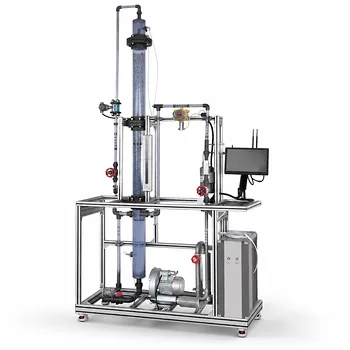
Ignoring the distinction between static and operating holdup fundamentally undermines the calibration of a pilot plant and distorts the kinetic data it produces. When you treat total liquid holdup as a single, uniform value, you are masking two very different physical mechanisms. This conflation leads to systematic errors in calculating true liquid residence time, apparent reaction rates, and, ultimately, the parameters you are trying to scale up.
The core problem is data interpretation. Calibrating a pilot plant’s performance without separating static holdup (the stagnant "inventory") from operating holdup (the dynamic flow) makes it impossible to distinguish between a slow chemical reaction and a slow physical diffusion process. Accurate analysis demands isolating these two components to prevent a mass transfer limitation from being misinterpreted as intrinsic catalyst activity.
Why a Single "Total Holdup" Value Fails
The total volume of liquid in your pilot plant is not one homogeneous phase. A single measurement is a composite of two distinct behaviors that respond differently to process variables.
The Nature of Static Holdup
Static holdup is a function of the packing, not the flow rate. It is the liquid trapped in the catalyst’s internal pores and in the capillary spaces at particle contact points. This volume is a physical property dominated by particle diameter, surface tension, and porosity. Because it remains constant regardless of how fast you pump liquid through the bed, it acts as a fixed offset in your total volume measurement. Calibrating a flow model without subtracting this offset instantly makes your calculated dynamic residence time inaccurate.
The Behavior of Operating Holdup
Operating holdup is the liquid that is actually moving. This is the film flowing over the packing and the droplets in the void spaces. Its magnitude is a direct hydrodynamic result of the gas and liquid velocities. When you take a pressure drop reading across the column, you are primarily measuring the resistance to flow caused by this dynamic liquid volume. If static holdup is subtracted incorrectly, your correlation between pressure drop and liquid velocity becomes unreliable, making flow regime identification nearly impossible.
The Impact on Pilot Plant Calibration and Analysis
The real trouble begins when you translate these physical volumes into engineering metrics. The separation of these two components is not just academic; it’s a prerequisite for valid parameter estimation.
Deconvoluting Residence Time Distribution
Reaction kinetics depend on knowing how long the reactants were actually moving. A tracer study measures total residence time, which includes time spent diffusing in and out of the stagnant static holdup. For accurate kinetic modeling, you must deconvolute the tracer curve. The static holdup acts as a distributed capacitance, creating "tailing" in the response curve. Without quantifying it, you will incorrectly attribute this physical tailing to a slow kinetic adsorption step, leading to a lower calculated reaction rate constant than the true value.
Assessing Catalyst Wetting Efficiency
An unwetted catalyst is a dead catalyst. The relationship between total holdup and catalyst effectiveness is not linear. The wetting efficiency is governed by the operating holdup, which forms the active film over the particle. However, a catalyst with high internal porosity might show high static holdup, giving a false high total holdup reading. You could be running a reactor where the catalyst is internally saturated (high static) but externally dry (low operating), thereby grossly overestimating the effective reaction volume during calibration. Distinguishing these components clarifies whether your reactant is contacting active sites or just trapped in a pore.
Diagnosing Mass Transfer Limitations
This single distinction reveals your true rate-limiting step. If your pilot plant data shows a strong sensitivity of conversion to liquid flow rate, you must immediately check the operating-to-static holdup ratio. A high operating holdup suggests the reaction is likely limited by the supply of liquid-phase reactants (mass transfer controlled). A dominant static holdup with high internal porosity suggests the catalyst is loaded with reactant, but you may be limited by internal diffusion. Without this split, you are blind to the actual bottleneck, making process optimization guesswork.
Understanding the Trade-offs in Measurement
Accurately distinguishing static from operating holdup in a pilot plant is technically demanding and forces a trade-off between data resolution and operational simplicity. There are inherent risks if this is ignored.
The Trap of Simplistic Tracer Methods
A simple salt washout test gives you total holdup, which is almost useless for kinetic analysis. To separate them, you need a step-change displacement technique, often using two liquids of different conductivities. The high-conductivity fluid trapped in the static zones will diffuse out slowly, creating a long tail. Cutting off the measurement too early misses static holdup entirely. This leaves you with an artificially low total holdup on paper, which you might interpret as a higher liquid velocity and a lower residence time.
The Flooding and Over-design Risk
Failure to distinguish holdup types can lead to catastrophic mis-scale-up. A student might observe a stable pilot plant and misinterpret the total holdup as dynamic capacity. If this error is scaled to industrial design, the static offset is mistaken for operating volume. This leads to undersized liquid distributors or an overestimation of the column’s throughput capacity, potentially causing premature flooding. Conversely, excessive liquid hold-up, unanalyzed, drastically increases pressure drop by constricting the vapor path, creating a hidden bottleneck.
How to Apply This to Your Project
Effective pilot-plant analysis hinges on aligning your measurement strategy with your end goal. The depth of your holdup analysis must match the diagnostic question you are asking.
- If your primary focus is education on hydrodynamics: Visually demonstrate the difference by draining the column immediately after flow stops (drainage volume = operating holdup), then weighing a section of damp packing (retained volume = static holdup) to show the physical irreversibility of capillary forces.
- If your primary focus is kinetic parameter estimation: Always subtract the independently measured static holdup from the total volume before calculating the dynamic liquid residence time (
τ_dynamic = V_operating / Q). Use this corrected value for fitting your rate equations to avoid diffusion-disguised kinetics. - If your primary focus is scalable reactor design: Run your pilot plant correlations based on operating holdup to predict dynamic pressure drop and flow regime transitions. Use static holdup exclusively to calculate the total startup and flush-out time for the industrial unit.
A successful pilot plant study never reports a lumped parameter when a mechanistic split is required. Separating the trapped inventory from the active flow is what turns raw data into a truly predictive scale-up model.
Summary Table:
| Feature / Metric | Static Liquid Holdup | Operating (Dynamic) Liquid Holdup |
|---|---|---|
| Definition | Liquid trapped in catalyst pores and capillary contact points. | Moving liquid film and droplets flowing through void spaces. |
| Key Drivers | Particle diameter, surface tension, and packing porosity. | Gas and liquid velocities (hydrodynamics). |
| Calibration Impact | Causes "tailing" in tracer curves; distorts kinetic rates. | Determines pressure drop and active catalyst wetting. |
| Scale-up Risk | Misinterpreted as active volume, leading to catalyst underutilization. | Miscalculated flow capacity, leading to premature flooding. |
| Measurement | Weight of retained liquid after column drainage. | Volume of liquid drained immediately after stopping flow. |
Optimize Your Research and Training with LABPARK Pilot Plants
Accurate hydrodynamic analysis is critical for successful process scale-up and engineering education. LABPARK designs and manufactures premium Educational and Vocational Unit Operations Pilot Plants for chemical engineering, bioprocess & biotech, and environmental & water treatment applications.
We help universities, research institutes, and enterprises build hands-on learning environments and reliable research platforms that simplify complex concepts like fluid dynamics and kinetics.
Ready to upgrade your laboratory capabilities? Contact LABPARK today to request a quote or discuss your custom pilot plant needs!
Related Products
- Packed Bed Absorption Educational Unit Operations Pilot Plant
- High-Gravity Emulsification and Mass Transfer Educational Pilot Plant
- Micro-Scale Gas-Solid Catalytic Reaction Educational Pilot Plant
- Absorption and Desorption Educational Unit Operations Pilot Plant
- Fixed-Bed Chemical Reaction and Gas Dust Tar Removal Unit Operations Pilot Plant
People Also Ask
- How Do Flow Regimes Transition in Packed Bed Pilot Plants? Key Scale-up Insights
- How does reactant concentration determine absorption column control? Gas-film vs. dual-film.
- How is the packing height of an absorption column calculated? Master HTU & NTU Concepts
- Why is counter-current flow selected for gas absorption? Maximize Pilot Plant Efficiency
- How to demonstrate physical vs chemical absorption using a pilot plant? A practical lab guide.