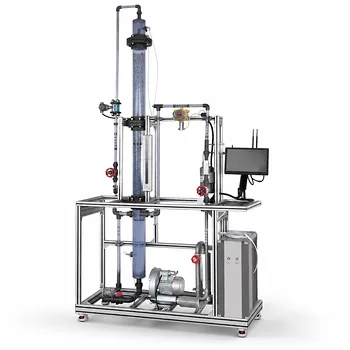
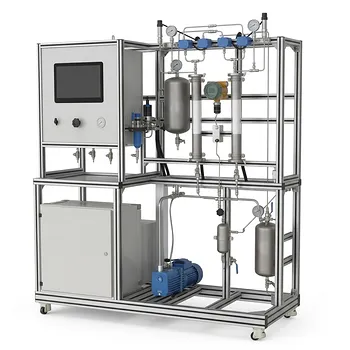
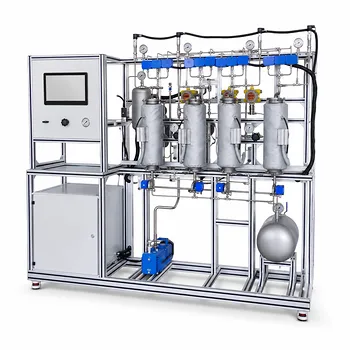
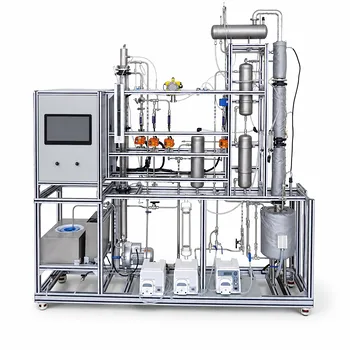
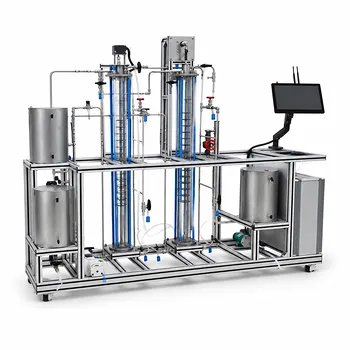
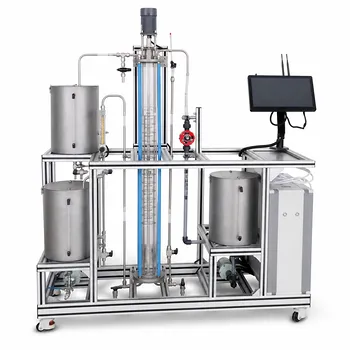
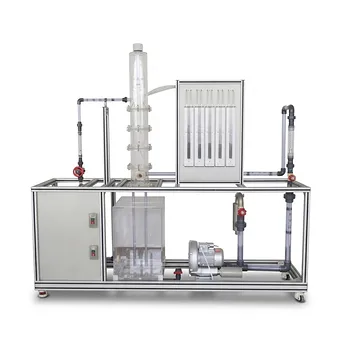
In a gas absorption pilot plant, counter-current flow isn’t just a preference—it’s the configuration that maximizes mass transfer efficiency by maintaining the steepest possible concentration gradient throughout the packed column. By feeding fresh solvent at the top and the gas mixture at the bottom, the leanest exiting gas always contacts the zero‑solute liquid, creating a large driving force exactly where it matters most. This sustained, high gradient translates directly into superior absorption: more solute removed per unit of solvent, lower outlet gas concentrations, and less solvent waste.
The core insight: Counter‑current operation is selected because it maintains a uniform, high mass transfer driving force over the entire column height. This leads to maximum solute removal with minimal solvent consumption, while also serving as an ideal platform for teaching mass transfer fundamentals and optimizing process parameters in a pilot environment.
The Mass Transfer Driving Force at the Heart of Counter‑Current Selection
The Uneven Driving Force Problem in Co‑Current Flows
In a co‑current column, gas and liquid travel in the same direction, so both phases enter with their richest solute concentrations at the same end. The initial driving force is high, but it plummets rapidly as the gas and solvent approach equilibrium near the outlet. You end up with an average concentration difference that is far lower—and less uniform—than what’s possible with counter‑current operation.
How Counter‑Current Creates a Uniform and High Gradient
Counter‑current flow staggers the concentration profiles. The gas that has already lost much of its solute at the top meets the freshest solvent, sustaining a meaningful driving force even at the lean end. At the bottom, the richest gas contacts the solvent that has already picked up solute, still keeping a substantial gradient. This self‑balancing effect yields a consistently high driving force from top to bottom, which directly boosts absorption efficiency.
Why This Boosts Absorption Efficiency in Pilot Plants
Maximizing Solute Removal with Minimum Solvent
A high and uniform driving force means you can achieve a given separation target with a shorter packed height or less solvent flow. In a pilot plant, that translates to lower operating costs, reduced waste, and easier scale‑up. The primary reference underscores this: counter‑current operation consistently delivers a lower solute concentration in the outlet gas compared to co‑current, making it the default choice for demonstrations and data‑driven studies.
Visualizing the Operating Line and Transfer Units
Pilot plants are often used to measure the height of a transfer unit (H_OG) and the number of transfer units (N_OG). Because counter‑current flow keeps the driving force almost constant, the relationship between the operating line and the equilibrium curve becomes easier to analyze. By varying the liquid‑to‑gas ratio (L/G), students can directly observe how the absorption parameter (m G_m / L_m) influences N_OG—and confirm that an optimal value of 0.7–0.8 really does minimise column height.
The Counter‑Current Pilot Column as a Teaching Tool
Demonstrating Real‑World Mass Transfer Gradients
In an educational or vocational setting, the visual nature of a counter‑current packed column makes abstract concepts tangible. Researchers can watch the solvent drip down while gas bubbles up, literally seeing the phase contact that drives separation. This hands‑on exposure cements understanding of concentration profiles, equilibrium stages, and the importance of maintaining a driving force.
Optimizing the L/G Ratio and Absorption Parameter
A pilot plant lets users tweak solvent flow rate (L_m) against a fixed gas flow (G_m) and immediately see how the slope of the operating line shifts. Too little solvent, and the operating line pinches the equilibrium curve; too much, and you waste resources. The empirical verification of the Colburn (1939) optimal range (m G_m / L_m = 0.7–0.8) becomes a powerful lesson in process economy and design.
Understanding the Trade‑offs: When Counter‑Current Isn’t the Answer
Flooding Limits and Hydraulic Constraints
Counter‑current flow has a built‑in weakness: flooding. If the gas velocity becomes too high, it traps the descending liquid, causing a dramatic drop in performance. This caps throughput and forces careful selection of packing and operating rates. A co‑current column, by contrast, never floods, so it can handle much higher flow rates with lower pressure drops—an important consideration when you need raw throughput over efficiency.
The Niche Role of Co‑Current Flow for Fast Chemical Reactions
When the chemical reaction between the solute and the solvent is extremely fast, the liquid‑film resistance becomes the dominant factor. According to the film model, the reaction finishes entirely within the film, and the bulk liquid concentration of the absorbed gas remains near zero. In that case, maximizing the gas‑liquid interfacial area is what matters most—not the driving force profile. Packed columns still excel because of their high specific interfacial area, but co‑current operation becomes viable and sometimes advantageous, allowing researchers to study trickle, bubble, pulse, and spray flow regimes without flooding. Thus, in educational pilot plants, co‑current mode is often reserved for kinetic studies involving fast reactions, not for conventional absorption efficiency demonstrations.
Making the Right Choice for Your Pilot Plant Goal
Your decision must be guided by what you’re trying to learn or achieve. Use the following goal‑based guidance:
- If your primary focus is maximum absorption efficiency and low solvent consumption: Stick with counter‑current flow and systematically vary the
L/Gratio to experimentally verify the 0.7–0.8 absorption parameter rule. MeasureH_OGfor different packing types to intensify the process. - If your primary focus is studying hydrodynamic flow regimes or fast‑reaction kinetics: A co‑current downward configuration can be a deliberate choice. It eliminates flooding concerns and lets you observe distinct flow patterns, but be prepared for a shorter driving force—design your experiment around that limitation.
- If your primary focus is teaching core mass transfer principles: The counter‑current packed column provides the most intuitive, data‑rich platform. Students will grasp the link between driving force, operating lines, and equipment size in a way that purely theoretical exercises cannot replicate.
Choose the flow direction that aligns with your learning objective or research goal—and always use the pilot plant to collect the data that turns textbook concepts into practical engineering judgment.
Summary Table:
| Feature | Counter-Current Flow | Co-Current Flow |
|---|---|---|
| Driving Force | High and uniform throughout the column | High at the inlet, drops rapidly near the outlet |
| Absorption Efficiency | Maximum solute removal with minimal solvent | Lower overall solute removal efficiency |
| Flooding Risk | Susceptible to flooding at high gas velocities | No flooding risk; handles higher flow rates |
| Best Suited For | Absorption efficiency studies & core mass transfer teaching | Fast chemical kinetics & hydrodynamic flow regime studies |
Enhance Your Engineering Lab's Capabilities with LABPARK
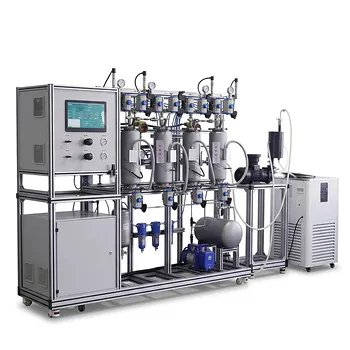
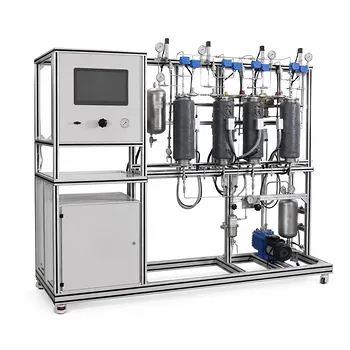
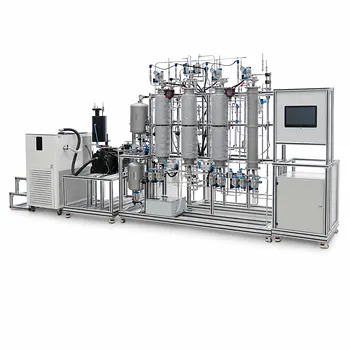
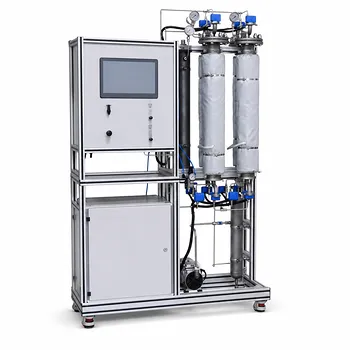
To effectively teach complex mass transfer concepts like gas absorption, academic and research institutions need reliable, real-world equipment. LABPARK provides premium Educational and Vocational Unit Operations Pilot Plants in chemical engineering, bioprocess & biotech, and environmental & water treatment designed specifically for universities, research institutes, and enterprises.
Our pilot systems enable students and researchers to easily configure flow paths, experiment with L/G ratios, and study hydraulic limits like flooding in a safe, controlled environment.
Ready to upgrade your laboratory? Contact LABPARK today to discuss your project requirements!
Related Products
- Packed Bed Absorption Educational Unit Operations Pilot Plant
- Absorption and Desorption Educational Unit Operations Pilot Plant
- Bench Scale Dual Column Gas Separation and Capture Educational Pilot Plant
- Multimodal Absorption and Desorption Pilot Plant for Unit Operations Training
- Pressure Swing Adsorption Educational Unit Operations Pilot Plant
People Also Ask
- How Do Flow Regimes Transition in Packed Bed Pilot Plants? Key Scale-up Insights
- How does reactant concentration determine absorption column control? Gas-film vs. dual-film.
- How is the packing height of an absorption column calculated? Master HTU & NTU Concepts
- How does static vs. operating holdup affect pilot plant calibration? Avoid Critical Scale-Up Errors
- How to demonstrate physical vs chemical absorption using a pilot plant? A practical lab guide.