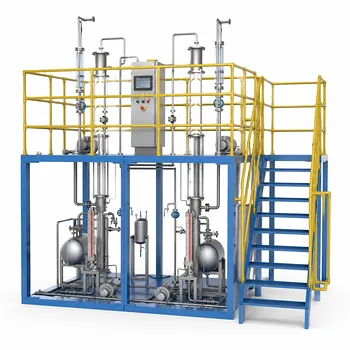
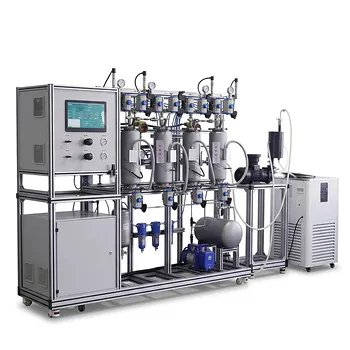
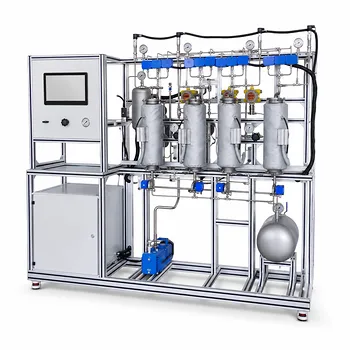
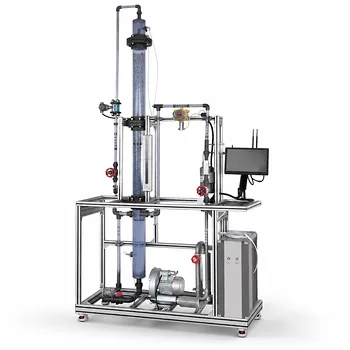
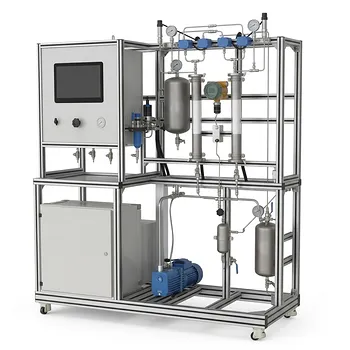
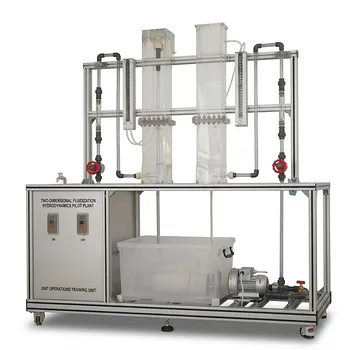
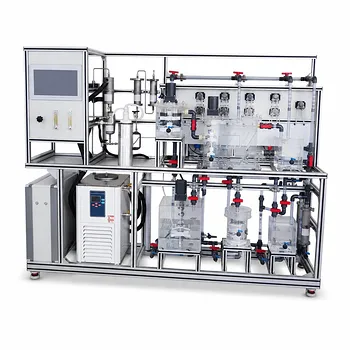
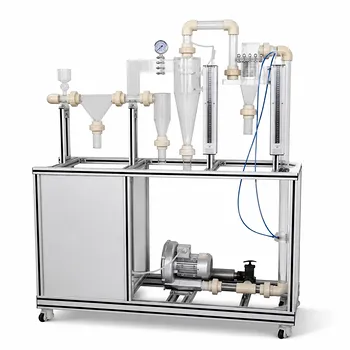
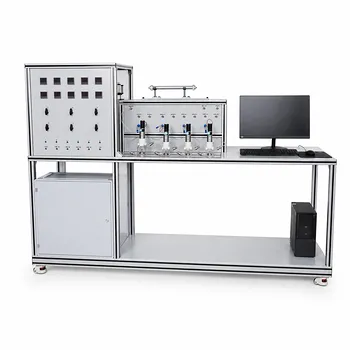
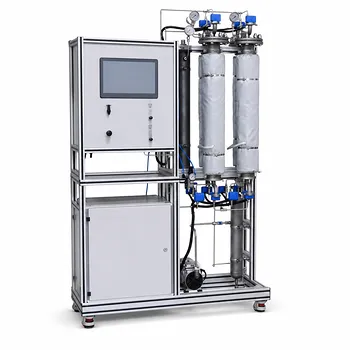
The enhancement factor (β) quantifies how dramatically a chemical reaction amplifies absorption rates. Using a gas absorption pilot plant, you run two controlled experiments—physical absorption of CO₂ into water, then chemical absorption of the same gas into an alkaline solution like sodium hydroxide. By measuring inlet/outlet concentration changes, you calculate the overall mass transfer coefficients for both cases. The direct ratio of the chemical absorption rate to the physical absorption rate under the same driving force gives β, vividly demonstrating how reactive systems shrink liquid-film resistance and intensify gas purification.
Core Takeaway: The pilot plant makes β tangible: you first measure the sluggish physical mass transfer of CO₂ into water, then observe the jump when a fast chemical reaction removes the solute from the liquid film. That measured amplification factor—directly computed from concentration data and mass transfer coefficients—is the enhancement factor, and it reveals why chemical absorbents are the workhorses of industrial gas cleaning.
How Pilot Plants Bring the Enhancement Factor to Life
The surface need is to see and calculate β. The deeper need is to understand why chemical enhancement works, how to apply it, and what it means for real-world column design and solvent selection. A well-instrumented pilot plant makes this causal chain visible.
The Comparative Experiment at the Heart of the Demonstration
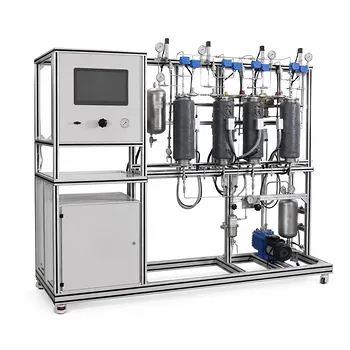
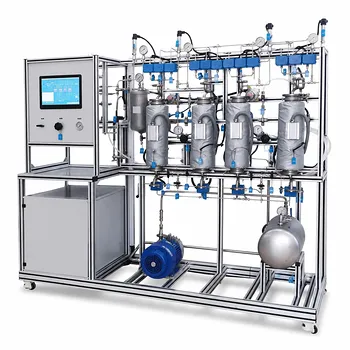
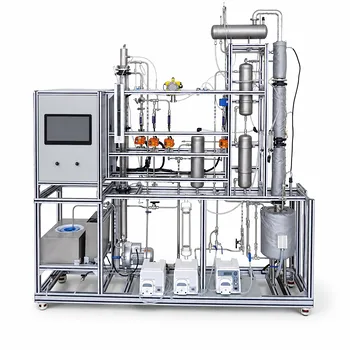
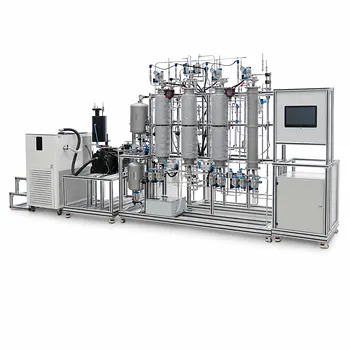
A gas absorption unit operations pilot plant is set up with the same column geometry, gas flow, and liquid flow for two runs.
In the first run, a non-reactive absorbent—typically water—scrubs CO₂ from the gas stream. This is physical absorption where solubility follows Henry’s Law and mass transfer is limited by slow liquid-side diffusion.
In the second run, the water is replaced by an alkaline solution (e.g., NaOH). The CO₂ now reacts irreversibly with hydroxide ions in the liquid film, consuming the dissolved gas and steepening the concentration gradient.
The only changed variable is the chemical environment.
Any difference in absorption rate is directly attributable to the reaction.
From Raw Data to a Quantified β
The pilot plant collects critical measurements: gas-phase inlet/outlet concentrations (e.g., % CO₂) and liquid-phase inlet/outlet compositions.
From these, you calculate the overall mass transfer coefficient ((K_G a) or (K_L a)) for each run using standard material-balance equations.
The enhancement factor is then:
[ \beta = \frac{\text{Rate of chemical absorption}}{\text{Rate of physical absorption}} = \frac{(K_G a){\text{chem}}}{(K_G a){\text{phys}}} ]
Because the reaction effectively consumes the transferred solute, the liquid-side mass transfer coefficient becomes (\beta k_L), and the liquid-film resistance is slashed.
This experimental ratio can be directly compared against theoretical predictions from absorption models, confirming the principles.
Why the Double-Film Model Suffices for Teaching and Design
For an irreversible pseudo-first-order reaction—common in CO₂-NaOH demonstrations—three classical models exist: the double-film model, the penetration model, and the surface renewal model.
The supplementary references confirm that in typical operating ranges, the calculated β from all three models differs by less than 10%.
Therefore, the mathematically simpler double-film model is more than adequate for pilot-plant analysis and educational purposes.
This model treats mass transfer as steady-state diffusion across stagnant films, with the chemical reaction fully confined to the liquid film—a clean, teachable framework.
The Modular Design That Makes Measurement Possible
A well-designed teaching pilot plant is inherently modular.
Columns can often be connected in series, or a single column can accept variable bed heights and tray counts.
This modularity lets you extend gas-liquid contact time, physically demonstrating how increased contact volume enhances β’s impact on total acid gas removal.
Inline sensors for gas composition, temperature, and liquid pH provide the real-time data stream necessary to compute mass transfer coefficients with confidence.
Temperature regulation is critical because the chemical reaction releases heat, and you must maintain a stable operating point to get a repeatable β.
Understanding the Trade-offs in Enhancement Factor Demonstrations
β is powerful, but it’s not a universal constant. Its value depends heavily on reaction kinetics, solvent concentration, and operating conditions—and educational setups often simplify reality.
The Danger of Generalizing from a Single Reaction
The CO₂-NaOH system is often chosen because it is rapid, irreversible, and visually clear.
However, in industrial processes like amine scrubbing with MDEA, reactions are reversible and equilibrium-limited.
The enhancement factor calculated from an irreversible pilot-plant run will overestimate the benefit in a regenerative solvent system.
Students and researchers must understand that β is reaction-specific: a high β for one solvent-solute pair does not translate directly to another.
When Irreversible Assumptions Meet Reality
Pilot-plant demonstrations typically ignore solvent depletion along the column and assume uniform alkalinity.
In a long column, the alkaline concentration drops significantly, reducing the local enhancement factor at the bottom.
Consequently, the global apparent β calculated from terminal measurements is an average, smoothing over axial gradients.
For rigorous design, the pilot plant should be operated with fresh solvent makeup to maintain a constant driving force—or the data must be corrected for concentration profiles.
The Solvent Selection Trade-off: Enhancement vs. Regeneration
Chemical absorption’s high β comes from a strong reaction that lowers the equilibrium partial pressure (effectively reducing Henry’s constant by a factor ((1+K'c_B^0))).
But that same affinity makes solvent regeneration energy-intensive.
Pilot plants can quantify the enhancement gain but rarely include the regeneration loop. Students must be reminded that the true process trade-off is between absorption rate (β) and the energy penalty for stripping the reacted solute back out.
Making the Right Choice for Your Pilot Plant Studies
To extract maximum insight about β from a gas absorption pilot plant, align your experimental design with your primary goal.
- If your primary focus is education and visualizing the film theory: Stick with the NaOH-CO₂ system and use the double-film model. The simplicity yields an unambiguous β that matches theory to within 10%, and students can see the liquid-film control first-hand.
- If your primary focus is solvent screening for industrial carbon capture: Move beyond irreversible model reactions. Operate the pilot plant with candidate amines (e.g., MDEA, DEA) at industrial concentrations, measure β under reversible conditions, and pair absorption data with a desorption strip to assess the real trade-off between mass transfer enhancement and regeneration cost.
- If your primary focus is column scale-up and design: Use the pilot plant’s modular capability to test different bed heights and liquid flow rates. Determine how β couples with interfacial area and residence time, and generate data to validate rate-based process simulators—not just to calculate a single factor.
By treating β not as a static number but as a window into liquid-film dynamics, a pilot plant becomes the definitive tool for understanding why reactive absorption outperforms physical scrubbing and for designing columns that leverage that advantage responsibly.
Summary Table:
| Parameter | Physical Absorption (e.g., $CO_2$ + Water) | Chemical Absorption (e.g., $CO_2$ + NaOH) |
|---|---|---|
| Mechanism | Physical solubility (Henry's Law) | Chemical reaction consumes solute in liquid film |
| Mass Transfer Rate | Slow (Limited by liquid-side diffusion) | Rapid (Slashes liquid-film resistance) |
| Enhancement Factor (β) | $\beta = 1$ (Baseline) | $\beta > 1$ (Quantifies absorption rate amplification) |
| Key Focus / Constraint | Liquid film resistance control | Solvent depletion, regeneration energy penalty |
Bring Chemical Engineering Principles to Life with LABPARK
Bridge the gap between theoretical calculations and practical application. LABPARK provides state-of-the-art Educational and Vocational Unit Operations Pilot Plants in chemical engineering, bioprocess & biotech, and environmental & water treatment.
Specially designed for universities, research institutes, and enterprises, our modular pilot plants feature real-time sensors and flexible configurations, allowing you to accurately measure mass transfer coefficients and visualize complex phenomena like chemical enhancement.
Ready to elevate your training and research capabilities? Contact LABPARK today to find the perfect pilot plant solution for your lab!
Related Products
- Dual-Mode Gas Absorption and Desorption Unit Operations Training Pilot Plant
- Multi-Component Gas Pressure Swing Adsorption Pilot Plant for Unit Operations Education
- Carbon Dioxide Adsorption and Capture Educational Unit Operations Pilot Plant
- Packed Bed Absorption Educational Unit Operations Pilot Plant
- Absorption and Desorption Educational Unit Operations Pilot Plant
People Also Ask
- How do two-film & penetration theories apply to gas absorption pilot plant teaching? Key pedagogical insights.
- How is the direction and driving force of mass transfer determined in a gas absorption unit operations pilot plant?
- How does partial pressure behavior influence gas absorption pilot plants? Master Mass Transfer
- What are the limitations of Henry's Law in gas absorption pilot plants? Avoid critical lab errors.
- How to model chemical absorption as physical absorption? The pilot plant simplification criterion.