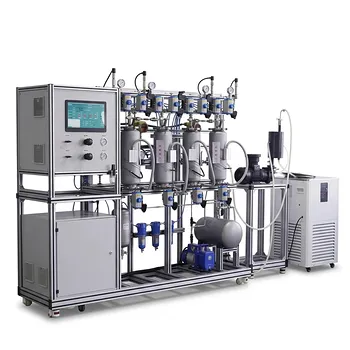
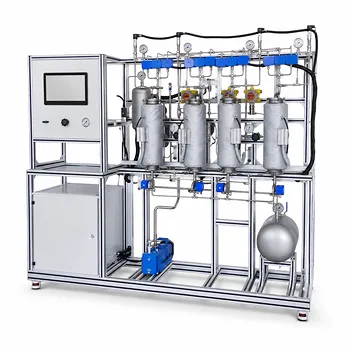
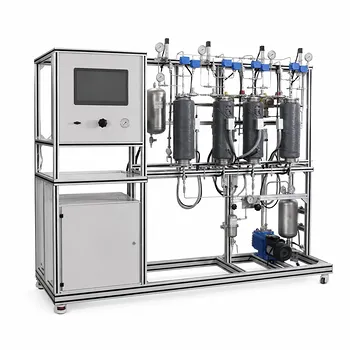
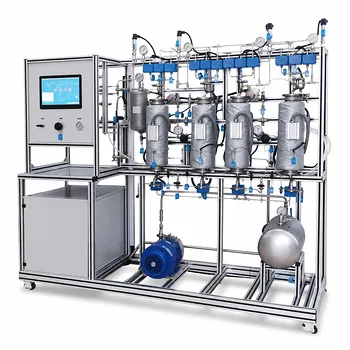
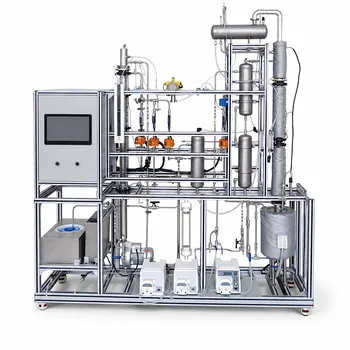
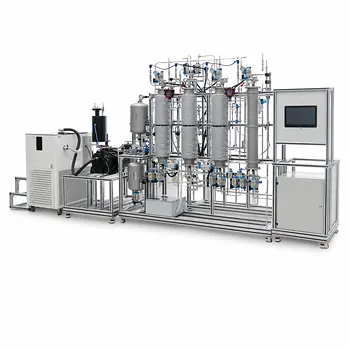
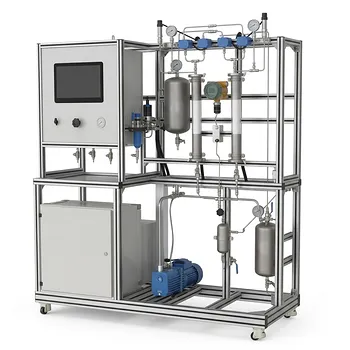
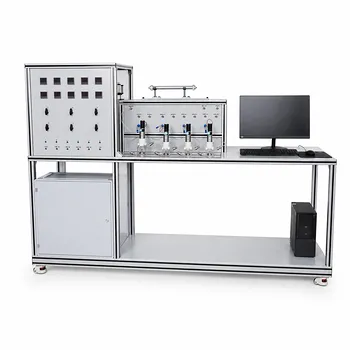
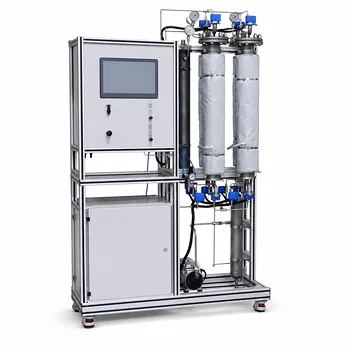
CO2’s molecular structure is not just a textbook diagram—it’s the blueprint that determines how you design, operate, and monitor your gas absorption pilot plant. The central carbon’s sp hybridization creates a linear O=C=O molecule that is non-polar overall, despite the polar C=O bonds. This electronic arrangement directly controls how the gas dissolves, reacts, and even how you can measure it. In a pilot-scale absorption column, that translates into solvent choice, liquid-to-gas ratios, temperature and pressure setpoints, column packing selection, and the very sensors you install to track performance.
Process understanding begins at the molecular level. Carbon dioxide’s sp hybridization gives it a linear, non-polar structure that prefers chemical absorption over simple physical dissolution. By linking bonding theory to pilot plant operation, you can select amine-based solvents that exploit CO2’s electrophilic carbon, tune column conditions to shift thermodynamic equilibria, and use the molecule’s infrared-active vibrational modes for real-time analytical control.
The Molecular Blueprint: Why CO2’s sp Hybridization Matters
A Linear Geometry Built on Sigma and Pi Bonds
Carbon dioxide’s central carbon atom is sp hybridized. Two sp hybrid orbitals form sigma bonds with the oxygen atoms, creating the linear backbone. The remaining two p orbitals on carbon overlap with p orbitals on oxygen to form two pi bonds that are perpendicular to each other and to the molecular axis. The result is a bond order of 2 for each C=O link—strong, short, and rigid.
This bonding arrangement is the reason CO2 is axially symmetric and possesses a center of inversion. The two bond dipoles point in exactly opposite directions and cancel, giving the molecule no net dipole moment. This single fact sets the stage for everything that follows in the absorption loop.
The Key Consequence: A Non-Polar Molecule with a Hidden Twist
Because the dipole cancels, CO2 behaves as a non-polar molecule in many solvents. Its primary intermolecular forces are London dispersion forces, which are weak. However, the carbon atom carries a partial positive charge (it is electron-deficient due to the electronegative oxygens) and the oxygens carry partial negative charges. This gives CO2 a significant quadrupole moment—a more subtle charge distribution that still allows it to interact with polar solvents and nucleophilic reagents like amines.
In pilot plant terms, this means: You cannot rely on simple polar dissolution to absorb large quantities of CO2 efficiently. You need a strategy that either drastically increases the driving force (high pressure, low temperature) or, more effectively, turns the absorption into a chemical reaction that capitalizes on the carbon’s electrophilic character.
From Molecular Properties to Pilot Plant Solvent Selection
Why Physical Absorption Often Falls Short
In physical absorption, a gas dissolves purely by intermolecular attraction. CO2’s non-polar nature means its solubility in water—a highly polar solvent—is modest, even though solubility rises slightly with pressure and drops with temperature. The pilot plant would need to operate at elevated pressures or chilled temperatures to achieve acceptable capacity, increasing capital and energy costs.
More critically, physical absorption is governed by Henry’s law, and the equilibrium partial pressure of CO2 above a purely physical solvent quickly rises as the liquid loads up with gas. The column would require very high liquid flow rates to maintain driving force, making the operation inefficient and costly.
How Chemical Absorption Exploits CO2’s Electronic Structure
This is where sp hybridization becomes a design lever. The electron-deficient carbon atom—a direct consequence of the polar C=O bonds in the linear structure—is a prime target for nucleophilic attack. Aqueous amine solutions (like monoethanolamine, MEA) contain nitrogen atoms with lone electron pairs that readily form a bond with the carbon. This reaction forms a carbamate or bicarbonate, effectively locking the CO2 into the liquid phase.
The result: Chemical absorption dramatically increases the mass transfer rate and equilibrium capacity. The driving force for mass transfer is no longer just a partial pressure difference; it is augmented by the kinetics of the chemical reaction. In your pilot plant, this means you can achieve high removal efficiency with a shorter column, a lower liquid-to-gas ratio, and at atmospheric pressure—all because the molecular structure of CO2 makes it reactive toward nucleophiles.
Designing the Column: How Molecular Behavior Drives Operating Conditions
Temperature and Pressure Control Based on Solubility Limits
Once you understand the molecular interactions, you can set meaningful operating windows. For physical absorption studies, the pilot plant must be equipped to run at elevated pressures (up to 20–30 bar) or chilled temperatures (5–10 °C) to push solubility limits. For chemical absorption, the focus shifts to temperature optimization: the reaction with amines is exothermic, so intercoolers or heat exchangers on the recirculation loop become essential to prevent the column from overheating and reducing absorption efficiency.
Thermodynamic models like Edwards’ correlation or Pitzer’s equation use molecular and ionic parameters to predict partial pressures over loaded amine solutions. By integrating these models into your pilot plant data analysis, you can validate that the column is operating near theoretical equilibrium and that the chosen solvent concentration is matched to the task.
Thermodynamic Models that Build on Molecular Constants
Accurate equation-of-state calculations—using critical constants for CO2—allow you to simulate fluid behavior, size columns, and predict pressure drops. In the pilot plant, comparing empirical data with theoretical predictions from models like SRK or Peng-Robinson reinforces the connection between the molecule’s fundamental properties and unit operation performance. For example, you can demonstrate how CO2’s low critical temperature (31 °C) means that near supercritical conditions can be exploited to boost physical absorption, but only in high-pressure columns.
The Role of Column Internals for Slow-Kinetic Systems
The reaction between CO2 and amines is kinetically slower than some acid gas reactions (like HCl with caustic). This means that mass transfer rate becomes a limiting factor. In the pilot plant, you must select packing materials with high surface area and good liquid distribution to compensate. Structured packing or high-efficiency random packing (like Pall rings) can be tested to see how they improve mass transfer coefficients—a direct translation of the molecular kinetic reality into hardware choices.
Real-Time Control: How Vibrational Modes Enable Online Monitoring
The Link Between Asymmetric Stretching and NDIR Sensors
CO2’s linear, centrosymmetric structure has another crucial consequence: it exhibits vibrational modes that change the dipole moment. The asymmetric stretching mode, in particular, creates a fluctuating dipole that can absorb infrared light at a characteristic wavelength (around 4.26 µm). This is the basis of Non-Dispersive Infrared (NDIR) sensors.
In a pilot plant, you can install NDIR analyzers on the inlet and outlet gas streams. By measuring the absorption of light at this specific wavelength, you get a real-time, non-destructive measurement of CO2 concentration. This lets students and researchers instantly see how changes in solvent rate, temperature, or packing type affect removal efficiency—connecting the molecule’s vibrational freedom to operational feedback.
Using Sensor Data to Validate Mass Transfer Efficiency
With online data, you can close the loop: measure the actual mass transfer coefficient and compare it to predictions based on the Danckwerts surface-renewal model or penetration theory. This empirical validation directly tests whether your molecular-level assumptions about solubility and kinetics are translating into measurable pilot plant performance. It also enables automatic logging and control, turning a teaching pilot into a modern Industry 4.0 demonstrator.
Understanding the Trade-offs: When Molecular Properties Create Challenges
The Energy Penalty of Chemical Absorption
The reactivity that makes chemical absorption attractive also imposes a cost. Regenerating the solvent requires breaking the chemical bonds between CO2 and the amine. This is an energy-intensive stripping process that often demands significant steam input. In your pilot plant, you must measure the thermal energy per ton of CO2 captured and assess what chemical bonding theories already tell you: stronger binding means more efficient absorption, but a harder regeneration. This drives research into advanced solvents and process configurations like intercooled absorbers or split-flow cycles.
The Cost of High Surface Area Packing
Because CO2 absorption can be liquid-film controlled (due to slower reaction kinetics), packing with high specific surface area is beneficial. However, these packings come with higher pressure drop and greater cost. The pilot plant allows you to test the trade-off: does a structured packing’s increased mass transfer performance justify its expense and the added blower power? The answer often depends on whether you are targeting physical absorption (where pressure drop matters directly for equilibrium) or chemical absorption (where kinetic enhancement can offset modest pressure drops).
Balancing Modeling Accuracy with Pilot Plant Practicality
Accurate thermodynamic models require extensive data on molecular constants and interaction parameters. In a teaching or research context, you may need to simplify models to keep the pilot plant exercise manageable. Understanding CO2’s molecular structure helps you decide which simplifications are safe—for example, treating CO2 as a non-polar solute for physical absorption but explicitly accounting for its quadrupole moment and reaction kinetics when amines are present. This prevents you from building an overly complex simulation that obscures the learning objectives.
Making the Right Choice for Your Gas Absorption Pilot Plant
How you translate CO2’s molecular structure into a pilot plant configuration depends on your primary goal. Use the following guidelines to align your design with your purpose.
- If your primary focus is demonstrating chemical absorption mechanisms: Choose an aqueous amine solvent, equip the column with high-efficiency packing, and install heat exchangers to manage the exothermic reaction. Emphasize how the sp-hybridized carbon’s electrophilic nature drives carbamate formation.
- If your primary focus is studying physical absorption under thermodynamic control: Design a high-pressure, low-temperature column capable of operating up to 30 bar. Use water or a physical solvent like Selexol, and integrate equation-of-state models to compare predicted solubility with experimental data, highlighting CO2’s non-polar, quadrupolar behavior.
- If your primary focus is real-time process analytical technology: Incorporate NDIR analyzers at both inlet and outlet. Link the asymmetric stretch vibration to the sensor’s principle, and let students optimize column conditions by directly observing concentration changes, reinforcing the molecule-to-measurement connection.
- If your primary focus is energy-efficient solvent regeneration: Configure a complete absorption–stripping loop with precise temperature control. Measure the heat duty for solvent regeneration and contrast it with the strength of the chemical bond that made absorption effective, illustrating the inherent trade-off.
When you design the pilot plant around the molecule’s own properties, you turn a simple separation exercise into a tight integration of theory and practice—the very essence of process understanding.
Summary Table:
| Molecular Property of $CO_2$ | Process Engineering Impact | Pilot Plant Design Application |
|---|---|---|
| sp Hybridization (Linear & Non-polar) | Weak intermolecular forces; limited physical solubility in water. | Requires high-pressure/low-temperature configurations for physical absorption. |
| Electrophilic Carbon Atom | Highly susceptible to nucleophilic attack by amines. | Favor amine-based solvents (e.g., MEA) for high-efficiency chemical absorption. |
| Slow Reaction Kinetics | Mass transfer is liquid-film controlled and relatively slow. | Install high-surface-area column internals (structured or random packing). |
| Asymmetric Stretch Vibration | Absorbs infrared light at 4.26 µm due to fluctuating dipole. | Integrate real-time NDIR gas analyzers at column inlet and outlet. |
Bridge the Gap Between Chemical Theory and Process Reality
Looking to equip your laboratory with advanced, industry-aligned training systems? LABPARK designs and manufactures high-quality Educational and Vocational Unit Operations Pilot Plants across chemical engineering, bioprocess & biotech, and environmental & water treatment.
We help universities, research institutes, and enterprises build hands-on learning environments that demonstrate complex molecular thermodynamic and kinetic principles in action—from gas absorption columns to complete solvent regeneration loops.
Ready to elevate your engineering curriculum or research capabilities? Contact the LABPARK team today to discuss your custom pilot plant requirements!
Related Products
- Dual-Mode Gas Absorption and Desorption Unit Operations Training Pilot Plant
- Multi-Component Gas Pressure Swing Adsorption Pilot Plant for Unit Operations Education
- Carbon Dioxide Adsorption and Capture Educational Unit Operations Pilot Plant
- Packed Bed Absorption Educational Unit Operations Pilot Plant
- Absorption and Desorption Educational Unit Operations Pilot Plant
People Also Ask
- How do temperature and pressure affect gas absorption and desorption? Optimize Pilot Plant Performance
- How do two-film & penetration theories apply to gas absorption pilot plant teaching? Key pedagogical insights.
- How does partial pressure behavior influence gas absorption pilot plants? Master Mass Transfer
- How is the direction and driving force of mass transfer determined in a gas absorption unit operations pilot plant?
- What are the limitations of Henry's Law in gas absorption pilot plants? Avoid critical lab errors.