Most chemical engineering students first meet the acentric factor as a tidy number in a table. In a thermodynamics and unit operations pilot plant, that number becomes the difference between a compressor curve that makes sense and one that sends you back to the drawing board. Understanding the acentric factor lets you accurately predict the real‑fluid compressibility factor (Z) using the linear relationship ( Z = Z^{(0)} + \omega,Z^{(1)} ). This one insight connects molecular asymmetry directly to the pressure drops, phase splits, and column efficiencies you measure at pilot scale.
The acentric factor is the pilot plant engineer’s bridge from ideal‑gas intuition to real‑fluid reality. It transforms the corresponding‑states principle into a tool that can handle the non‑spherical molecules you actually pump, boil, and separate. Mastering it means you can diagnose why a distillation column isn’t meeting spec, not just simulate it.
The Gap Between Ideal Theory and Pilot Plant Reality
Why ( PV = nRT ) Is Rarely Enough
Textbook problems often assume ideal gases. Pilot plants never do.
At the elevated pressures and low temperatures common in unit operations – gas compression, absorption, or high‑pressure VLE – intermolecular forces and molecular shape dominate behavior.
Ignoring these effects leads to gross errors in calculating volumetric flow rates, compressor power, and column diameters.
The acentric factor gives you a systematic way to correct for those forces without requiring a complete molecular simulation every time.
The Acentric Factor: A Molecular Fingerprint for Real Fluids
Moving from Two‑ to Three‑Parameter Corresponding States
The simple corresponding‑states idea says two fluids at the same reduced temperature and pressure share the same reduced properties – but only if they are simple, monatomic fluids.
Once molecules become non‑spherical or slightly polar, you need a third parameter.
That parameter is the acentric factor ((\omega)): zero for a perfect sphere like argon, positive for everything else.
Pilot‑plant fluids – from light hydrocarbons to carbon dioxide – sit far from (\omega = 0).
Without (\omega), you are effectively treating propane as argon, and your calculated vapor pressure curve will be dangerously wrong.
The Linear Mixing Rule That Simplifies Your Lab Notebook
The power of (\omega) shows up in the compressibility calculation:
[ Z = Z^{(0)}(T_r, P_r) + \omega , Z^{(1)}(T_r, P_r) ]
Here (Z^{(0)}) is the simple‑fluid contribution and (Z^{(1)}) is the deviation function that captures molecular asymmetry.
In a pilot plant, this means you can quickly estimate actual volumetric behavior during a compressor test or a distillation run, using only critical constants and one additional, tabulated number.
You get physically meaningful (Z) values without solving a full cubic equation of state every time – though those, too, embed (\omega) in their mixing rules.
Practical Applications in Unit Operations Pilot Plants
Predicting Compressibility and Pressure Drop Correctly
When a high‑pressure gas flows through a rotameter or a packed bed, the volumetric flow rate depends on (Z).
Misestimation of (Z) by even 10 % alters the Reynolds number, the friction factor, and the final pressure drop you record in the data log.
By inserting the acentric factor into a reliable corresponding‑states correlation, you can back‑calculate the real density at your operating (P) and (T).
This closes the loop between the gauge readings on the pilot skid and the mass balance you must justify in your report.
Nailing Vapor‑Liquid Equilibrium and Distillation
Distillation columns live and die by the relative volatility.
That, in turn, depends on accurate vapor pressures predicted by equations of state – and (\omega) is the key to getting those vapor pressures right for non‑ideal components.
When students model a pilot‑scale binary separation, they often see discrepancies between simulation and experiment.
Tuning the acentric factor (or verifying it against measured boiling points) often resolves the mismatch, showing whether the problem is the model or the packing.
Ensuring Reliable Scale‑Up Data
Pilot plants exist to generate scale‑up parameters.
If your enthalpy balance or compressor discharge temperature is calculated for an ideal gas when the real fluid (\omega) is 0.15, the error will propagate exponentially when you double the equipment size.
The acentric factor lets you remove that systematic error from the start.
You are then left with genuine process uncertainty – not a hidden modeling flaw that will explode at full production scale.
Understanding the Trade‑offs and Limitations
The Breaking Point for Polar and Associating Fluids
Corresponding‑state methods built on (\omega) work beautifully for non‑polar and weakly polar substances, typically those with (\omega) less than about 0.25.
When your pilot plant handles water ((\omega\approx0.35)), ammonia, alcohols, or amines, these simple models break down.
For such fluids, the acentric factor still carries physical meaning, but you must switch to equations of state with more sophisticated mixing rules or use shape factors that account for hydrogen bonding.
The Hidden Pitfall in Your Simulation Database
Even when the theory is sound, the data file can betray you.
A component database entry must follow a precise format, for example:
3,"CO2",1069.9,547.7,.225
A missing acentric factor, a space after a comma, or a decimal entered as a comma will cause the thermodynamics code to fail – or worse, silently produce garbage numbers.
In a pilot plant context, that silent error might appear as “the column is flooding,” when the real culprit is a formatting slip in the component list.
Making the Right Choice for Your Goal
How you leverage the acentric factor depends on what you need to achieve during a pilot‑plant session.
- If your primary focus is accurate pressure drop and flow measurement: Use the three‑parameter corresponding‑states method to calculate (Z) and verify the real gas density at your operating conditions before trusting a rotameter reading.
- If your primary focus is distillation column design or VLE experiments: Confirm the acentric factor values for your key components, then trace how changing (\omega) by 5 % shifts the predicted bubble point and reflux ratio.
- If your primary focus is troubleshooting a mismatch between simulation and pilot data: Check if your equation‑of‑state package is relying on a default (\omega) that doesn’t match your actual chemical; this simple fix often reconciles the mass and energy balances.
- If your primary focus is handling water or polar solvents: Recognize that (\omega)‑based correlations alone are insufficient, and be ready to apply activity‑coefficient or advanced cubic models that still use (\omega) inside a broader framework.
The acentric factor is not a mere database entry; it is a diagnostic lens that reveals how far a real fluid has strayed from the idealized assumptions that fail so quietly in a pilot plant.
Summary Table:
| Unit Operation / Task | Role of the Acentric Factor (\omega) | Pilot Plant Impact |
|---|---|---|
| Compressibility & Flow | Calculates real compressibility ($Z$) | Corrects volumetric flow and pressure drop predictions |
| VLE & Distillation | Predicts accurate vapor pressures | Resolves mismatches between simulation & experimental data |
| Process Scale-Up | Eliminates systematic thermodynamic error | Prevents propagation of ideal-gas calculation errors |
| Polar/Associating Fluids | Identifies applicability limits | Signals when to switch to advanced activity models |
Bridge the Gap Between Theory and Practice with LABPARK
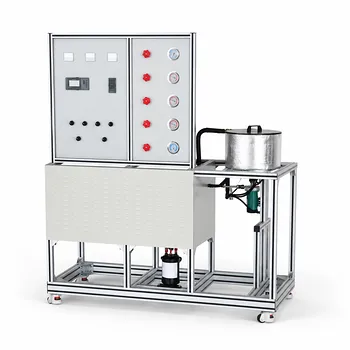
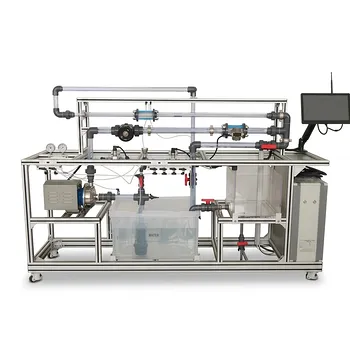
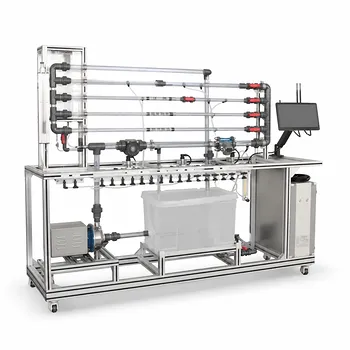
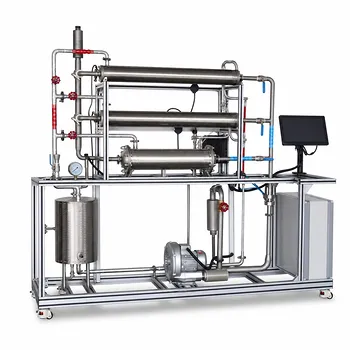
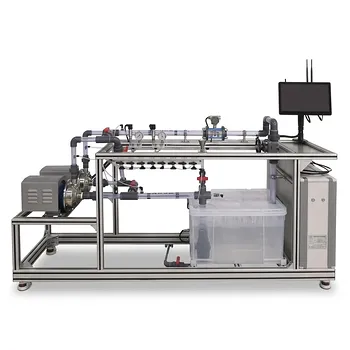
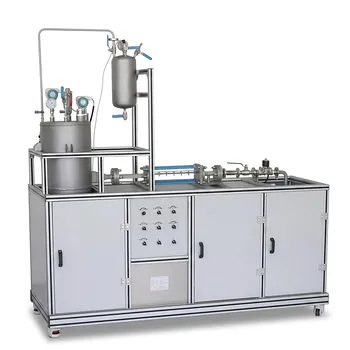
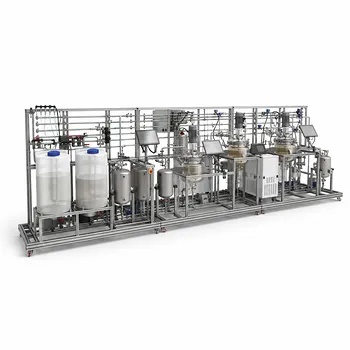
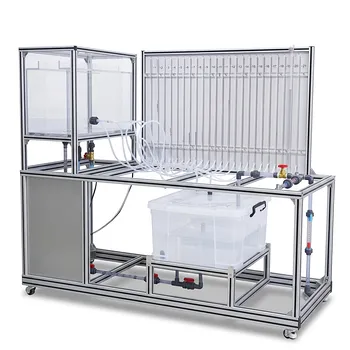
Looking to give your students and researchers hands-on experience with real-fluid thermodynamics? LABPARK provides state-of-the-art Educational and Vocational Unit Operations Pilot Plants in chemical engineering, bioprocess & biotech, and environmental & water treatment.
Designed specifically for universities, research institutes, and enterprises, our pilot plants allow students to safely and accurately analyze real-world fluid behavior, pressure drops, and phase separations.
Ready to elevate your engineering lab? Contact LABPARK today to find the perfect pilot plant solution!
Related Products
- Educational Compression Refrigeration Performance Determination Unit Operations Pilot Plant
- Multi Functional Catalytic Reaction and Reactor Evaluation Educational Unit Operations Pilot Plant
- Centrifugal Pump Performance and Orifice Flowmeter Calibration Educational Pilot Plant
- Fluid Friction Resistance Determination Educational Unit Operations Pilot Plant
- Comprehensive Heat Transfer Coefficient Determination Educational Unit Operations Pilot Plant
People Also Ask
- Why Switch Unit Operations Flow Configurations? Impact on Experimental Measurements
- Why is distinguishing between elastic and plastic deformation critical? Prevent tablet capping.
- How is unsteady-state flow analyzed & taught? Master Transient Systems in Unit Ops
- What are the differences between set-point, servo, and program control? Master unit operations training.
- How to use pilot plants to estimate gas compression costs? Master scale-up economics.