Set-point, servo, and program control are not just academic labels—they are three fundamentally different objectives that dictate how a control system responds to the world. At their core, the difference lies in the behavior of the set-point itself. Set-point control defends a single, constant target value. Servo control chases a target that moves unpredictably. Program control follows a carefully planned, time-based roadmap. Understanding these distinctions is the first step to mastering process automation.
The essential difference between the three strategies is whether the target value is fixed, randomly changing, or following a known schedule. In unit operations training, they are demonstrated not with different hardware, but by simply changing the signal fed into the controller’s set-point input—from a constant voltage to a manual dial, and finally to a pre-set ramp generator. This shift in objective reveals the strengths and weaknesses of the same basic PID controller under different real-world demands.
Three Fundamental Control Objectives
The controller itself doesn’t know what it’s controlling. Its job is simply to minimize the error between where you are (process variable) and where you want to be (set-point). The type of control system is defined entirely by how that set-point changes over time.
Set-Point Control: The Anchor in a Stormy Sea
This is the most common form of industrial control, often called regulation. The set-point is a constant, fixed value.
The system’s entire challenge is to reject external disturbances. Think of maintaining a precise liquid level in a reboiler despite fluctuations in the steam supply or feed flow rate. The target never moves; the controller must push back against any force that knocks the process variable off its perch.
Servo Control: The Art of the Chase
In servo, or tracking, control, the set-point is a moving target that changes arbitrarily. There is no warning or pattern.
The primary objective shifts from disturbance rejection to rapid, accurate tracking. The process variable must follow the set-point with minimal lag and overshoot. Imagine an operator manually turning a dial to change a flow rate, forcing the controller to chase that command instantly. The system must be tuned for agility, not stability.
Program Control: The Conductor’s Baton
Program control also involves a moving set-point, but the movements are pre-defined and time-dependent. The path is a known sequence.
The goal is to execute a recipe perfectly. A classic example is a chemical reactor’s temperature profiling—heat to 80°C, hold for 30 minutes, ramp to 120°C, hold again. Here, the future is known, allowing the controller to anticipate changes and avoid overshooting the critical temperature ramps. It’s a blend of planning and precise execution.
Demonstrating the Difference in Unit Operations Training
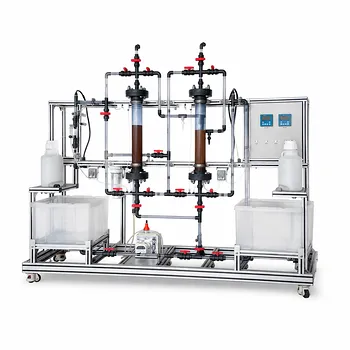
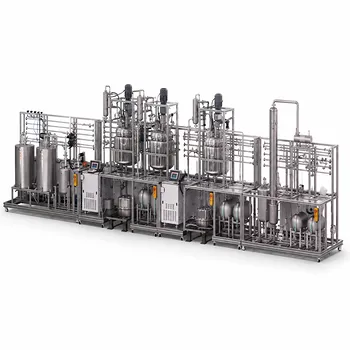
Educational pilot plants use the same physical equipment—tanks, pumps, heaters—to illustrate these abstract concepts, making the control strategy the star of the lesson. The demonstration is in the configuration of the controller’s input.
Constant Level in a Distillation Column Reboiler
To demonstrate set-point control, an instructor sets a target level of 50% in the reboiler. Then, they introduce a disturbance—perhaps by suddenly increasing the bottoms product withdrawal.
Students observe the controller valve opening to increase the inlet flow and restore the level to exactly 50%. The lesson is clear: the set-point didn’t move, but the controller fought back. This teaches tuning for robust error correction and minimal steady-state offset.
Manual Flow or Pressure Tracking
To demonstrate servo control, the set-point is disconnected from a constant source and linked to a manual potentiometer or software slider. The instructor acts as an unpredictable demand signal, moving the target flow rate up and down arbitrarily.
The process variable must chase these erratic commands. Students learn the trade-off between aggressive tuning (fast tracking with risk of oscillation) and conservative tuning (smooth movement but large lag error). It’s a visceral lesson in why robot arms and missile fins need fundamentally different controller settings than a steady boiler.
Programmed Temperature Profiling in a Reactor Pilot Plant
For program control, a digital ramp/soak profile is loaded into the controller’s set-point generator. The pilot plant’s heating system then executes the sequence: a gentle ramp to 80°C, a precise 30-minute soak, followed by a steeper ramp.
Students witness how the control system, knowing the ramp is coming, can pre-emptively add more heat to follow the slope without lag, then settle perfectly into the soak phase. This demonstrates the power of feedforward elements and how a control system can be smarter when it knows the plan in advance.
Understanding the Trade-offs and Common Misconceptions
The boundaries between these strategies can blur, leading to critical mistakes in controller tuning and system design.
The Hidden Cost of Steady Regulation
A controller tuned perfectly for disturbance rejection (set-point control) will almost certainly perform poorly during a set-point change. The aggressive parameters needed to kill an error fast will cause large overshoots when the target itself moves. A single loop cannot be optimized for both objectives simultaneously without adaptive tuning.
When Random Tracking Becomes Impossible
Demanding perfect servo control for a truly random, high-frequency signal is a recipe for actuator fatigue and instability. The controller will constantly slam the valve open and shut trying to match every jitter. In training, students see that the system’s physical limits—valve speed, sensor lag—set the maximum frequency of a chaseable signal.
Not Every Moving Target is Program Control
A common misconception is that any sequence of set-point changes qualifies as program control. True program control implies the controller uses the known future path for anticipatory action. Simply generating a series of timed step changes without a ramp is still just a sequence of set-point control events, not a true program. The distinction matters for reactor safety and product quality.
Making the Right Choice for Your Learning Goal
For an educator or trainee using a unit operations lab, the focus of the experiment should match the learning objective.
- If your primary focus is understanding disturbance rejection: Concentrate on set-point control experiments. Vary the feed rates and steam pressure to a reboiler while observing how the level returns to its constant target.
- If your primary focus is mastering dynamic tracking: Dive into servo control exercises. Manually inject a sine wave or random steps into a flow controller’s set-point and analyze the lag and overshoot characteristics.
- If your primary focus is learning batch automation: Work with program control profiles on a reactor or a heat exchanger. Design multi-step temperature ramps and soaks to understand how time-based recipes are executed precisely and safely.
By isolating the set-point behavior, a simple pilot plant reveals the entire spectrum of automatic control challenges, from the steadfast anchor to the swift chaser and the orchestrated conductor.
Summary Table:
| Control Type | Set-Point Behavior | Primary Objective | Unit Operations Example |
|---|---|---|---|
| Set-Point Control | Constant, fixed target | Reject external disturbances | Reboiler liquid level control |
| Servo Control | Random, arbitrarily changing target | Rapid, accurate target tracking | Manual flow rate adjustments |
| Program Control | Pre-defined, time-dependent profile | Execute sequence (ramp & soak) | Reactor temperature profiling |
Enhance Your Process Automation Training with LABPARK
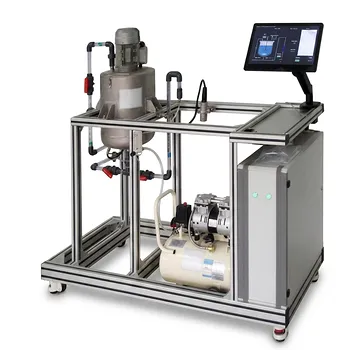
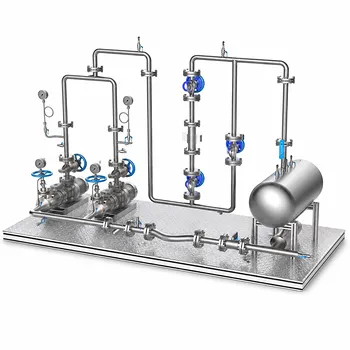
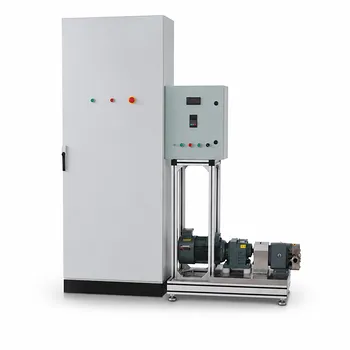
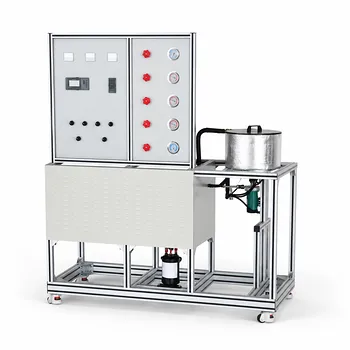
To effectively teach these control concepts, students need hands-on experience with real-world systems. LABPARK provides advanced Educational and Vocational Unit Operations Pilot Plants in chemical engineering, bioprocess & biotech, and environmental & water treatment for universities, research institutes, and enterprises.
Help your learners master set-point, servo, and program control on industry-grade equipment. Contact LABPARK today to find the perfect pilot plant solution for your lab!
Related Products
- Agitation and Mixing Educational Unit Operations Pilot Plant
- Multi-Functional Membrane Separation Educational Pilot Plant for Unit Operations Lab
- Multi-Modal Distillation Unit Operations Training Pilot Plant
- Multimodal Absorption and Desorption Pilot Plant for Unit Operations Training
- Three-Tube Heat Transfer Educational Pilot Plant for Unit Operations Training
People Also Ask
- How do cost-capacity exponents vary across chemical equipment? Scaling insights.
- What are the primary considerations when managing and scaling up shear rates in pilot plant mixing operations? Guide
- Evaluate Tablet Compaction: Force, Density & Porosity in Unit Operations Pilot Plants
- Why Switch Unit Operations Flow Configurations? Impact on Experimental Measurements
- Why is mixing equipment symbol selection critical in pilot plants? Avoid costly scale-up errors.