Anisotropic membranes overcome flux limitations by decoupling the selective barrier from the mechanical support. Early homogeneous membranes were uniformly dense, creating a fatal trade-off: thick enough to withstand pressure meant impossibly low water throughput. The Loeb-Sourirajan process introduced an asymmetric structure—a sub-micron, dense polymer skin on top of a highly porous substrate—that minimizes hydraulic resistance while retaining high salt rejection, making RO dynamics visible and teachable in a single lab session.
The invention of the asymmetric membrane was the pivotal step that transformed reverse osmosis from a theoretical curiosity into a hands-on educational tool. By confining the molecular-sieving layer to a mere 0.2–0.5 µm, the design slashes the pressure drop, boosts water flux to measurable levels, and lets students observe the real-time interplay of pressure, flow rate, and salt rejection without sacrificing mechanical integrity.
The Historical Bottleneck: Homogeneous Membrane Limits
Why Early Membranes Failed
Before the 1960s, membranes were isotropic—chemically and structurally uniform throughout their thickness. A homogeneous dense film could reject salts, but only if it was thick enough to endure operating pressures. That thickness choked water transport, yielding fluxes too low to measure or demonstrate in a practical pilot plant.
The Flux–Thickness Conundrum
Water flux through a dense membrane is inversely proportional to its selective-layer thickness. A homogeneous film thick enough to support itself acted as a massive hydraulic resistor. Students would have seen little more than a trickle over hours, making meaningful experiments impossible.
The Loeb-Sourirajan Breakthrough: Asymmetric Architecture
Separating Function from Support
The Loeb-Sourirajan process creates an anisotropic (asymmetric) membrane by phase inversion. It forms two distinct zones in one material: an ultrathin, dense skin and a thick, sponge-like substructure. This separation of roles is the key to solving the flux problem.
The Skin Layer – Molecular Gatekeeper
The top 0.2–0.5 µm layer is non-porous and performs the molecular sieving. It rejects salts while allowing water to pass. Because it is astoundingly thin, water molecules need to travel only a tiny distance, cutting hydraulic resistance to a fraction of that in a homogeneous membrane.
The Porous Substrate – A Highway for Water
Beneath the skin lies a highly porous, interconnected network. This layer provides mechanical strength to withstand high pressure but offers negligible resistance to water flow. Once water passes the skin, it drains rapidly to the permeate side, producing a flux that is high, stable, and measurable.
How Anisotropic Design Drives Educational Pilot Plant Value
Real-Time Observation of Transport Phenomena
In a university pilot plant, the asymmetric structure delivers fluxes that change visibly with pressure. Students can turn a valve, increase the driving force, and immediately see the permeate flow rate respond, turning Darcy’s law and solution-diffusion theory into tangible, live data.
Demonstrating Pressure–Flux Relationships
Because the skin’s resistance is low, the system operates in a regime where subtle pressure changes yield clear flux variations. Without the asymmetric design, the baseline flux would be so small that instrumental noise would swamp the signal, making it impossible to teach the linear pressure–flux relationship in a normal lab period.
Teaching Membrane Characterization
The structure also lends itself to instructive tests. Students can calculate hydraulic permeability, assess salt passage, and even infer skin integrity. The very heterogeneity that enables high flux becomes a pedagogical tool—comparing an anisotropic RO membrane to an isotropic microfiltration membrane reveals how structure governs transport.
Understanding the Trade-offs
Compaction and Long-Term Stability
The porous substrate, while essential, can compress under sustained high pressure. Over prolonged operation, compaction gradually reduces porosity and increases resistance. Educational runs usually avoid this timeline, but it illustrates why industrial systems require robust pretreatment and membrane selection.
Fouling Susceptibility
The thin, dense skin is highly effective at salt rejection but also a magnet for colloidal and biological foulants. Any demonstration must include a discussion of concentration polarization and fouling management—problems directly tied to the asymmetric design’s incredible flux.
Handling and Integrity
The active layer is vulnerable to scratches, drying, or chemical attack. A small defect in that sub-micron skin can ruin salt rejection. Teaching proper membrane handling, storage, and module assembly becomes a critical part of the curriculum, highlighting the care needed to preserve the architecture’s benefits.
Making the Right Choice for Your Pilot Plant
Selecting the right membrane hinges on what you want your demonstration to teach. The anisotropic RO membrane is not a universal solution, but it is indispensable for desalination-focused experiments.
- If your primary focus is visual, real-time demonstration of desalination: An anisotropic RO membrane is essential. Its thin skin provides the high flux needed to show pressure-dependent permeate flow and complete salt rejection within minutes.
- If your primary focus is teaching structural fundamentals of membrane separation: Use a side-by-side comparison. Run an isotropic microfiltration membrane and an anisotropic RO membrane under identical conditions to dramatize how asymmetry alone transforms performance.
- If your primary focus is exploring nanofiltration or selective ion rejection: Switch to an asymmetric NF membrane. It retains a thin skin but with slightly larger pores, allowing you to demonstrate selective divalent ion removal—a powerful extension of the anisotropic concept.
The Loeb-Sourirajan process did more than create a lab-ready membrane; it embedded the core lesson of membrane science into the material itself: when you separate the job of selectivity from the job of support, you make the invisible physics of transport visible, measurable, and teachable.
Summary Table:
| Membrane Type | Structure | Resistance & Flux | Suitability for Educational Labs |
|---|---|---|---|
| Homogeneous (Isotropic) | Uniformly dense layer | High resistance; extremely low water flux | Poor (processes take too long to observe) |
| Asymmetric (Anisotropic) | Thin active skin (0.2–0.5 µm) + porous support | Low resistance; high, measurable water flux | Excellent (allows real-time flow & pressure data) |
Bring Membrane Dynamics to Life in Your Lab
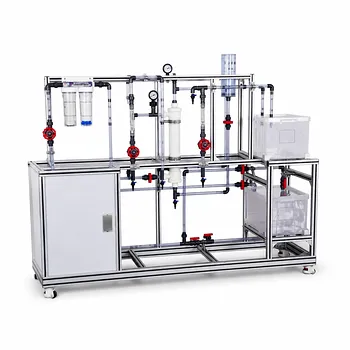
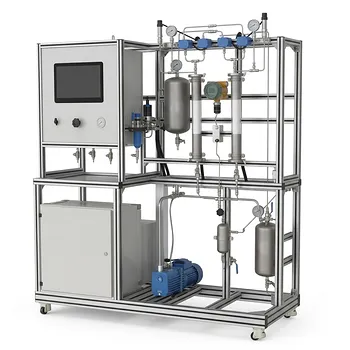
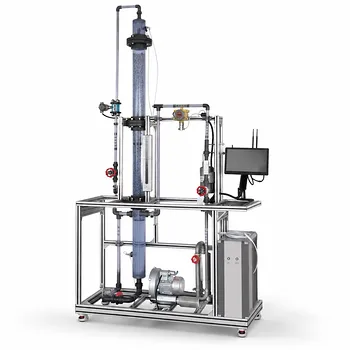
At LABPARK, we provide state-of-the-art Educational and Vocational Unit Operations Pilot Plants across chemical engineering, bioprocess & biotech, and environmental & water treatment. Designed specifically for universities, research institutes, and enterprises, our systems integrate advanced membrane technologies to ensure students observe real-time, measurable transport phenomena within a single class.
Ready to upgrade your engineering curriculum with robust, hands-on learning systems? Contact LABPARK today to discover our customizable pilot plant solutions.
Related Products
- Multifunctional Membrane Separation Educational Pilot Plant with Ultrafiltration, Nanofiltration, Reverse Osmosis
- Multi-Functional Membrane Separation Educational Pilot Plant for Unit Operations Lab
- Ultrafiltration Membrane Separation Educational Pilot Plant
- Hollow Fiber Ultrafiltration Membrane Separation Educational Pilot Plant
- Photocatalytic Membrane Separation and Degradation Unit Operations Pilot Plant
People Also Ask
- Pervaporation vs. Vapor Permeation: Handling Suspended Solids in Membrane Pilot Plants
- How do PEI, PVDF, and PSU membranes compare in pilot plants? Find the best fit.
- What are the trade-offs of polymer vs inorganic membranes in teaching pilot plants? Key laboratory comparison.
- What are the key flow configuration loops in membrane pilot plants? Optimize Performance
- What are the advantages of membrane separation in pilot plants? Efficient Organic Vapor Recovery