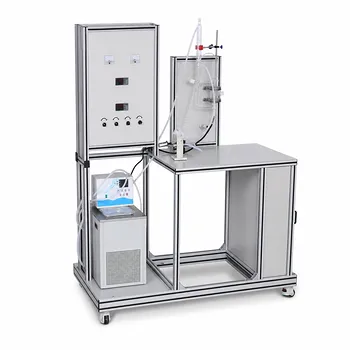
The Peng-Robinson (PR) equation of state demonstrates a high degree of accuracy in predicting the critical properties of multicomponent hydrocarbon mixtures, achieving an average absolute error of approximately 2.33% for pressure and 1.31% for temperature. This precise thermodynamic modeling is not just a theoretical exercise. In a chemical engineering pilot plant, this accuracy forms the bedrock of safe operational design, directly preventing unexpected phase transitions inside distillation columns or high-pressure separators that could lead to inaccurate data or dangerous conditions.
Predicting a critical point with an error of only ~25 psia and ~7.7 °R is what transforms a miniaturized plant from an expensive mock-up into a reliable, scalable source of truth. The core relevance of the PR equation is its unmatched ability to validate whether the phase behavior observed in the pilot plant matches the theoretical model, bridging the gap between a paper design and a billion-dollar industrial facility.
How the Peng-Robinson Equation Accurately Predicts Criticality
The critical point represents the delicate condition where distinct liquid and vapor phases cease to exist. In a mixture of 3 to 12 components, finding this window is phenomenally complex. The PR equation excels here because of its fundamental structure and specific parameterization.
The Mathematical Foundation for Near-Critical Accuracy
Unlike simpler models, the PR equation is a two-constant cubic equation with a specific temperature dependence designed to improve liquid density predictions. This structure directly impacts its performance near the critical region.
The equation’s physics are tuned to the unique compressibility of hydrocarbons at elevated pressures. At the critical point, the distinction between liquid and vapor vanishes, a condition that causes many equations of state to fail mathematically. The PR equation’s functional form, however, remains robust, yielding accurate phase envelopes and critical points for complex synthetic mixtures containing paraffins, nitrogen, carbon dioxide, and hydrogen sulfide.
Superior Performance in the Retrograde Region
The true test of a model is its performance in the most challenging thermodynamic territory: the retrograde region. This is where a pressure drop at constant temperature causes unexpected liquid formation.
For gas condensates and volatile oil mixtures, the PR equation provides a significantly improved prediction of upper dew points. It accurately matches experimental data for liquid volume percentages and equilibrium ratios (K-values) in this region without needing to be tuned to mixture-specific experimental data. In contrast, the Soave-Redlich-Kwong (SRK) equation consistently overestimates vapor pressures and liquid volumes in this zone, making PR the definitive choice for modeling retrograde condensation.
The Direct Relevance to Pilot Plant Operations
A pilot plant’s purpose is to generate empirical phase behavior data under controlled, real-world physical conditions. The PR equation serves as the critical analytical partner in this mission, offering benefits that range from safety to scalability.
Operational Safety and Preventing Unexpected Phase Transitions
Preventing unsafe conditions is the primary directive of any plant. A distillation column or gas absorption unit operating near a mixture’s critical point can transition from two-phase to single-phase flow without warning, causing a loss of separation efficiency or mechanical damage.
The PR equation’s precise critical property predictions allow operators to establish safe operating windows with confidence. An error of only 25 psia means the pressure alarm setpoints can be calculated with high certainty. This directly prevents the unexpected phase transitions that can lead to over-pressurization or dangerous liquid dropout in suction drums and compressors.
Validating Experimental Data for Industrial Scale-Up
Pilot plants exist to de-risk the design of commercial-scale facilities. This is where the equation’s simplicity becomes a massive asset. Because it is a two-constant cubic equation, it allows for analytical vapor-liquid equilibrium (VLE) calculations, avoiding the slow, iterative procedures required by complex multi-constant equations.
This enables a rapid, direct comparison loop. A student or researcher can sample the bottom stream of a deethanizer, measure its temperature and pressure, and immediately verify the composition against the theoretical model. This calibration process validates the model, and the validated model is then used to design the industrial column. Without this symbiotic validation, scale-up is purely speculative.
Handling the Complexity of Water in Hydrocarbon Streams
Real hydrocarbon streams are rarely dry. The presence of water complicates phase behavior dramatically, introducing risks of corrosion and hydrate formation. The PR equation extends its utility to these complex scenarios.
By incorporating a fitted binary interaction parameter (BIP) for water-hydrocarbon pairs, the model accurately calculates water content in the vapor and liquid phases. This allows for the prediction of three-phase liquid-liquid-gas (L1L2G) equilibria. In a pilot plant studying steam distillation or dehydration, this capability is critical for predicting the water dew point and preventing liquid water dropout that could damage compressors or plug cryogenic heat exchangers.
Understanding the Trade-offs and Limitations
While powerful, the PR equation requires sound engineering judgment. Blindly applying it without understanding its limits can lead to process failures.
A key limitation is its performance with heavy hydrocarbon fractions (C10+). These large, complex molecules deviate from the cubic equation’s assumptions, often requiring specific parameter tuning against pilot plant data to achieve acceptable accuracy.
Furthermore, the model is fundamentally designed for non-polar and slightly polar systems. While it handles sour gas (H2S, CO2) well, its accuracy diminishes with highly polar compounds unless carefully fitted binary interaction parameters are used. The pilot plant’s physical data becomes essential here, providing the measurements needed to refine these parameters and correct the model's systematic biases.
Making the Right Choice for Your Pilot Plant Goal
Your choice of thermodynamic model must align with the pilot plant’s specific research objective. The PR equation is often superior, but its application should be intentional.
- If your primary focus is simulating retrograde condensation in a gas condensate: The PR equation is the unequivocal choice. It significantly outperforms SRK in predicting liquid dropout and upper dew points in the retrograde region.
- If your primary focus is validating a distillation unit for light hydrocarbons: Use the PR equation for its unmatched speed in analytical VLE calculations and its high accuracy for critical pressure and temperature prediction. This allows for rapid data iteration.
- If your primary focus is handling sour gas mixtures with high CO2 and H2S content: Select the PR equation and ensure you are using validated binary interaction parameters. Its strong predictive performance for these specific non-hydrocarbon components is a major advantage.
- If your primary focus is determining the risk of hydrate or water dropout: Apply the PR equation with carefully fitted water-hydrocarbon interaction parameters to model three-phase equilibria. The model’s predictive power here is a vital tool for operational safety.
Ultimately, the Peng-Robinson equation acts as the essential theoretical partner to the physical pilot plant, providing the accurate, actionable thermodynamic insight needed to turn physical observations into industrial design rules.
Summary Table:
| Process Metric / Feature | Peng-Robinson (PR) Performance | Pilot Plant Relevance |
|---|---|---|
| Critical Temperature ($T_c$) | ~1.31% Average Absolute Error | Establishes safe operating limits for thermal units. |
| Critical Pressure ($P_c$) | ~2.33% Average Absolute Error | Setting accurate high-pressure alarm thresholds. |
| Retrograde Region | Accurate upper dew point & K-value predictions | Prevents unexpected liquid dropout in suction drums. |
| Water-Hydrocarbon Mixtures | Models 3-phase (L1L2G) via binary interaction parameters | Avoids hydrate formation and corrosion in wet gas streams. |
Bridge Theory and Practice with LABPARK Pilot Plants
Accurate thermodynamic modeling using the Peng-Robinson equation is crucial, but validating these models requires high-precision physical systems. LABPARK provides industry-grade Educational and Vocational Unit Operations Pilot Plants in chemical engineering, bioprocess & biotech, and environmental & water treatment.
Designed specifically for universities, research institutes, and enterprises, our pilot plants deliver the reliable empirical data you need to ensure safe operations and seamless industrial scale-up.
Ready to elevate your research or training facilities? Contact us today to discuss your project requirements!
Related Products
- Carbon Dioxide PVT Curve Determination Educational Unit Operations Pilot Plant
- Binary System Vapor Liquid Equilibrium Data Determination Educational Unit Operations Pilot Plant
- Ternary Liquid-Liquid Equilibrium Educational Pilot Plant
- Throttling Effect Determination Educational Unit Operations Pilot Plant
- Multi Functional Catalytic Reaction and Reactor Evaluation Educational Unit Operations Pilot Plant
People Also Ask
- How do temperature variations affect CO2 transport models in pilot plants? Model vs Reality
- What unit operations are critical for CCUS training pilot plants? Build hands-on engineering expertise.
- What key thermodynamic properties & engineering challenges affect scCO2 reactions in pilot plants?
- How are titration curves used in pilot plants? Guide to process control & endpoint accuracy
- What are the applications and limitations of the Virial EOS? Enhance Your Pilot Plant Lab