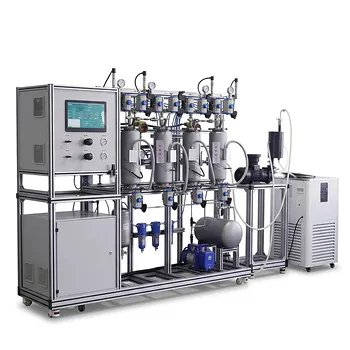
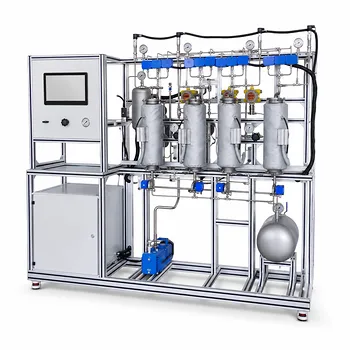
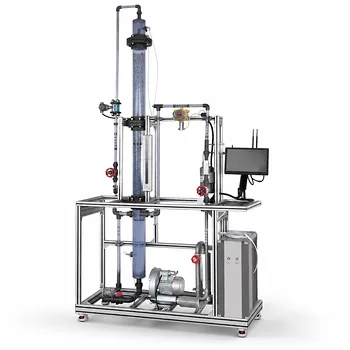
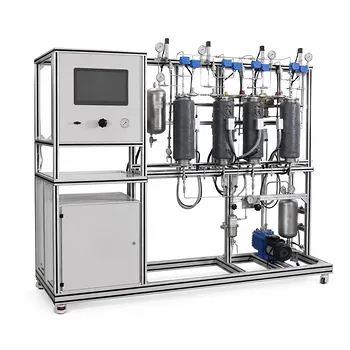
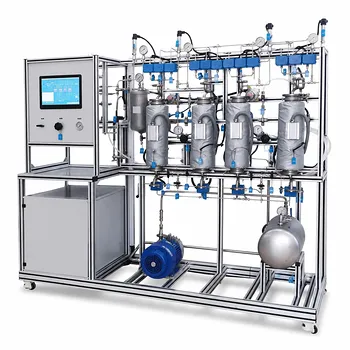
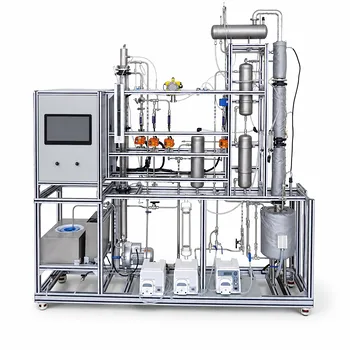
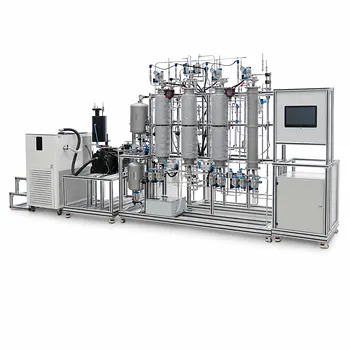
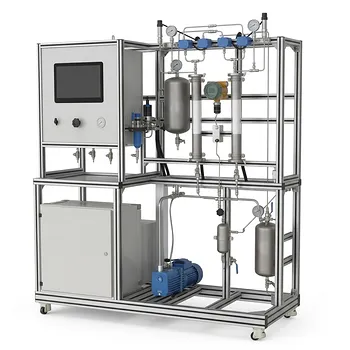
The core separation mechanism—whether physical dissolution or a chemical reaction—completely reshapes how you design, operate, and learn from a gas absorption pilot plant.
Physical absorption relies on the straightforward dissolution of a gas into a solvent, governed by temperature and pressure. Chemical absorption adds a reactive component that binds the solute, dramatically boosting capacity and mass transfer. This distinction dictates everything from the pressure rating of your column to how you regenerate the solvent and what experiments you can run. Your choice of absorption mode determines the plant’s hardware, its safe operating window, and the fundamental principles your students or researchers will investigate.
In a unit operations pilot plant, physical absorption demands high-pressure or low-temperature systems to explore Henry’s Law, while chemical absorption requires precise chemical dosing, thermal management for reaction heat, and a regeneration stripper. The decision hinges on whether you need to demonstrate equilibrium solubility physics or reaction-intensified industrial gas cleaning—and it directly shapes the plant’s cost, complexity, and pedagogical power.
How the Absorption Mechanism Dictates Pilot Plant Design
Solvent Selection Shapes the Whole System
In physical absorption, you work with physical solvents like water, methanol, or polyethylene glycol dimethyl ether (Selexol). They dissolve the solute without any chemical change.
For chemical absorption, you introduce a reactive solvent—commonly amine solutions (MEA, MDEA) or alkaline liquids. The chemical reaction consumes the solute in the liquid phase, lowering its equilibrium partial pressure far below what physical solubility alone could achieve. This choice dictates every downstream design parameter.
Pressure and Temperature: Two Completely Different Worlds
Physical absorption pilot plants operate at the extremes. To achieve meaningful solubility, you often need high pressures (2–5 MPa) and sometimes cryogenic temperatures (as low as -54°C for methanol-based Rectisol). The column and ancillaries must be rated accordingly.
Chemical absorption plants run at mild conditions: absorption at 20–40°C and near-atmospheric pressure. However, regeneration is a different story—you must heat the rich solvent above 105°C to reverse the chemical bonds. The plant must include a heated stripper and handle a pronounced temperature swing.
Regeneration: Flash It or Heat It
This is where the operational heart of the plant diverges most.
Physical absorption often regenerates the solvent with a simple pressure letdown (flash). You release dissolved gas by dropping the pressure, requiring almost no external heat.
Chemical absorption demands thermal regeneration. You have to supply significant heat to break the chemical bonds, so the pilot plant needs a reboiler, a stripper column, and robust temperature control. Energy use is an order of magnitude higher, and operators must monitor heat integration.
Instrumentation and Control Focus
A physical absorption pilot plant centers on precise pressure and temperature sensors, high-pressure flow meters, and gas analyzers to map equilibrium curves.
A chemical absorption plant adds chemical dosing pumps, pH/conductivity monitors, corrosion probes, and extensive thermal instrumentation to track the reaction exotherm and manage solvent condition. Column hydraulics are critical because reactive systems can foam or degrade if not properly controlled.
How Pilot Plant Operation and Learning Outcomes Diverge
Demonstrating Mass Transfer Principles
When running a physical absorption experiment, students see how solubility shifts with pressure and temperature—a clear illustration of Henry’s Law. The mass transfer is purely physical.
Switch to a chemical absorption system, and the overall mass transfer coefficient can jump dramatically. The chemical reaction consumes the solute in the liquid film, steepening the concentration gradient and effectively reducing mass transfer resistance. Students can compute the enhancement factor and quantify how reaction kinetics accelerate the separation.
Managing and Observing Heat Effects
Physical absorption is largely isothermal. The heat of dissolution is minimal, and column temperature profiles remain flat.
Chemical absorption is exothermic. The reaction releases heat as the solute binds, creating a measurable temperature bulge along the column. Operators use this profile to locate the reaction zone, diagnose maldistribution, and evaluate solvent efficiency. It also reinforces the need for later thermal regeneration.
Comparative Experiments Unlock Deeper Insight
A well-designed pilot plant can run both a non-reactive solvent (e.g., water) and a reactive one (e.g., alkaline solution) for the same gas.
By comparing inlet and outlet gas concentrations, researchers can calculate mass transfer coefficients for physical vs. reactive absorption under similar hydrodynamics. This direct A/B comparison cements the concept that chemical reaction reduces the solute’s equilibrium backpressure and can drastically shorten the required column height.
Understanding the Trade-offs
Physical absorption pilot plants sidestep chemical handling and corrosion issues, but they lock you into high-pressure equipment, which raises capital cost, engineering complexity, and safety requirements. They also struggle to achieve high removal efficiencies at low gas concentrations because they rely entirely on solubility.
Chemical absorption plants deliver deep purification at moderate pressure and mirror real-world carbon capture or gas sweetening processes. However, they introduce solvent degradation, corrosion, waste handling, and high thermal energy consumption for regeneration. Operators must constantly monitor solvent quality and manage heat utility loads. For educational labs, the lower-pressure operation of amine systems is often safer and cheaper to run than cryogenic high-pressure setups, but the chemical safety protocols are non-negotiable.
Making the Right Choice for Your Pilot Plant Goal
- If your primary focus is teaching foundational solubility and Henry’s Law: Choose a physical absorption setup with a pressure-rated column and a simple flash regeneration loop. It allows students to map equilibrium as a function of pressure and temperature without chemical complexity.
- If your primary focus is industrial relevance—carbon capture, acid gas scrubbing, or desulfurization: Opt for a chemical absorption plant using amine solutions. It demonstrates reaction-enhanced mass transfer, thermal regeneration, and the real-world trade-offs of energy consumption and solvent management.
- If you need a flexible platform for side-by-side comparison: Invest in a dual-mode pilot plant that can safely switch between physical and chemical solvents. This enables direct measurement of enhancement factors and gives students a complete picture of process selection.
- If laboratory safety and low utility costs are paramount: A chemical absorption plant operating at ambient pressure with a small thermal regeneration loop is typically more practical than high-pressure or cryogenic physical systems—provided rigorous chemical handling and corrosion monitoring are in place.
Every design choice in your pilot plant flows from the absorption mechanism. Aligning that mechanism with your educational goals, safety constraints, and desired industrial realism is what transforms a collection of pipes and sensors into a powerful learning tool.
Summary Table:
| Feature | Physical Absorption | Chemical Absorption |
|---|---|---|
| Solvent Type | Water, methanol, physical solvents | Amines (MEA, MDEA), alkaline solutions |
| Operating Conditions | High pressure (2–5 MPa) | Near-atmospheric pressure, thermal stripping |
| Regeneration Method | Pressure letdown (flash loop) | Thermal regeneration (reboiler & stripper) |
| Key Principle | Henry's Law, solubility physics | Reaction kinetics, mass transfer enhancement |
| Main Challenges | High pressure equipment safety & cost | Solvent degradation, corrosion, high energy use |
Elevate Your Engineering Lab with LABPARK
Are you looking to equip your laboratory with advanced educational tools? LABPARK provides premium Educational and Vocational Unit Operations Pilot Plants in chemical engineering, bioprocess & biotech, and environmental & water treatment for universities, research institutes, and enterprises.
Whether you need to demonstrate Henry's Law through physical absorption or simulate industrial carbon capture with amine-based chemical absorption systems, our custom pilot plants deliver unmatched safety, pedagogical value, and industrial realism.
Contact our engineering experts today to design the perfect pilot plant for your curriculum or research needs!
Related Products
- Dual-Mode Gas Absorption and Desorption Unit Operations Training Pilot Plant
- Multi-Component Gas Pressure Swing Adsorption Pilot Plant for Unit Operations Education
- Carbon Dioxide Adsorption and Capture Educational Unit Operations Pilot Plant
- Packed Bed Absorption Educational Unit Operations Pilot Plant
- Absorption and Desorption Educational Unit Operations Pilot Plant
People Also Ask
- How do two-film & penetration theories apply to gas absorption pilot plant teaching? Key pedagogical insights.
- How does partial pressure behavior influence gas absorption pilot plants? Master Mass Transfer
- How is the direction and driving force of mass transfer determined in a gas absorption unit operations pilot plant?
- What are the limitations of Henry's Law in gas absorption pilot plants? Avoid critical lab errors.
- Why does increasing flow fail to enhance absorption in fast chemical reactions? Pilot Plant Insights