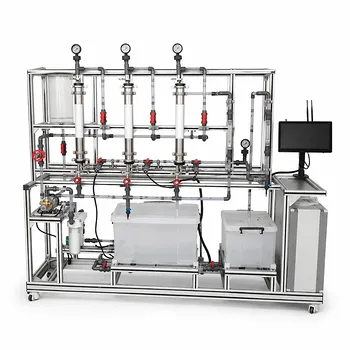
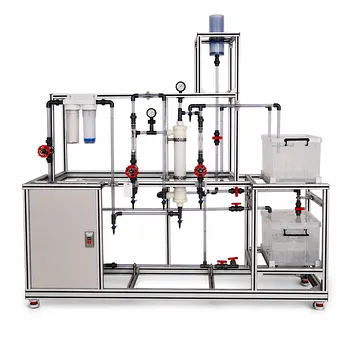
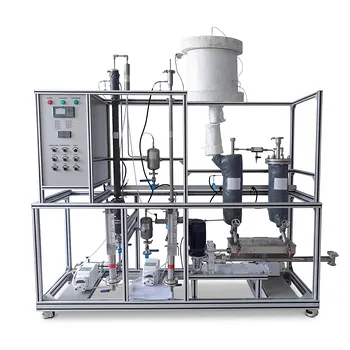
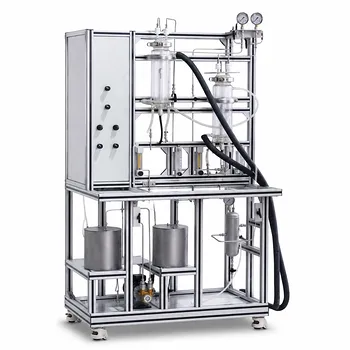
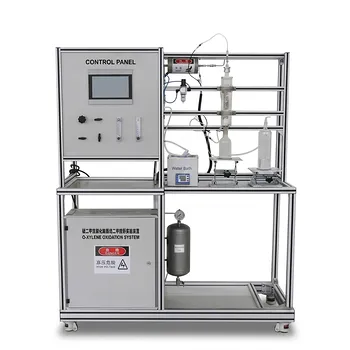
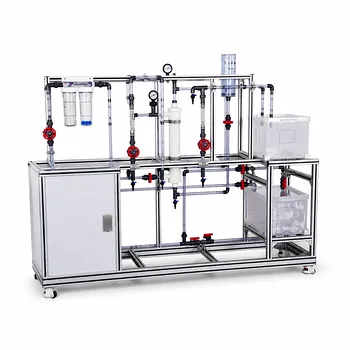
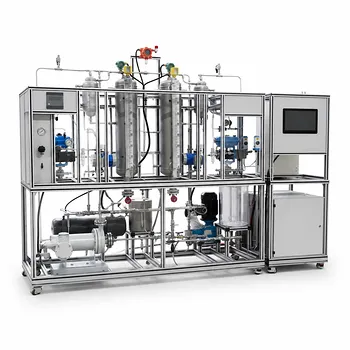
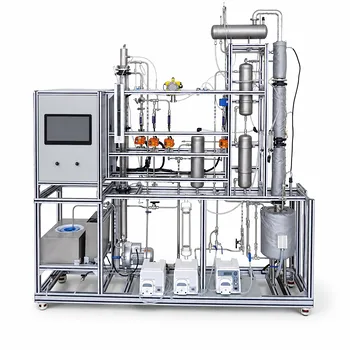
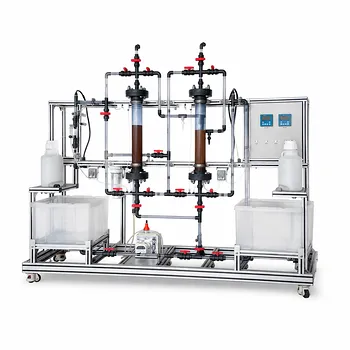
By consolidating the oxygen supply and reforming reactor into a single unit, oxygen membrane reforming eliminates the most capital-intensive component of a syngas plant—the cryogenic air separation unit. This directly slashes the upfront equipment cost of generating synthesis gas by over 30% compared to conventional autothermal reforming. In a chemical engineering pilot plant, this advantage is demonstrated by operating a heated membrane reactor that produces syngas without a standalone oxygen plant, while simultaneously allowing students to measure the membrane’s oxygen flux and the resulting reaction kinetics.
The primary capital efficiency gain of OMR comes from replacing a massive, multi-million-dollar cryogenic ASU with a compact ceramic membrane that selectively feeds oxygen ions into the reaction zone. A well-designed pilot plant proves this principle by integrating separation and reaction, then comparing the resulting energy balance and product slate directly against a conventional ATR experiment.
The Capital Cost Hurdle in Conventional Autothermal Reforming
Conventional autothermal reforming (ATR) is a workhorse for syngas production, but its economics are dominated by the need for a dedicated oxygen source.
The Air Separation Unit as a Cost Driver
To supply the high-purity oxygen that drives the partial oxidation reaction, an ATR plant must include a cryogenic air separation unit (ASU). These units are massive, energy-hungry, and extremely expensive.
The ASU alone can account for a disproportionate share of the total plant investment. By eliminating this single piece of equipment, OMR removes a major cost and complexity barrier from the process flow sheet.
The Capital Cost Comparison
The reference data indicates that OMR can reduce syngas generation capital costs by over 30% compared to ATR.
This saving stems from fewer compressors, no cryogenic distillation columns, and a far simpler overall plant layout. The capital efficiency isn’t a marginal gain—it’s a step-change in the economic viability of small- to medium-scale syngas production.
How Oxygen Membrane Reforming Integrates Separation and Reaction
OMR’s capital efficiency is built on material science. It uses a non-porous, multicomponent metallic oxide ceramic membrane—an ion transport membrane (ITM)—that works at high temperatures.
The Selective Oxygen Conduction Mechanism
The membrane selectively extracts oxygen from air on one side. At the operating temperature, oxygen molecules dissociate into ions (O²⁻) and migrate through the ceramic lattice under a partial pressure gradient.
On the other side of the membrane, the oxygen ions immediately react with the hydrocarbon feed (natural gas and steam) in the presence of a catalyst. This combination of unit operations is the essence of process intensification.
Eliminating External Oxygen Supply
Because the membrane acts as both separator and distributor, there is no need for an external air separation unit. The reformer itself becomes the oxygen plant.
This single-unit design slashes piping, structural steel, and instrumentation—directly translating to lower capital expenditure. The reduction is not just theoretical; it is a direct consequence of removing a major block from the plant’s equipment list.
Demonstrating the Efficiency Gain in a Pilot Plant
A chemical engineering pilot plant is the ideal environment to validate OMR’s capital-efficiency promise and teach the underlying principles of advanced process technology.
Combining Separation and Reaction in One Unit
Incorporate a membrane reaction module into the pilot plant. This unit houses the ion transport membrane, heated to typical reforming temperatures, with air flowing on one side and a methane/steam mixture on the other.
Students observe that syngas emerges from the reactor without any external oxygen feed. By measuring input and output streams, they can calculate that all required oxygen is supplied through the membrane, directly demonstrating the elimination of the ASU.
Measuring Oxygen Flux and Kinetics
The pilot plant must be instrumented to measure the oxygen flux across the membrane. This involves monitoring the air-side flow and composition, then comparing it to the product-side oxygen consumption.
At the same time, students sample the syngas to evaluate the kinetics of reforming reactions occurring directly on the membrane surface. This data teaches the critical relationship between oxygen permeation rate, temperature, and overall conversion, reinforcing why the membrane must be engineered to match the reaction demands.
Comparing Allothermal and Autothermal Heat Management
The supplementary references clarify how reaction heat is supplied. In a pilot unit running in allothermal mode, an external furnace supplies the endothermic heat for steam reforming.
In autothermal operation, the exothermic partial oxidation of methane with oxygen generates heat directly inside the catalyst bed. OMR works autothermally with a twist: the oxygen is delivered through the membrane rather than pre-mixed.
Students can run both conventional ATR (with bottled oxygen or an ASU simulator) and OMR back-to-back. By recording the external heating duty required in each case, they will see that OMR achieves the same syngas production with a lower installed equipment cost and a fundamentally different heat integration strategy.
Understanding the Trade-offs and Limitations
No technology is without its constraints. While OMR offers compelling capital savings, pilot-plant demonstrations must also teach the engineering hurdles.
- Membrane Stability: Ion transport membranes operate at very high temperatures (typically above 800 °C) and are sensitive to thermal cycling and contaminants. Long-term stability remains a research frontier.
- Oxygen Flux Limitations: The rate of oxygen transport directly limits syngas throughput. If the flux is too low, the reactor must be larger, potentially eroding some capital cost advantage.
- Catalyst Integration: The reforming catalyst must function in close proximity to the membrane surface without degrading the ceramic material. This requires careful design and is a key topic for advanced unit operations labs.
- Scale-Up Complexity: While a pilot plant proves the principle, scaling up to commercial production involves challenges in membrane module manufacturing and reactor engineering that are not present in conventional ATR.
Teaching these trade-offs gives students a realistic view of where OMR fits in the technology landscape.
Making the Right Choice for Your Educational or R&D Focus
When designing a pilot-plant experiment to showcase capital efficiency, your setup should reflect the learning outcome you prioritize.
- If your primary focus is demonstrating process intensification: Use a single-tube OMR reactor and show how one unit replaces an ASU and a reformer. Measure the reduction in equipment footprint and control complexity.
- If your primary focus is membrane materials characterization: Equip the pilot plant with precise oxygen sensors and mass flow controllers to quantify flux as a function of temperature and pressure. Compare the results against literature data for different perovskite compositions.
- If your primary focus is comparative energy and economic analysis: Run the same feed and product specifications with a conventional ATR setup using purchased oxygen. Have students calculate the capital cost difference using standard equipment factors, validating the 30%+ reduction claim.
- If your primary focus is industrial readiness: Stress-test the membrane under simulated startup and shutdown cycles, and analyze the syngas quality for downstream Fischer-Tropsch or methanol applications.
By letting the pilot plant tell the story of capital efficiency through direct measurement and comparison, you prepare engineers not just to accept OMR’s advantages, but to critically evaluate and ultimately commercialize the next generation of clean syngas technologies.
Summary Table:
| Feature | Conventional Autothermal Reforming (ATR) | Oxygen Membrane Reforming (OMR) |
|---|---|---|
| Oxygen Source | External Cryogenic ASU (Expensive & Complex) | Integrated Ceramic Membrane (ITM) |
| Capital Cost | Baseline | >30% Reduction (No ASU required) |
| System Footprint | Large (Requires compressors & columns) | Compact (Integrated separation & reaction) |
| Heat Integration | Autothermal with pre-mixed feed | Autothermal via selective ion transport |
Bring Advanced Syngas Process Technology to Your Facility
Looking to demonstrate process intensification, membrane separation, and advanced reaction kinetics in your labs? LABPARK provides premium Educational and Vocational Unit Operations Pilot Plants in chemical engineering, bioprocess & biotech, and environmental & water treatment.
Designed specifically for universities, research institutes, and enterprises, our custom-engineered pilot plants enable hands-on learning and cutting-edge R&D in clean energy and chemical processing.
Contact LABPARK today to discuss your pilot plant requirements and request a custom quote!
Related Products
- Multifunctional Membrane Separation Educational Pilot Plant with Ultrafiltration, Nanofiltration, Reverse Osmosis
- Ultrafiltration Membrane Separation Educational Pilot Plant
- Steam Methane Reforming Hydrogen Production and Purification Educational Pilot Plant
- Photocatalytic Membrane Separation and Degradation Unit Operations Pilot Plant
- Multi-Functional Membrane Separation Educational Pilot Plant for Unit Operations Lab
People Also Ask
- How do membrane separation pilot plants differ from traditional filtration and extraction? Key Mechanisms
- Why is solid-liquid separation challenging in bioprocessing, and how do membrane separation pilot plants address this?
- How do PEI, PVDF, and PSU membranes compare in pilot plants? Find the best fit.
- How can operators optimize operating conditions and cleaning protocols in membrane separation pilot plants to mitigate fouling?
- How does surface modification mitigate membrane fouling? Key grafting & charge strategies.