The solubility of the gas you are trying to absorb is the single most powerful diagnostic tool in your pilot plant. It acts as a master switch, instantly telling you where the primary bottleneck to mass transfer resides. For highly soluble gases like ammonia in water, the resistance is overwhelmingly in the gas film, and your optimization efforts must focus there. For sparingly soluble gases like carbon dioxide or oxygen in water, the resistance shifts almost entirely to the liquid film, demanding a completely different optimization strategy. Misidentifying this dominant resistance is the fastest route to a failed scale-up.
The two-film theory reveals that the overall resistance to mass transfer is a series circuit, but solubility determines the path of least resistance. A highly soluble gas races through the liquid film, leaving the gas film as the sole bottleneck. A sparingly soluble gas struggles to penetrate the liquid, making the gas film's resistance inconsequential. Your entire process optimization strategy must pivot on this fundamental distinction.
The Two-Film Theory: A Circuit of Resistances
Visualize the gas-liquid interface not as a sharp line, but as two stagnant films standing as barriers to molecules trying to cross from one phase to the other. Solute molecules must diffuse through a stagnant gas film and then a stagnant liquid film.
The Sum of Resistances
The overall resistance to mass transfer is simply the sum of these two individual resistances acting in series. You cannot eliminate one, but you can almost always identify one as the overwhelmingly dominant bottleneck.
This is where solubility, quantified by Henry's Law constant (H) , becomes the deciding factor. It dictates which film presents the greater obstacle.
Henry's Law: The Deciding Factor
Henry's Law describes how a gas partitions itself between the gas phase and a liquid phase at equilibrium. The magnitude of the Henry's Law constant for your specific gas-solvent pair directly reveals the controlling resistance.
- For highly soluble gases (large H): The solute has a high affinity for the liquid. It is effectively "sucked" into the bulk liquid, making the liquid-film resistance negligible. The process is gas-film controlled. The overall mass transfer coefficient becomes practically equal to the gas-film coefficient ($K_G \approx k_g$).
- For sparingly soluble gases (small H): The solute resists entering the liquid. It piles up at the interface, making the journey through the liquid film agonizingly slow. The gas-film resistance is negligible. The process is liquid-film controlled. The overall liquid-phase coefficient approximates the individual liquid-film coefficient ($K_L \approx k_l$).
Dictating the Optimization Strategy
Once you've diagnosed the controlling film, your pilot plant ceases to be a black box and becomes an instrument you can tune with precision. You will stop wasting effort on parameters that don't matter.
Optimizing a Gas-Film Controlled System
For a system like ammonia absorption in water, the liquid side offers virtually no resistance. The ammonia molecule's struggle is to reach the liquid surface through the gas phase.
Your primary lever is gas-phase turbulence. To enhance the absorption rate, you must violently disrupt the stagnant gas film. This means increasing the gas velocity and designing internals that promote gas-phase mixing. You will see a direct, strong correlation between gas flow rate and the overall mass transfer coefficient ($K_G a$). Liquid flow rate adjustments will have a comparatively minor effect.
Optimizing a Liquid-Film Controlled System
For a system like carbon dioxide absorption in water, the CO₂ molecule has reached the liquid side but is now met with a formidable barrier. Disrupting the gas film yields minimal improvement because it was never the real obstacle.
Your focus must shift entirely to the liquid side. You need to maximize the liquid-film mass transfer coefficient ($k_L$) and the interfacial area. Key levers include increasing the liquid flow rate to create ripples and turbulence, perfecting the liquid distributor to ensure complete packing wetting, and using packing with high surface area. Here, the overall $K_L a$ will be highly sensitive to liquid velocity and temperature, while gas velocity becomes a secondary consideration.
Understanding the Trade-offs
Focusing on the dominant resistance is essential, but a purely one-dimensional approach creates blind spots in your pilot plant work.
The Temperature Trap
A universal thermodynamic truth complicates optimization: gas solubility decreases as temperature increases. Lower temperatures favor absorption, while higher temperatures favor stripping. You might be tempted to lower the temperature in a liquid-film controlled system to increase solubility and the driving force. However, a lower temperature also increases the liquid's viscosity, which can slow molecular diffusion and reduce the mass transfer coefficient. You cannot decouple these effects without experimental data from your pilot plant.
The Limitation of Single-Phase Focus
In a well-designed pilot plant study, you must experimentally confirm that the "negligible" resistance is truly negligible. This assumption ($1/k_g \gg 1/(H \cdot k_l)$ or vice-versa) simplifies calculations, but in a real pilot column, unexpected fluid dynamics can create secondary bottlenecks. For instance, a maldistributed liquid flow in a gas-film controlled system can create dry patches, inadvertently introducing a liquid-side resistance. A comprehensive study uses your pilot plant to verify the theoretical assumption before committing to an optimization path.
Turning Insight into Experimental Action
Your goal dictates which lever you pull. Use the solubility of your chosen system to frame your pilot plant study from day one.
- If your primary focus is diagnosing an unknown system: Begin by comparing the calculated gas-film resistance ($1/k_g$) to the solubility-weighted liquid-film resistance ($1/(H \cdot k_l)$). A difference of an order of magnitude or more confidently identifies the controlling film.
- If your primary focus is enhancing the absorption rate of a sparingly soluble gas: Direct your investment toward the liquid-phase hydraulics. Run experiments varying liquid flow rate and distributor types while measuring $K_L a$. You will find your biggest performance gains here, not in the gas blower.
- If your primary focus is teaching these principles in a unit ops lab: Choose two classic systems intentionally—one for gas-film control (ammonia-water) and one for liquid-film control (CO₂-water)—and have students generate their own $K_G a$ vs. velocity plots. The visual evidence of the distinct rate-limiting regimes creates an unforgettable lesson.
Let solubility dictate your strategy, and your pilot plant will move from trial-and-error operation to designed experimentation.
Summary Table:
| Solubility | Controlling Film | Key Optimization Lever | Example System |
|---|---|---|---|
| Highly Soluble (Large H) | Gas Film | Increase gas-phase velocity and turbulence | Ammonia in Water |
| Sparingly Soluble (Small H) | Liquid Film | Increase liquid flow rate and packing surface area | Carbon Dioxide in Water |
Scale Up Your Chemical Engineering Labs with LABPARK
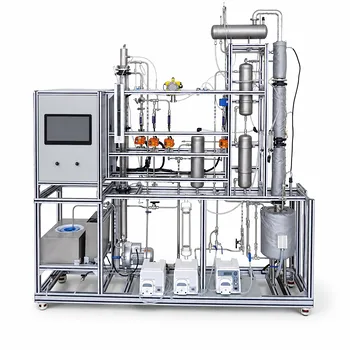
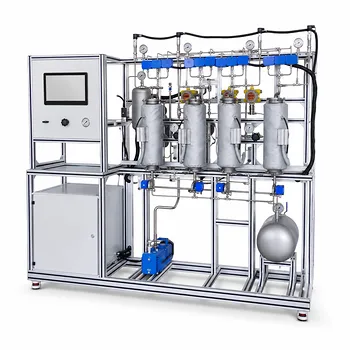
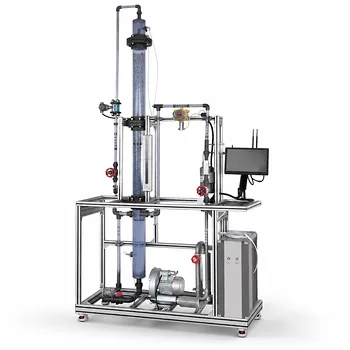
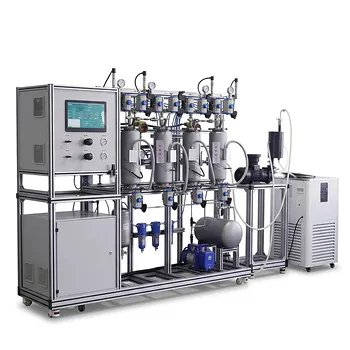
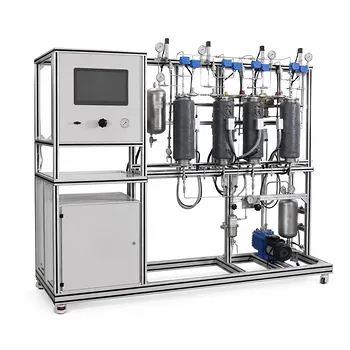
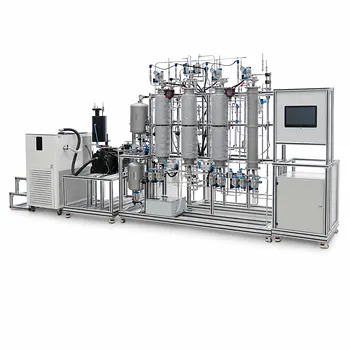
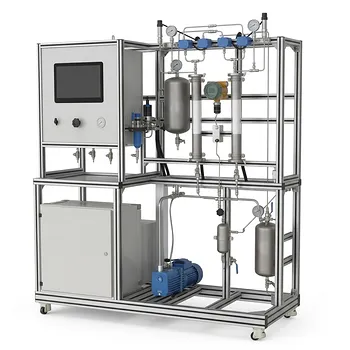
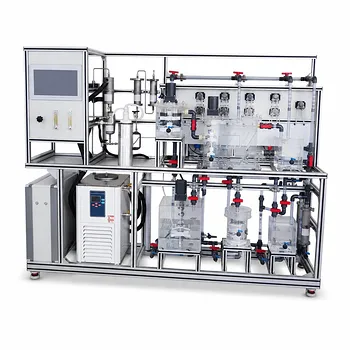
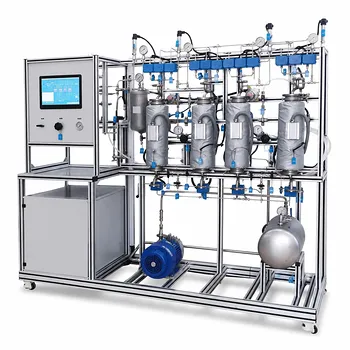
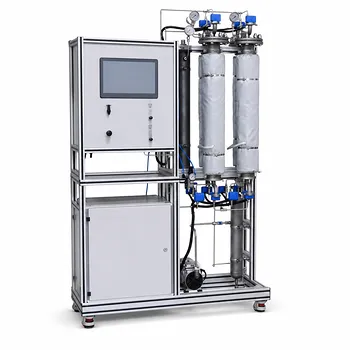
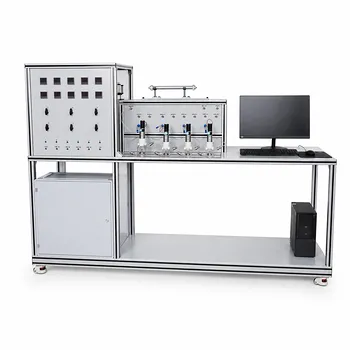
To successfully demonstrate or scale up gas absorption processes, you need reliable, high-precision equipment. LABPARK provides state-of-the-art Educational and Vocational Unit Operations Pilot Plants in chemical engineering, bioprocess & biotech, and environmental & water treatment, specifically designed for universities, research institutes, and enterprises.
Our pilot plants allow students and researchers to accurately measure mass transfer coefficients, manipulate process variables, and visualize gas- vs. liquid-film resistance in real time.
Contact our technical specialists today to find the ideal pilot plant configuration for your facility!
Related Products
- Dual-Mode Gas Absorption and Desorption Unit Operations Training Pilot Plant
- Carbon Dioxide Absorption and Desorption Educational Pilot Plant for Carbon Capture Studies
- Carbon Dioxide Adsorption and Capture Educational Unit Operations Pilot Plant
- Absorption and Desorption Educational Unit Operations Pilot Plant
- Packed Bed Absorption Educational Unit Operations Pilot Plant
People Also Ask
- How do two-film & penetration theories apply to gas absorption pilot plant teaching? Key pedagogical insights.
- How is the direction and driving force of mass transfer determined in a gas absorption unit operations pilot plant?
- How does partial pressure behavior influence gas absorption pilot plants? Master Mass Transfer
- Why does increasing flow fail to enhance absorption in fast chemical reactions? Pilot Plant Insights
- What are the limitations of Henry's Law in gas absorption pilot plants? Avoid critical lab errors.