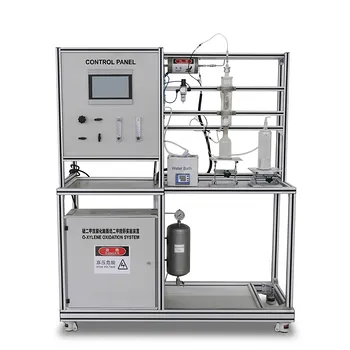
A fixed-bed catalytic reactor pilot plant demonstrates partial oxidation by turning reaction stoichiometry into measurable process data. Students feed ethylene and oxygen, or air, through a catalyst bed and analyze the outlet gas for ethylene oxide, unreacted oxygen, nitrogen, and carbon dioxide on a water-free basis. They then use these measurements to perform component material balances and calculate ethylene conversion, ethylene oxide selectivity, and excess oxygen or air.
The central lesson is that reactor performance cannot be judged from the desired reaction alone. Outlet composition reveals how much feed reacted, how much formed the target product, and how much was consumed by competing combustion.
How the Pilot Plant Represents the Process
Gas Flow Through the Fixed Bed
A fixed-bed reactor contains catalyst particles held stationary inside a reactor vessel. The gaseous feed passes through the bed, where ethylene and oxygen react on the catalyst surface.
This arrangement allows students to observe a continuous heterogeneous reaction while controlling variables such as feed rate, temperature, and reactant ratio.
Partial Oxidation to Ethylene Oxide
The desired reaction is the partial oxidation of ethylene:
[ \mathrm{C_2H_4 + \frac{1}{2}O_2 \rightarrow C_2H_4O} ]
The objective is to convert ethylene into ethylene oxide while limiting further oxidation.
Competing Complete Combustion
Some ethylene may undergo complete oxidation instead:
[ \mathrm{C_2H_4 + 3O_2 \rightarrow 2CO_2 + 2H_2O} ]
Carbon dioxide in the outlet therefore provides evidence that oxygen was consumed by the undesired combustion pathway. Water is formed as well, but it is excluded when the gas composition is reported on a water-free basis.
How Students Perform the Material Balance
Establishing the Basis
Students first define a calculation basis, such as a measured inlet flow over a fixed period or a specified amount of ethylene feed. All inlet and outlet quantities must use consistent units, commonly molar flow or moles per operating interval.
If air is used, nitrogen is treated as an inert component. Its measured outlet amount can help verify the flow balance and indicate how much air passed through the reactor.
Measuring the Outlet Composition
The outlet gas is analyzed for components such as:
- Ethylene oxide
- Nitrogen
- Unreacted oxygen
- Carbon dioxide
- Unreacted ethylene, where measured
The reported concentrations are normalized after removing water from the gas basis. Students combine these mole percentages with the total outlet flow to obtain the amount of each species leaving the reactor.
Applying Component Balances
For each chemical component, students apply conservation of mass:
[ \text{Input} - \text{Output} + \text{Generation} - \text{Consumption} = 0 ]
Nitrogen provides a convenient inert balance because it is neither generated nor consumed. Oxygen and carbon balances then help distinguish ethylene oxide formation from complete combustion.
The reaction extents can be represented as:
[ \xi_{\mathrm{EO}} = \text{extent of ethylene oxide formation} ]
[ \xi_{\mathrm{comb}} = \text{extent of complete combustion} ]
Using the stoichiometric equations:
[ n_{\mathrm{C_2H_4,out}}
n_{\mathrm{C_2H_4,in}}
\xi_{\mathrm{EO}}
\xi_{\mathrm{comb}} ]
[ n_{\mathrm{C_2H_4O,out}} = \xi_{\mathrm{EO}} ]
[ n_{\mathrm{CO_2,out}} = 2\xi_{\mathrm{comb}} ]
These relationships allow students to estimate how the consumed ethylene was divided between the desired and competing reactions.
Reactor Performance Indicators
Ethylene Conversion
Ethylene conversion measures the fraction of the ethylene feed that reacts:
[ X_{\mathrm{C_2H_4}}
\frac{n_{\mathrm{C_2H_4,in}}-n_{\mathrm{C_2H_4,out}}} {n_{\mathrm{C_2H_4,in}}} ]
A high conversion alone does not prove good reactor performance. Ethylene may be disappearing because it is being converted into carbon dioxide rather than ethylene oxide.
Ethylene Oxide Selectivity
Selectivity measures the preference for the desired reaction relative to the total reacted ethylene. On an ethylene-consumption basis:
[ S_{\mathrm{EO}}
\frac{\xi_{\mathrm{EO}}} {\xi_{\mathrm{EO}}+\xi_{\mathrm{comb}}} ]
Students can calculate this from the ethylene oxide and carbon dioxide measurements when the reaction stoichiometry and analytical basis are applied consistently.
Product Yield
Yield combines conversion and selectivity:
[ Y_{\mathrm{EO}} = X_{\mathrm{C_2H_4}}S_{\mathrm{EO}} ]
This shows why industrial reactor evaluation must consider both how much reactant reacts and how much becomes the desired product.
Excess Oxygen or Air
Students compare the actual oxygen supplied with the stoichiometric oxygen requirement for the observed reaction mixture:
[ %\text{ excess oxygen}
\frac{n_{\mathrm{O_2,actual}}-n_{\mathrm{O_2,stoich}}} {n_{\mathrm{O_2,stoich}}} \times 100 ]
When air is used, the oxygen feed is inferred from the air flow or its measured composition, while nitrogen acts as an inert reference. The calculation demonstrates how feed sizing affects both reaction completion and unwanted combustion.
What the Hands-On Exercise Teaches
Connecting Stoichiometry to Real Equipment
Students begin with ideal reaction equations but must reconcile them with measured flows and compositions. This exposes the difference between a theoretical reactor calculation and an operating process containing unreacted feed and side products.
Evaluating Catalyst Performance
The catalyst is assessed indirectly through conversion and selectivity. Changes in operating conditions can reveal whether the catalyst favors ethylene oxide formation or promotes complete oxidation.
The fixed-bed format also introduces practical concerns such as flow distribution, temperature control, and the effect of conditions along the catalyst bed.
Checking the Quality of Experimental Data
A material balance is also a data-validation tool. If the calculated carbon, oxygen, or inert balances do not close reasonably, students must investigate measurement errors, inconsistent flow bases, omitted species, or incorrect assumptions about the water-free analysis.
Sizing Industrial Feed Requirements
Once conversion and selectivity are known, students can determine the feed required to produce a target amount of ethylene oxide. The calculation includes the unreacted ethylene that would need separation or recycle in a larger process.
Understanding the Trade-offs
Conversion Versus Selectivity
Operating conditions that increase ethylene conversion may also increase complete combustion. A reactor producing a large amount of carbon dioxide may have high conversion but poor ethylene oxide selectivity.
The useful operating point is therefore a balance between reaction extent, target-product formation, oxygen consumption, and byproduct generation.
Oxygen Supply Versus Process Control
Excess oxygen can help provide sufficient oxidant, but it also changes the outlet composition and may increase the opportunity for complete oxidation. Insufficient oxygen leaves more unreacted ethylene and reduces overall throughput.
Students learn that the oxygen ratio must be evaluated against both conversion and selectivity rather than optimized as an isolated variable.
Water-Free Analysis Versus Complete Accounting
Removing water from the reported gas basis simplifies comparison of dry gas compositions, but water is still part of the actual combustion material balance. Ignoring its formation would produce an incomplete oxygen and hydrogen balance.
Pilot Results Versus Industrial Design
A pilot plant provides measured evidence under controlled conditions, but its results do not automatically represent full-scale behavior. Industrial design may introduce additional concerns involving heat removal, catalyst life, recycle, purge streams, and separation equipment.
How to Apply This to Your Project
The exercise is most valuable when students treat the reactor, analysis system, and calculations as one complete process experiment.
- If your primary focus is material balances: Measure inlet and outlet flow rates and compositions on a consistent basis, then close separate balances for ethylene, oxygen, carbon dioxide, ethylene oxide, and nitrogen.
- If your primary focus is reactor performance: Calculate ethylene conversion, ethylene oxide selectivity, and product yield from the same experimental dataset.
- If your primary focus is feed design: Use the reaction extents and excess-oxygen calculation to determine the required ethylene and air or oxygen feed for a target product rate.
- If your primary focus is catalyst evaluation: Compare operating conditions using conversion and selectivity together, since conversion alone can conceal increased complete combustion.
- If your primary focus is experimental verification: Use nitrogen as an inert reference and investigate any material-balance closure error before drawing conclusions about reactor behavior.
A fixed-bed catalytic reactor pilot plant makes reaction engineering tangible by linking catalyst operation, gas analysis, stoichiometry, and material balances in one measurable system.
Summary Table:
| Topic | What students measure or calculate | Key insight |
|---|---|---|
| Desired reaction | Ethylene oxide formation from ethylene and oxygen | Connects stoichiometry with catalyst operation |
| Side reaction | Carbon dioxide from complete combustion | Reveals unwanted ethylene oxidation |
| Material balance | Inlet and outlet component flows | Tests conservation of mass and data quality |
| Conversion | Fraction of ethylene that reacts | Shows overall reactant consumption |
| Selectivity | Fraction of reacted ethylene forming ethylene oxide | Distinguishes useful conversion from combustion |
| Product yield | Conversion multiplied by selectivity | Estimates actual process performance |
| Excess oxygen | Actual versus stoichiometric oxygen feed | Demonstrates the effect of feed control |
| Inert reference | Nitrogen flow when air is used | Supports flow verification and balance closure |
Bring reaction engineering theory into measurable practice with LABPARK Educational and Vocational Unit Operations Pilot Plants. Our fixed-bed catalytic reactor systems help universities, research institutes, and enterprises teach and evaluate partial oxidation, gas analysis, catalyst performance, material balances, conversion, selectivity, and feed optimization. LABPARK also provides pilot plants for chemical engineering, bioprocess and biotech, and environmental and water treatment applications. Contact LABPARK to discuss your teaching, research, or process-development requirements and identify the right pilot plant configuration for your laboratory.
Related Products
- Fixed Bed Gas Solid Catalytic Reaction Educational Pilot Plant
- Fixed-Bed Chemical Reaction and Gas Dust Tar Removal Unit Operations Pilot Plant
- Multi Functional Catalytic Reaction and Reactor Evaluation Educational Unit Operations Pilot Plant
- Ethylbenzene Dehydrogenation Educational Unit Operations Pilot Plant
- Educational Unit Operations Pilot Plant for Intraparticle Diffusion Effective Factor Measurement
People Also Ask
- Fixed-Bed vs. Fluidized-Bed Reactor: How to Choose the Right Pilot Plant for Gas-Solid Catalytic Reactions
- How to determine catalyst pore radius & porosity? Optimize your chemical engineering pilot plant.
- What reactor configurations study gas-solid reactions? Guide to key types and applications.
- How does identifying the rate-limiting step optimize reaction conditions? Pilot Plant Guide
- How do reactor pilot plants safely study gas-solid reactions? Master kinetics with thermal & flow control.