Capacitive level sensors measure the level of a liquid by detecting changes in capacitance—a value that directly depends on the medium’s dielectric constant. In chemical engineering unit‑operations pilot plants, any fluctuation in the process liquid’s temperature or concentration quietly alters that dielectric constant. The result is a shifted baseline capacitance, which the instrument misinterprets as a true level change, injecting systematic error even when the physical liquid height stays perfectly still.
The simple truth: in a pilot plant, temperature and concentration variations become hidden dials that twist the reading of a capacitive level sensor. Without active compensation, a sensor will faithfully report a distorted level, undermining research data and scale‑up decisions. Understanding how these factors corrupt the measurement—and how to calibrate them away—is what separates a noisy reading from reliable process insight.
Why the Dielectric Constant is the Sensor’s Achilles’ Heel
The Fundamentals of Capacitive Level Sensing
A capacitive sensor forms a capacitor with the tank wall or a reference electrode. The liquid acts as the dielectric material between the plates. As the liquid rises or falls, the proportion of high‑dielectric liquid to low‑dielectric air changes, producing a linear shift in total capacitance.
For a given probe geometry, the measured capacitance is directly proportional to the effective dielectric constant of the medium occupying the sensing field. So, any change that re‑writes that dielectric constant will be interpreted as a level change—this is the core vulnerability.
Concentration Changes Re‑write the Dielectric Signature
In pilot‑plant reactors, distillation columns or mixers, the concentration of solutes or the composition of a mixture rarely stays fixed. Adding more salt to water, altering the monomer fraction in a polymer solution, or shifting the solvent ratio in an extraction loop all modify the liquid’s polarizability.
This polarizability governs the bulk dielectric constant. For example, a 5% brine solution has a drastically different dielectric constant than pure water. If a process transitions from one concentration to another, the sensor sees a different capacitance for the same liquid height, and reports a fictitious level deviation. The error is proportional to the magnitude of the dielectric shift, not to any real process upset.
Temperature Dips Into the Same Vulnerable Parameter
Temperature touches the dielectric constant through two mechanisms. First, for many polar liquids, the static dielectric constant drops as thermal motion disrupts molecular alignment. Second, temperature changes the liquid density—altering the number of dipoles per unit volume—which also reduces the dielectric constant in most cases.
In pilot‑plant operations like exothermic batch reactions or temperature‑cycled crystallizers, the liquid temperature can swing 50–80 °C. A capacitive level sensor will sense a steadily falling capacitance, even if the tank level is absolutely constant, because the medium’s dielectric constant is decaying with heat. The instrument converts that capacitance drop into a false low‑level or high‑level alarm.
How These Variations Manifest as Real‑World Measurement Errors
A Single Root Cause with Multiple Symptoms
Both temperature and concentration strike the same measurement principle: they alter the calibrated relationship between capacitance and level. The errors can appear in several forms:
- Static offsets when the process operates at a new steady‑state condition different from the calibration point.
- Drift during dynamic transitions, such as during a product changeover or a temperature ramp.
- Hysteretic behavior if the dielectric constant follows a non‑linear path with temperature or concentration, leaving the sensor momentarily lost.
Why Pilot Plants Are Especially Sensitive
Unit‑operations pilot plants exist to explore parameter space. Operators intentionally vary temperature, feed composition, and catalyst concentration to map process behavior. This means the sensor is exposed to a wider dielectric landscape than in a fixed‑recipe manufacturing line. Without intervention, every experiment that changes temperature or concentration also erodes level measurement confidence—undermining the mass balance data essential for scale‑up.
Bridging the Accuracy Gap with Smart Compensation
Dynamic Calibration Curves
The primary defense is to stop treating the sensor as a linear, single‑slope device. Instead, the instrument should have a family of calibration curves—or a mathematical model—that maps capacitance to level as a function of the medium’s temperature and concentration.
For example, a polypropylene‑glycol solution in a pilot reactor can be characterized off‑line: measuring the dielectric constant at several representative temperatures and concentrations. These data points generate a look‑up table or a fitted surface. The live system then measures the process temperature (via a fast‑response RTD or thermocouple) and adjusts the level calculation in real time, using the appropriate curve. This approach directly attacks the error at its source.
In‑Process Reference Measurements
A more robust method, especially for complex or non‑ideal mixtures, is to install a reference capacitance probe that is always submerged at a fixed, known level. This reference sensor sees the same liquid condition but no level variation. Its output becomes a live indicator of the current dielectric state. The main level‑sensing probe’s reading is then corrected by the ratio of the reference capacitance to a baseline value, effectively canceling out the dielectric shift.
This technique is particularly valuable in pilot plants where the liquid composition may change unpredictably, because no off‑line characterisation can pre‑capture every possible mixture.
Built‑in Temperature Compensation
Many commercial capacitive sensors include an integrated temperature sensor whose signal is used to apply a first‑order correction to the measured capacitance. While this handles pure temperature effects well, it cannot compensate for concentration changes that happen independently. For that, you must combine temperature compensation with either concentration modeling or the dual‑probe reference strategy.
Understanding the Trade-offs
Even with compensation, capacitive level sensing in variable media carries inherent limitations that the pilot‑plant team must accept.
- Calibration complexity: Building a multi‑variable calibration map requires a laboratory‑grade network analyser or precision samples, and the effort must be repeated if the process chemistry changes substantially.
- Speed vs. stability: Fast‑correcting algorithms can amplify measurement noise, while heavy filtering can smear real level changes during rapid transients. The pilot‑plant operator must balance response time (as discussed for temperature sensors in fast‑exothermic systems) against signal cleanliness.
- Not all media cooperate: Some industrial liquids have a dielectric constant that varies with temperature or concentration in a non‑linear, non‑monotonic way, making simple compensation models unreliable. For such systems, a through‑air radar or guided‑wave radar sensor may be a more pragmatic choice.
- Accuracy class constraints: If the required process accuracy for level is very tight—say ±0.5 % of span—the noise introduced by dielectric compensation may eat into that budget. The team must evaluate whether the overall measurement chain, after compensation, still meets the required accuracy class, analogous to selecting a 0.5‑class instrument for a tight temperature tolerance.
Making the Right Choice for Your Pilot‑Plant Goal
Whether capacitive level sensing remains viable depends on what the experiment truly needs.
- If your primary focus is high‑fidelity mass balances for scale‑up: Invest in full dielectric characterization, a reference probe, and a real‑time compensation algorithm. This preserves the capacitive sensor’s speed and cost advantage while delivering the accuracy you require.
- If your primary focus is simple monitoring in a relatively stable, known mixture: A sensor with a basic internal temperature correction may suffice. Document the expected error envelope for the expected temperature and concentration swings, and decide if that uncertainty is acceptable.
- If your primary focus is a wide‑ranging, exploratory pilot campaign: Prioritize sensor technologies less sensitive to dielectric drift—such as guided‑wave radar—for the most critical level measurements. Reserve capacitive sensors for applications where the medium properties are tightly controlled or well‑understood.
- If your primary focus is student training or educational pilot plants: Use capacitive sensors as an explicit teaching opportunity. Let students measure the dielectric drift firsthand, build the compensation curves, and compare corrected and uncorrected readings. This exercises the same calibration mindset used with RTDs and standard tables, deepening their instrumentation literacy.
A capacitive level sensor is not inherently inaccurate—it is selectively blind. When temperature and concentration vary, it faithfully reports the changed dielectric world you gave it. The trick is to teach the instrument what that world looks like, so its output keeps pointing only at the actual liquid surface.
Summary Table:
| Parameter | Impact on Capacitive Sensor | Compensation Strategy |
|---|---|---|
| Temperature | Lowers dielectric constant (thermal disruption & density drop); causes false alarms. | Integrated temp sensors, dynamic lookup tables. |
| Concentration | Alters bulk dielectric constant (solute/solvent ratio shifts); creates static offsets. | Reference capacitance probes, concentration mapping. |
| Dynamic Changes | Causes drift & hysteresis during process transitions. | Multi-variable calibration curves, real-time algorithms. |
Optimize Your Pilot Plant Instrumentation with LABPARK
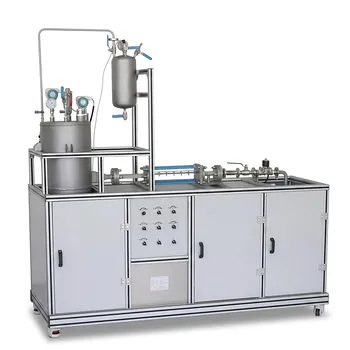
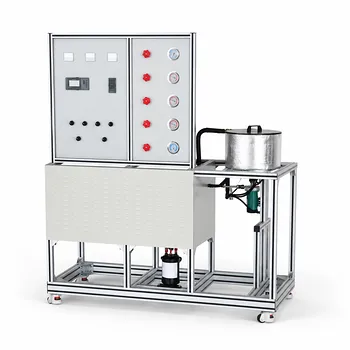
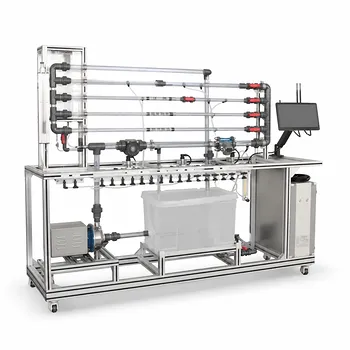
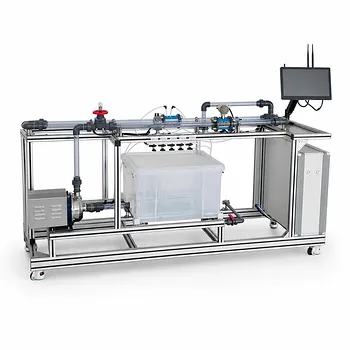
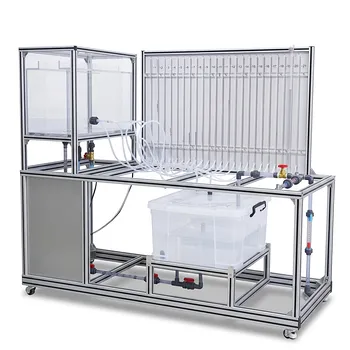
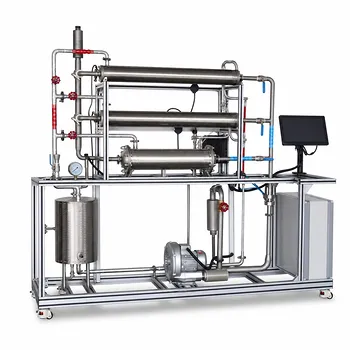
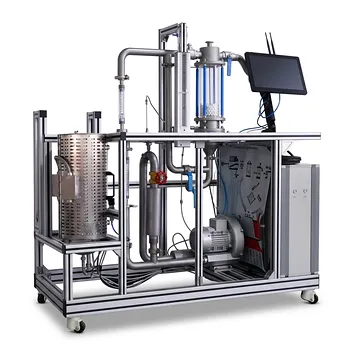
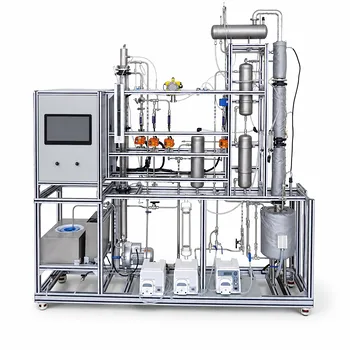
Accurate level and temperature measurements are critical for generating reliable scale-up data. At LABPARK, we supply state-of-the-art Educational and Vocational Unit Operations Pilot Plants in chemical engineering, bioprocess & biotech, and environmental & water treatment for universities, research institutes, and enterprises.
Whether you are demonstrating sensor calibration to students or optimizing industrial processes, our custom pilot plants ensure hands-on, high-fidelity results. Contact LABPARK today to discuss your laboratory and training needs!
Related Products
- Cavitation Phenomenon Demonstration and Analysis Educational Unit Operations Pilot Plant
- Educational Compression Refrigeration Performance Determination Unit Operations Pilot Plant
- Fluid Friction Resistance Determination Educational Unit Operations Pilot Plant
- Orifice and Venturi Flowmeter Calibration Educational Pilot Plant for Fluid Mechanics Laboratory
- Constant Pressure Filtration Educational Unit Operations Pilot Plant
People Also Ask
- How do pilot plants teach U-tube manometers? Master Differential Pressure Calculations
- How to teach pump cavitation vs. gas binding? Interactive pilot plant teaching guide.
- What factors should be considered when selecting float valve types? F1 vs. V-4 vs. T-type Guide
- How does an FIA biosensor improve fermentation monitoring compared to HPLC? Speed & automation.
- What are key parameters for stable biosensor FIA in bioprocess training? Achieve optimal performance.