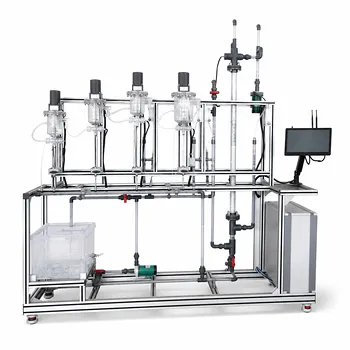
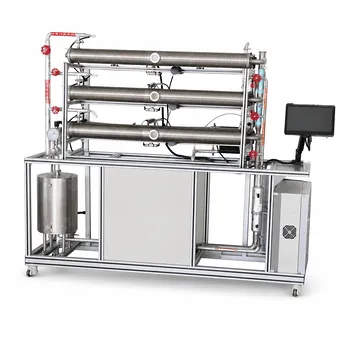
At the heart of copper smelting training reactors lies a simple thermodynamic truth: multi-phase separation is not engineered by guesswork, but by the predictive power of phase equilibria. The existence of a liquid‑liquid immiscibility gap in the Cu‑Fe‑S system — a composition region where copper‑rich and iron‑sulfide‑rich liquids refuse to mix — provides the fundamental blueprint. When the sulfur content drops below approximately 33 mol%, the system spontaneously partitions into a dense copper layer and a lighter slag, enabling the design of reactors that mimic industrial direct‑to‑blister copper production.
Designing a training reactor effectively means translating thermodynamics into physical reality: exploit the immiscibility gap to set your target bulk composition, use distribution coefficients to predict and manage impurity flow, and leverage the constant activity of pure condensed phases to radically simplify monitoring — all while accounting for kinetic and physical imperfections that pure equilibrium ignores.
The Immiscibility Gap Defines the Operating Window
The Cu‑Fe‑S phase diagram is not just a map — it is the reactor’s design specification. The target operating region must sit squarely inside the two‑liquid zone.
Understanding the Cu‑Fe‑S Miscibility Gap
At high temperatures, a fully molten sulfide‑metal system can split into two immiscible liquids: a heavy copper‑rich metallic phase and a lighter sulfide‑rich matte, with a slag on top. This separation only occurs in a specific composition band where the system is supersaturated in copper relative to its sulfur‑bearing capacity.
In the primary reference system (direct sulfidic ore conversion), the critical threshold is ~33 mol% sulfur. Above this sulfur content, a single‑liquid matte exists; below it, a copper‑rich phase precipitates, forming the distinct blister copper layer that can be tapped.
Designing for Copper Separation Below 33 mol% S
A training reactor must recreate this driving force. The bulk feed composition, including flux additions, is formulated to reach an overall sulfur content of less than 33 mol% during oxidation. This is achieved by injecting oxygen or air to oxidize FeS from the matte — the reaction FeS + O₂ → FeO + SO₂ effectively removes sulfur from the condensed system.
Once the sulfur‑depletion threshold is crossed, liquid‑liquid immiscibility takes over, and the body of the reactor must provide a quiescent zone for these two liquid phases to settle by density difference. The vessel geometry, tapping ports, and temperature profile are all subordinated to this thermodynamic boundary: no separation can occur until the composition enters the gap.
Mastering Impurity Control with Distribution Coefficients
Separation of copper is only half the job. In a training setting, understanding where iron, lead, zinc, and other tramp elements go determines whether the “copper” product is saleable or just a metallic mixture.
How Impurity Distribution Coefficients Guide Slag Design
Every element partitions between the matte (or metal) and slag according to a distribution coefficient, ( L_X = [X]{slag} / [X]{matte} ). These coefficients are functions of temperature, oxygen potential, and slag chemistry. By adjusting flux composition (e.g., silica, lime) and the partial pressure of oxygen, you shift the distribution to drive impurities into the slag, cleaning the copper phase.
A training reactor can be used to demonstrate this control systematically. Students vary the Fe/SiO₂ ratio and measure the resulting lead or zinc content in both layers. The thermodynamic prediction — derived from tabulated distribution data — serves as the baseline, and real experiments reveal kinetic and physical deviations.
Mitigating Physical Droplet Suspension
Even with favorable distribution coefficients, small copper‑rich droplets can become physically entrained in the slag. This mechanical suspension is not captured by equilibrium thermodynamics, but its probability is governed by interfacial tension and slag viscosity — which in turn depend on composition.
The design of the reactor must therefore incorporate either a settling zone (a wider, quiescent section) or a slag‑cleaning step. Training exercises can quantify the actual versus equilibrium copper loss, showing how droplet size distributions and residence times interact with the thermodynamic separation target.
Simplifying Reactor Monitoring with Constant Activity Thermodynamics
Supplementary thermodynamic knowledge becomes a powerful tool for practical reactor control and data acquisition.
Why Pure Condensed Phases Simplify Equilibrium Expressions
In heterogeneous reactions — such as the formation of solid magnetite or the presence of pure liquid metal — the activity of a pure condensed phase is unity and remains constant throughout the reaction. This means those components can be omitted from the equilibrium constant. For instance, the equilibrium for the reaction ( Cu_2S(l) + O_2(g) \rightleftharpoons 2Cu(l) + SO_2(g) ) simplifies because the activities of pure liquid copper and matte species are fixed.
Consequently, the equilibrium state is determined solely by the partial pressure of SO₂ (or O₂) and the concentration of dissolved species in the slag. You do not need to track the mass of bulk metal or matte to know whether the system is at equilibrium.
Designing a Sensor Strategy Around Gas Partial Pressures
In a training reactor, this means you can install a simple gas‑phase sensor (e.g., an SO₂ infrared analyzer or an oxygen probe) and infer the thermodynamic state without sampling the liquid metal.
The moment the sulfur content drops below the miscibility limit, the SO₂ partial pressure achieved at equilibrium becomes a reliable process indicator. The design can be streamlined: fewer sample ports, no need for bulk‑solid mass readings, and a clear link between on‑line gas data and the separation physics taught in the classroom. This mirrors the supplementary reference’s observation that only gas‑phase or liquid‑phase concentrations need monitoring, dramatically simplifying sensor integration.
Recognizing Practical Trade‑offs and Pitfalls
No equilibrium diagram survives contact with a real reactor unscathed. A responsible training reactor design must highlight these gaps.
Kinetics vs. Thermodynamics
The immiscibility gap tells you the destination, not the journey. Reaction rates, gas‑injection dynamics, and mixing intensity control how fast the system reaches the required low‑sulfur composition. A poorly mixed reactor may have local sulfur pockets that never enter the two‑liquid region, leaving copper trapped in matte despite a favorable overall bulk analysis.
The Illusion of Constant Activity in Non‑ideal Systems
While pure phases have unit activity, industrial slags and mattes are highly non‑ideal. Mixing small amounts of copper oxide into the slag changes the activity coefficient of Cu₂O far from unity. In a training unit, if the slag becomes saturated with a solid phase like magnetite, the constant‑activity simplification for that solid holds, but the liquid‑phase activities shift non‑linearly, complicating distribution calculations.
Entrainment Overwhelms Equilibrium
Even a perfect thermodynamic separation can be ruined by excessive gas stirring that creates a stable foam or emulsion of copper droplets in slag. The equilibrium copper solubility in slag is often below 1 wt%, but entrained droplets can elevate total copper loss to 5–10%. A training reactor must address this by either decoupling the oxidation and settling zones or by incorporating a coalescence promoter, and the exercise becomes a lesson in why thermodynamic purity is not enough.
Making the Right Choice for Your Training Reactor Goal
The final design of a pilot‑scale separation reactor should be tailored to the specific learning objective or experimental validation.
- If your primary focus is demonstrating the existence of liquid‑liquid immiscibility: Choose a simple batch system with a fixed bulk charge, gradually oxidize to below 33 mol% S, and let the two liquids settle without forced flow. The clear interface will speak for itself.
- If your primary focus is impurity‑distribution validation: Operate at multiple slag‑composition points, measure the realistic distribution coefficients, and compare them against published thermodynamic models. Deliberately introduce a tracer impurity and track its path.
- If your primary focus is process‑control training: Exploit the constant‑activity principle. Rely on gas‑phase oxygen or SO₂ probes to trigger the end‑point of the separation sequence, teaching operators that stoichiometric oxidation to a target gas partial pressure guarantees the bulk composition has entered the miscibility gap — no direct liquid sampling required.
By letting the rules of phase equilibria and immiscibility guide every design choice, a training reactor becomes a mirror of industrial reality, teaching not just what happens, but precisely why it happens.
Summary Table:
| Design Parameter | Thermodynamic Principle | Reactor Design Impact |
|---|---|---|
| Operating Window | Liquid-liquid immiscibility gap (<33 mol% S) | Vessel geometry shaped for density-based settling and tapping |
| Impurity Control | Slag/matte distribution coefficients ($L_X$) | Adjusting flux (silica/lime) to partition impurities to slag |
| Process Monitoring | Constant activity of pure condensed phases | Using gas sensors ($SO_2$/$O_2$) instead of complex liquid sampling |
| Physical Deviations | Interfacial tension, viscosity, and kinetics | Decoupling mixing from settling; adding coalescence zones |
Bring Industrial Thermodynamics to Life in Your Lab
Ready to elevate your chemical engineering curriculum or research? LABPARK provides state-of-the-art Educational and Vocational Unit Operations Pilot Plants in chemical engineering, bioprocess & biotech, and environmental & water treatment for universities, research institutes, and enterprises.
Our advanced training systems help students bridge the gap between thermodynamic theory and practical metallurgical or chemical reactor operation.
Contact LABPARK today to discover how our tailored pilot plants can transform your training and research capabilities!
Related Products
- Carbon Material Thermal Pretreatment Multiphase Separation Educational Pilot Plant
- Multi-Reactor Educational Pilot Plant for Reaction Engineering Unit Operations
- Fixed Bed Gas Solid Catalytic Reaction Educational Pilot Plant
- Multi-Stage Stirred Tanks in Series Residence Time Distribution and Mixing Performance Determination Educational Pilot Plant
- Carbon Dioxide Hydrogenation Methanol Synthesis Educational Unit Operations Pilot Plant
People Also Ask
- What challenges do gravity transitions present for pressure control in multiphase separation pilot plants?
- How does steady-state multiplicity affect the operation and safety of exothermic reactions within a CSTR pilot plant? - Guide
- Why is temperature regulation via a cooling jacket a critical feature in CSTR pilot plants used for laboratory training?
- What parameters to monitor transitioning from Batch to CSTR? Master Pilot Plant Setup
- How to select the right unit operations pilot plant for liquid separation? A complete guide.