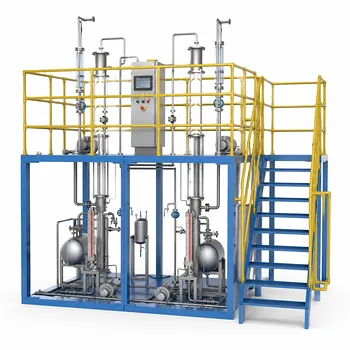
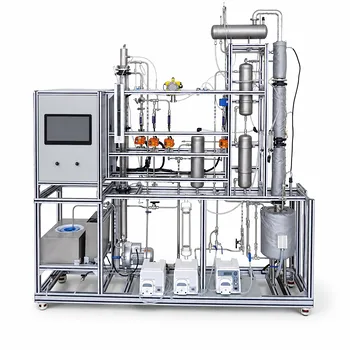
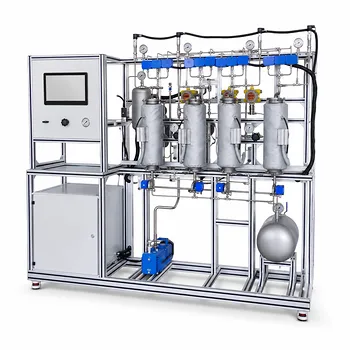
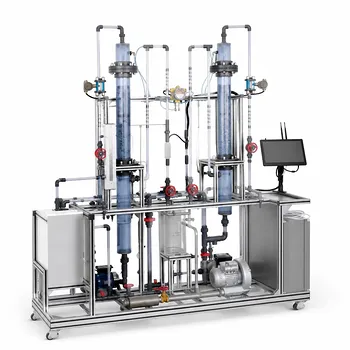
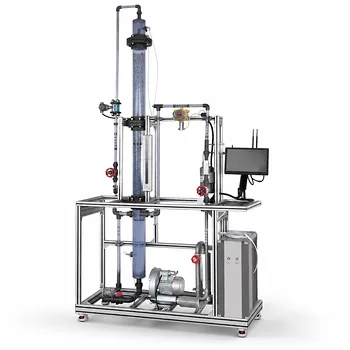
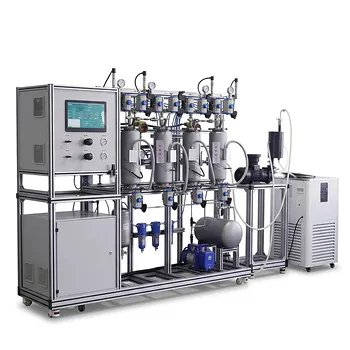
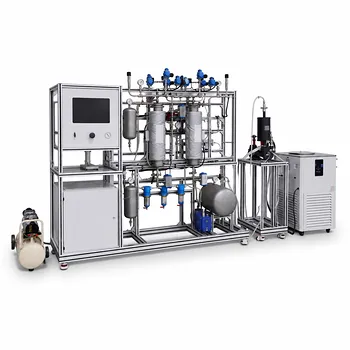
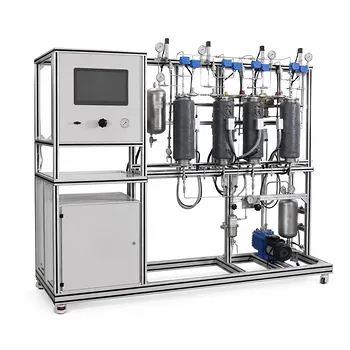
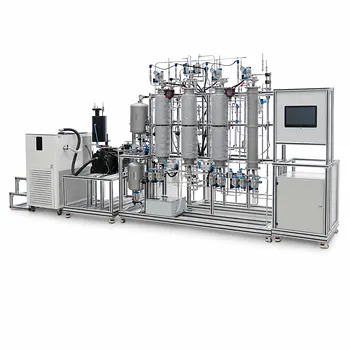
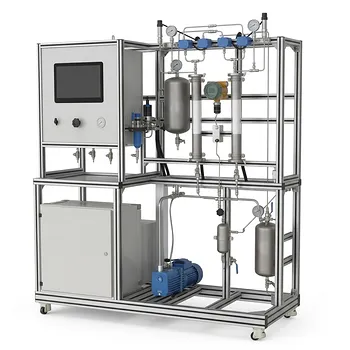
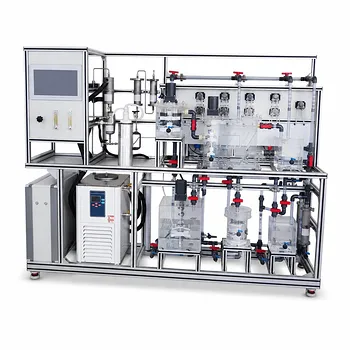
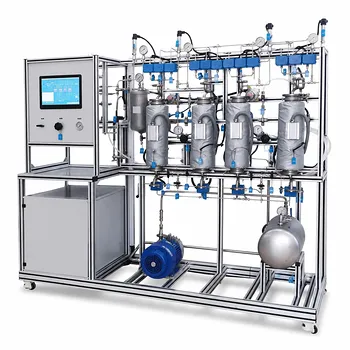
The van der Waals constants $a$ and $b$ profoundly impact pilot plant engineering by dictating how far a gas deviates from ideality, and thus what hardware, safety margins, and modeling depth you need. In gas absorption and reactor pilot plants, high‑$a$ gases like CO₂ demand meticulous temperature and pressure control to avert unwanted condensation, while low‑$a$, low‑$b$ gases such as hydrogen force you to rethink containment, sealing, and compressor selection from the ground up.
Getting $a$ and $b$ right is not an academic exercise—it is a direct path to sizing columns, selecting compressors, and setting safety interlocks. Overlooking these two numbers can lead to hydrate plugging, solvent loss, or dangerous pressure excursions in a pilot plant.
What the Constants Actually Mean for Your Gas
The pair of van der Waals constants describes the two physical traits that separate real gases from ideal ones.
$a$ – The Intermolecular Glue
- $a$ measures cohesive strength between gas molecules.
- A high $a$ value (e.g., CO₂ at 365.8 dm⁶·kPa·mol⁻²) means the gas wants to stick together, giving it a high boiling point and a strong tendency to condense.
- In a pilot plant, this behavior translates directly into thermal management: if you let the temperature drift too low or pressure climb too high, you will form liquid where you intended to have vapor—corroding equipment, upsetting mass balances, and destroying absorption efficiency.
$b$ – The Molecular Footprint
- $b$ accounts for the excluded volume of the molecules themselves; it is closely related to the liquid‑phase molar volume.
- Larger $b$ values indicate physically bigger molecules that cannot be compressed into arbitrarily small spaces.
- For process design, a gas with a large $b$ will diffuse more slowly and may require longer residence times in an absorber or reactor. It also tells you that the “available” volume for the gas is smaller than the vessel volume, a fact that influences pressure‑drop calculations and compressor sizing.
From Constants to Columns: Practical Design Implications
The influence of $a$ and $b$ moves from thermodynamics directly into the hardware decisions you make.
Thermal Management for Condensable, High‑$a$ Gases (CO₂, SO₂, NH₃)
- These gases deviate sharply from ideal behavior; small drops in temperature can push them across the saturation line.
- Column jackets, heat‑traced lines, and tight PID control loops become mandatory to keep the gas in the desired phase throughout the pilot unit.
- The Modified van der Waals (M‑VDW) equation demonstrates how easily conventional models fail: for water solubility in liquid CO₂, the Mark V equation can show errors of up to 840 %, while M‑VDW keeps errors under 20 %. Using an accurate equation of state directly prevents operational disasters like water dropout, unexpected hydrate formation, and separator under‑sizing.
Containment and Compression for Low‑$a$, Low‑$b$ Gases (H₂, He)
- Hydrogen and helium behave almost ideally, so you spend less time worrying about condensation. However, their small molecular size (reflected in a tiny $b$) means they leak through seals, gaskets, and even metal grain boundaries.
- Pilot‑scale rigs must use hard‑faced metal‑to‑metal connections, welded fittings, and high‑integrity pressure envelopes.
- Compressor selection also shifts: the low molecular weight demands high‑speed, multistage reciprocating or diaphragm compressors with special valve materials to handle the gas’s low viscosity and tendency to diffuse rapidly.
Sizing the Absorption Column
- For physical absorption, solubility of a solute gas rises with pressure and falls with temperature; for chemical absorption, reaction kinetics add heat management complexity. In both cases, the phase equilibrium constants fed into your simulation must come from an $a$, $b$‑aware EOS.
- A student or researcher comparing empirical plate counts to theoretical predictions will immediately see that using ideal‑gas assumptions for CO₂ leads to a gross overestimation of driving force and, consequently, an undersized column. Conversely, modeling H₂ with a complex EOS may add little accuracy while wasting computational effort—but the pilot plant still needs a column large enough to overcome its minuscule solubility.
Understanding the Trade‑offs
No single design approach fits all gases; the constants force you to make deliberate choices.
The Condensation‑vs.‑Absorption Tug‑of‑War
- For high‑$a$ gases, colder solvents improve solute solubility—yet too low a temperature invites condensation in the vapor space. The pilot plant must operate in a narrow window, often requiring a dedicated cascade chiller and line insulation that can be costly at research scale.
Over‑Engineering Near‑Ideal Systems
- When working with H₂, He, or CH₄, investing in exotic EOS algorithms and elaborate thermal jackets may add unnecessary capital and maintenance burden. The real risk is under‑estimating leakage, not phase separation. Spend the budget on leak‑tight construction and online gas detection instead.
The Hidden Hydrate Hazard
- For CO₂‑water systems, ignoring the $a$‑driven affinity for water can lead to solid hydrate formation at temperatures well above 0 °C. A pilot plant without accurate M‑VDW‑based safety margins can suffer plugged injection ports or burst pressure vessels overnight. This is not a rare edge case—it is a common failure in academic pilot labs.
Making the Right Choice for Your Pilot Plant Goal
Your ultimate focus determines where the $a$ and $b$ constants weigh most heavily.
- If your primary focus is physical absorption with condensable gases (CO₂, SO₂): Rigorously deploy accurate equation‑of‑state models like M‑VDW and build in precise temperature control to prevent phase separation and hydrate plugging.
- If your primary focus is handling light, low‑solubility gases (H₂, He): Prioritize high‑integrity sealing, bespoke low‑leakage compressors, and mass‑transfer correlations that account for the gas’s tiny molecular footprint.
- If your primary focus is an educational reactor or absorber: Design a flexible skid where students can toggle temperature and pressure setpoints and compare their measured phase data against different EOSs—this directly links theory to the $a$ and $b$ they learned in thermodynamics.
By letting the two van der Waals constants guide your material and operational choices, you turn a pilot plant from a pure hardware assembly into a faithful mirror of full‑scale process reality.
Summary Table:
| Gas Characteristic | Example Gases | Key Design Challenges | Recommended Hardware & Solutions |
|---|---|---|---|
| High $a$ (Strong Attraction) | $CO_2$, $SO_2$, $NH_3$ | Condensation, hydrate formation, phase equilibrium deviations | Jacketed columns, heat-traced lines, precise PID temperature control |
| Low $a$ & $b$ (Small Molecular Size) | $H_2$, $He$ | High leak potential, low solubility, diffusion through seals | Welded metal connections, high-integrity seals, diaphragm compressors |
Optimize Your Process Scale-Up with LABPARK
Translating thermodynamic theory into a reliable, physical system requires precision-engineered equipment. LABPARK provides state-of-the-art Educational and Vocational Unit Operations Pilot Plants in chemical engineering, bioprocess & biotech, and environmental & water treatment designed specifically for universities, research institutes, and enterprises.
Whether you need to teach students the fundamentals of real-gas deviations or scale up complex gas absorption and reactor processes, our systems deliver the accuracy, safety, and durability your projects demand.
Ready to elevate your research and training capabilities? Contact LABPARK today to consult with our engineering specialists!
Related Products
- Dual-Mode Gas Absorption and Desorption Unit Operations Training Pilot Plant
- Carbon Dioxide Absorption and Desorption Educational Pilot Plant for Carbon Capture Studies
- Carbon Dioxide Adsorption and Capture Educational Unit Operations Pilot Plant
- Absorption and Desorption Educational Unit Operations Pilot Plant
- Packed Bed Absorption Educational Unit Operations Pilot Plant
People Also Ask
- How do two-film & penetration theories apply to gas absorption pilot plant teaching? Key pedagogical insights.
- How is the direction and driving force of mass transfer determined in a gas absorption unit operations pilot plant?
- How does partial pressure behavior influence gas absorption pilot plants? Master Mass Transfer
- What are the limitations of Henry's Law in gas absorption pilot plants? Avoid critical lab errors.
- How to model chemical absorption as physical absorption? The pilot plant simplification criterion.