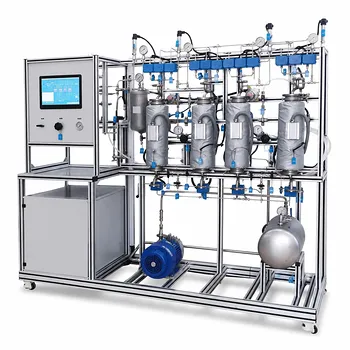
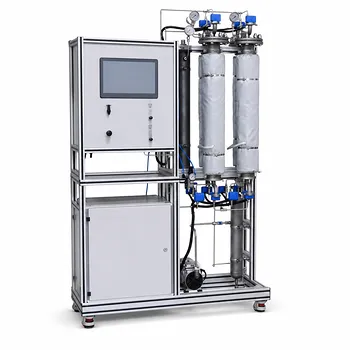
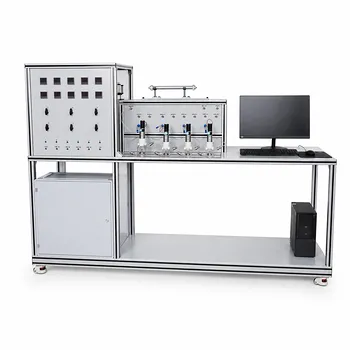
Larger specific surface area, enhanced wettability, and optimized geometry in column packing directly reduce the Height of a Transfer Unit (HTU). In a gas absorption pilot plant, the HTU—represented as $H_{OG}$ or $H_{OL}$—is inversely proportional to the volumetric mass transfer coefficient $K_Y a$. Since packing properties dictate both the overall mass transfer coefficient ($K_Y$) and the effective interfacial area per unit volume ($a$), packings that create more liquid surface contact, better liquid spreading, and higher gas-phase turbulence yield a smaller HTU. This means a shorter column can achieve the same absorption target, making packing selection the single most impactful equipment design choice for pilot-scale efficiency.
Core Insight: The Height of a Transfer Unit measures how “efficient” each meter of packing is. Packing properties directly control the available surface for mass transfer and how effectively that surface is used. A packing that wets easily, exposes a large geometric area, and holds a stable liquid film will always give a lower HTU—enabling compact, high-performance pilot columns. However, these gains must be balanced against increased pressure drop, and the fact that pilot-scale liquid distribution can behave very differently from industrial-scale units.
How Packing Properties Shape Mass Transfer Efficiency
The HTU formula $H_{OG} = \frac{V/\Omega}{K_Y a}$ makes the relationship clear: as $K_Y a$ increases, $H_{OG}$ decreases. This single number captures the overall resistance to mass transfer from the gas bulk to the liquid. Every property of the packing that improves either the coefficient $K_Y$ or the effective area $a$ will lower the HTU.
In a pilot plant, this turns packing selection into an experiment in process intensification—showing students and researchers how geometry and material science directly translate to column size and cost.
Specific Surface Area: The Foundation of Interfacial Contact
The nominal specific surface area ($a_p$, m²/m³) of a packing is the geometric area offered per unit bed volume. Smaller packing elements pack more surface into the same space.
- A 9.5 mm Raschig ring provides far more $a_p$ than a 50 mm ring, leading to a dramatically lower $H_G$ or $H_L$ under the same flow rates.
- This is because $K_Y a$ includes the effective interfacial area, $a$, which scales with the wetted fraction of $a_p$. With more geometry exposed, there are simply more sites for mass transfer to occur.
- However, the full geometric area is almost never fully utilized; it depends on liquid distribution and wettability.
Material Wettability and Liquid Spread
Even a high-surface-area packing fails if the liquid simply beads up and channels. The wetting characteristics of the material determine how much of that area becomes active.
- Hydrophilic materials (ceramic, glass, oxidized metal) spread aqueous solutions into thin films, maximizing $a$ and thus minimizing HTU.
- Hydrophobic surfaces can cause rivulet flow, drastically reducing $a$ and making the effective HTU much larger than the geometry alone would predict.
- In a pilot plant, swapping packings of identical shape but different substrate (e.g., stainless steel vs. polypropylene) demonstrates this immediately: the ceramic packing will often show a 20–40% lower $H_{OG}$ for water-based systems.
Packing Geometry: Turbulence, Mixing, and Stagnant Zones
Beyond surface area, the shape of the packing affects the gas-phase turbulence and the renewal of the liquid film.
- Modern structured packings (corrugated sheets) and random dumpings like Pall rings or Intalox saddles are designed with openings and ribs that break up liquid, create turbulent eddies in the gas, and prevent stagnant pockets.
- This turbulence directly increases the individual mass transfer coefficients ($k_G$ and $k_L$), which combine to form $K_Y$. The result is a further reduction in HTU beyond what surface area alone would provide.
- Even among dump packings, empirical correlations show that constants $\alpha, \beta, \gamma$ in $H_G = \alpha G^\beta W^\gamma (Sc_G)^{0.5}$ differ by 30% or more between Berl saddles and Raschig rings of the same nominal size—due entirely to flow pattern differences.
Understanding the Trade-offs: Why Smaller HTU Isn’t Always Better
While packing properties that lower HTU are desirable for reducing column height, they come with important operational and scaling trade-offs that any pilot-plant study must grapple with.
Pressure Drop and Flooding Limits
Higher surface area and tighter packing geometries increase frictional resistance to gas flow.
- A packing that cuts $H_{OG}$ by half may double or triple the pressure drop per meter, which can be unacceptable for low-pressure absorption processes or blower-limited pilot setups.
- Smaller packings also reach flooding at lower gas/liquid loads, limiting the throughput of the column. The operator must balance mass-transfer efficiency against hydraulic capacity.
Liquid Distribution and Wall Effects
The HTU is not a pure material constant; it is strongly influenced by how liquid is introduced and redistributed.
- At pilot scale (diameters often under 100 mm), wall flow can become severe: liquid clings to the column wall, bypassing the packing core entirely. This drastically reduces effective area $a$ and raises the observed HTU, even if the packing itself is highly efficient.
- A packing that performs beautifully in a lab test with perfect initial distribution can appear mediocre if the liquid distributer is poor or the column diameter-to-packing-size ratio is too small.
- This highlights why pilot-scale HTU data must be treated with caution: extrapolation to industrial diameters requires accounting for dramatically different distribution patterns.
The Pilot-Scale Paradox
Small columns exaggerate certain effects that diminish in large towers.
- Wall effects, end effects, and axial back-mixing can cause the measured HTU to be lower or higher than the true value for the packing alone.
- Because of this, researchers should test multiple packing heights and use repeatable, calibrated distributers when generating design data. The packing's surface properties still dominate, but the equipment's configuration can mask or amplify those effects.
Making the Right Choice for Your Pilot Plant Goal
Your objective determines which packing property trade-off you should prioritize. Use these guidelines to design meaningful experiments or teaching modules:
- If your primary focus is demonstrating the maximum process intensification: Select the smallest, most highly wetted structured packing or high-surface-area ceramic random packing available. Accept the higher pressure drop to showcase the lowest attainable HTU.
- If your primary focus is studying scale-up behavior and industrial relevance: Use a moderate surface area packing (e.g., 25 mm Pall rings) that avoids extreme wall effects and yields HTU values closer to what large towers would produce.
- If your primary focus is exploring material-wettability effects: Run side-by-side trials with chemically identical shape packing in metallic, ceramic, and plastic materials. The resulting HTU differences will make the impact of liquid spread tangible and quantifiable.
- If your primary focus is fundamentals of mass transfer correlations: Choose a classic dump packing like Raschig rings and vary size systematically. This isolates the geometric parameter $\alpha$ in empirical relations and gives students a clear lab-to-theory link.
Ultimately, the packing’s surface area, wettability, and geometry govern HTU by controlling the volumetric mass transfer coefficient $K_Y a$. Exploit these properties in your pilot plant to dissect the separation problem, but always record the operating conditions and column configuration—without them, the “HTU” you measure is a system property, not a packing property. Use that awareness to turn every pilot run into a lesson on true engineering performance.
Summary Table:
| Packing Property | Impact on HTU | Key Advantage | Operational Trade-off |
|---|---|---|---|
| Large Specific Surface Area | Decreases HTU | Maximizes gas-liquid contact area | Higher pressure drop; lower flooding limits |
| High Wettability | Decreases HTU | Prevents liquid channeling and dry spots | Dependent on material cost and chemical compatibility |
| Optimized Geometry | Decreases HTU | Enhances gas-phase turbulence and liquid renewal | Increased structural complexity; harder to clean |
Enhance Your Engineering Curriculum and Research with LABPARK
Are you looking to demonstrate core mass transfer principles with precision? LABPARK provides state-of-the-art Educational and Vocational Unit Operations Pilot Plants in chemical engineering, bioprocess & biotech, and environmental & water treatment. Designed specifically for universities, research institutes, and enterprises, our pilot plants help students and researchers bridge the gap between theory and industrial practice.
Ready to upgrade your laboratory capabilities? Contact LABPARK today to explore our customizable pilot plant solutions!
Related Products
- Dual-Mode Gas Absorption and Desorption Unit Operations Training Pilot Plant
- Carbon Dioxide Absorption and Desorption Educational Pilot Plant for Carbon Capture Studies
- Carbon Dioxide Adsorption and Capture Educational Unit Operations Pilot Plant
- Absorption and Desorption Educational Unit Operations Pilot Plant
- Packed Bed Absorption Educational Unit Operations Pilot Plant
People Also Ask
- How do two-film & penetration theories apply to gas absorption pilot plant teaching? Key pedagogical insights.
- How does partial pressure behavior influence gas absorption pilot plants? Master Mass Transfer
- How is the direction and driving force of mass transfer determined in a gas absorption unit operations pilot plant?
- What are the limitations of Henry's Law in gas absorption pilot plants? Avoid critical lab errors.
- Why does increasing flow fail to enhance absorption in fast chemical reactions? Pilot Plant Insights