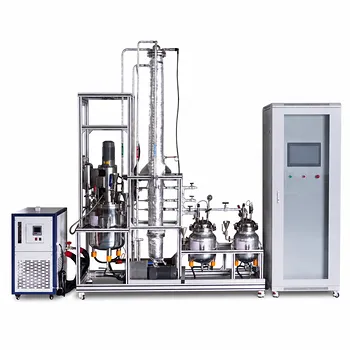
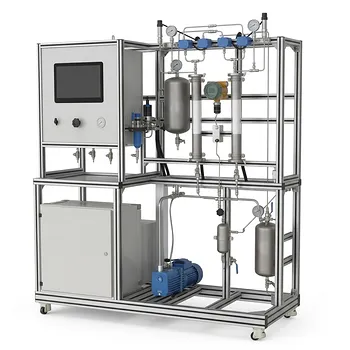
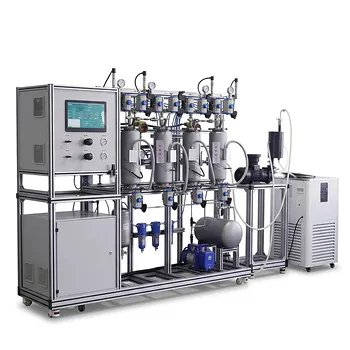
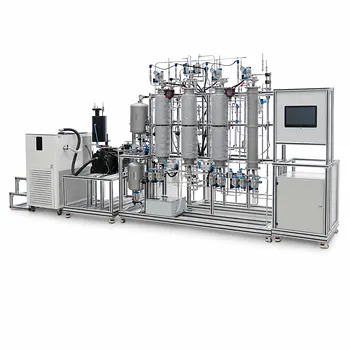
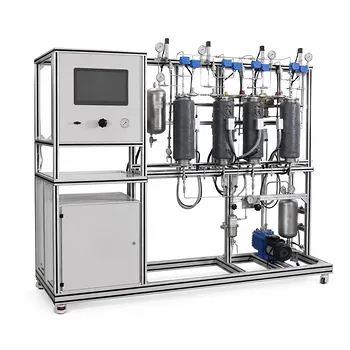
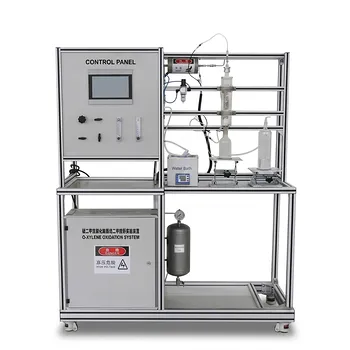
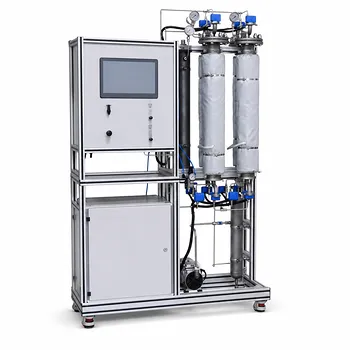
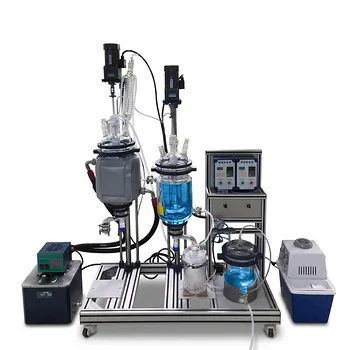
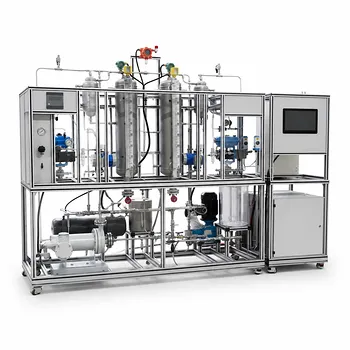
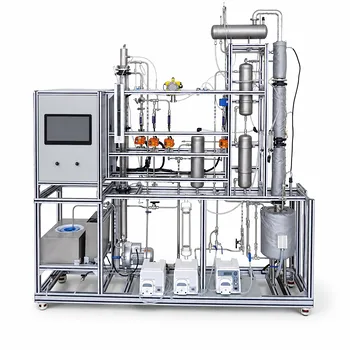
Perovskite membrane pilot plants are not simple scale-ups; they are high-temperature precision instruments.
Testing perovskite-type oxide membranes for air separation demands a pilot plant engineered around two non‑negotiable realities: an absolute requirement for sustained, uniform temperatures in the 800 K to 1200 K range, and the counter‑intuitive behavior that flux does not scale linearly with thickness once the membrane becomes thin. Because these materials conduct oxygen via thermally activated lattice vacancies, the plant must integrate advanced furnaces, precise thermal controls, and heat exchangers. For thin membranes (below ~0.3 mm), surface reactions become rate‑limiting, so the gas‑control and analytical systems must be capable of isolating bulk diffusion from surface kinetics. In short, the design is driven by the need to study flux under extreme thermal conditions while deconvoluting transport resistances.
The central design challenge is twofold: first, creating a stable high‑temperature environment that turns on oxygen‑ion conduction; second, building a measurement platform that accurately resolves the non‑linear flux‑thickness relationship caused by surface reactions. A perovskite air‑separation pilot plant is therefore a kinetic and thermal testbed, not just a filtration rig.
The Thermal Imperative: Why the Plant Must Have a Hot Core
Perovskite Membranes Run on Thermally Activated Vacancies
Perovskite‑type oxides are mixed ionic‑electronic conductors that transport oxygen exclusively via lattice vacancy diffusion. This mechanism is strongly temperature‑dependent. Measurable oxygen flux typically requires temperatures between 800 K and 1200 K, where the mobility of oxygen vacancies becomes high enough to support practical permeation rates. Without that thermal energy, the membrane remains essentially impermeable.
Designing the Thermal Envelope
Because the membrane’s performance emerges only in a narrow high‑temperature window, the pilot plant must include integrated high‑temperature furnaces capable of maintaining setpoints with minimal drift. Precise multi‑zone thermal control is essential to avoid cold spots that would choke flux and to map the Arrhenius‑like temperature dependence of permeation. Heat exchangers for pre‑heating feed and sweep gases are also mandatory, preventing thermal shock and ensuring that the entire membrane area operates at the target temperature. The furnace and thermal management system are not add‑ons—they define the reactor’s identity.
Thickness Matters, But Not With a Simple Inverse Rule
The Classical Linear Resistance Model Fails at Scale
In conventional membrane science, thicker layers simply add diffusion resistance, and flux is inversely proportional to thickness. While this fundamental relationship holds for bulk diffusion in perovskites, pilot‑plant design cannot rely on this simple proportionality alone.
When Surfaces Take Over: The Sub‑0.3 mm Regime
For perovskite membranes thinner than about 0.3 mm, surface reactions become rate‑limiting. Oxygen molecules must adsorb, dissociate, and incorporate into the lattice at the surface – steps that can proceed slower than bulk vacancy diffusion in a very thin film. As a result, total oxygen flux no longer scales with 1/thickness; it plateaus or increases only modestly. The pilot plant must be able to detect and analyze this transition.
Consequences for Gas Control and Analytical Systems
Because surface kinetics and bulk diffusion interact, the pilot plant needs a flexible gas handling system. Mass flow controllers for both feed air and sweep gas (often argon or helium) must support a wide range of flow rates to vary the driving force and decouple external boundary‑layer effects. The analytical suite must include sensitive oxygen detectors—typically a zirconia‑based oxygen sensor or mass spectrometer—to measure small changes in oxygen partial pressure with high accuracy. Moreover, the plant should allow gas flow configurations that isolate the different resistances, for example by testing a series of membranes of different thicknesses under identical temperature and flow conditions. This turns the pilot plant into a kinetic diagnostic tool, not just a flux measurement device.
Understanding the Trade‑offs
Engineering a perovskite membrane pilot plant involves balancing several competing factors:
- Temperature vs. stability: Higher temperatures boost flux but accelerate material degradation (cation segregation, phase decomposition) and increase energy consumption. The plant must accommodate long‑duration stability tests with thermal cycling, meaning seals and structural materials must tolerate these extremes without leaking.
- Thinness vs. mechanical integrity: Reducing thickness to raise bulk flux makes the membrane fragile. Practical implementations almost always use a thin dense layer on a porous support, mimicking asymmetric designs. The pilot plant must therefore test supported configurations and evaluate adhesion and crack resistance under operating conditions.
- Flux magnitude vs. measurement accuracy: With ultra‑thin membranes, high fluxes can overwhelm measurement systems; with thick ones, low fluxes may fall below noise levels. A successful pilot plant requires a dynamic‑range‑capable sensor setup and careful calibration to accurately capture data across the entire thickness range of interest.
- Kinetic study complexity: Deconvoluting surface and bulk contributions demands extra design effort—multiple sample ports, the ability to vary sweep‑side oxygen partial pressure independently, and often post‑mortem surface analysis. These capabilities add cost and complexity but are indispensable for a research‑grade pilot plant.
Applying These Principles to Real-World Design
The membrane reactor module itself reflects these intertwined requirements. A typical design uses a quartz or dense‑ceramic tube housed inside a tube furnace, with the membrane sealed using high‑temperature gaskets (e.g., gold O‑rings). Feed air flows on one side, while an inert sweep gas carries permeated oxygen to the sensor. Thermocouples directly monitor the membrane’s temperature. The entire system is built to allow rapid exchange of membrane samples with different thicknesses, enabling systematic studies that would be impossible in a scaled‑up production unit. The focus remains squarely on generating high‑quality kinetic data that can validate transport models and guide industrial design.
Making the Right Choice for Your Pilot Plant Goal
The final configuration of a perovskite membrane pilot plant should align with the specific questions you need to answer. Use these goal‑oriented recommendations to steer your design:
- If your primary focus is investigating surface reaction mechanisms: Equip the plant with precise mass flow controllers, an online oxygen analyzer with high temporal resolution, and the ability to test membranes of at least three different thicknesses simultaneously or sequentially. Include provisions for altering sweep‑side oxygen partial pressure to titrate surface kinetics.
- If your primary focus is demonstrating long‑term operational stability: Design the furnace and thermal management for minimal temperature drift over months, implement robust sealing technologies that survive thermal cycling, and integrate a data‑acquisition system that continuously logs flux and temperature to detect early signs of degradation.
- If your primary focus is scaling up process economics: Incorporate heat exchangers to recover energy, study the flux‑temperature trade‑off across the full 800–1200 K range, and test asymmetric membrane geometries that maximize flux per unit area while retaining mechanical reliability.
- If your primary focus is educational or fundamental research: Build a modular, transparent setup where students can vary temperature, thickness, and flow conditions rapidly, and include simple analytical models in the software so that the link between vacancy diffusion, surface exchange, and measured flux becomes directly visible.
A perovskite oxide membrane pilot plant is, at its heart, a controlled‑atmosphere kinetics laboratory that happens to perform air separation—design it accordingly.
Summary Table:
| Design Parameter | Impact on Perovskite Membrane | Pilot Plant Engineering Requirements |
|---|---|---|
| High Temperature (800 K – 1200 K) | Activates oxygen vacancy diffusion to enable permeation. | Multi-zone furnace, gas pre-heaters, thermal shock prevention, high-temp seals (e.g., gold O-rings). |
| Membrane Thickness (< 0.3 mm) | Surface reaction kinetics become rate-limiting (non-linear flux scaling). | Mass flow controllers (MFCs), high-sensitivity oxygen sensors, adjustable sweep gas flow. |
| Mechanical Integrity | Thin membranes are highly fragile and require porous supports. | Modules optimized for asymmetric geometries, dynamic pressure control, and thermal cycling durability. |
Optimize Your Membrane Research with LABPARK
Are you looking to advance your research in high-temperature gas separation or upgrade your chemical engineering laboratories?
LABPARK provides state-of-the-art Educational and Vocational Unit Operations Pilot Plants in chemical engineering, bioprocess & biotech, and environmental & water treatment. Designed specifically for universities, research institutes, and enterprises, our custom-engineered systems deliver the precise thermal management, mass-flow control, and analytical sensitivity required for advanced membrane kinetics testing.
Contact LABPARK today to build your custom pilot plant solution!
Related Products
- Ultrafiltration Membrane Separation Educational Pilot Plant
- Multifunctional Membrane Separation Educational Pilot Plant with Ultrafiltration, Nanofiltration, Reverse Osmosis
- Multi-Functional Membrane Separation Educational Pilot Plant for Unit Operations Lab
- Photocatalytic Membrane Separation and Degradation Unit Operations Pilot Plant
- Hollow Fiber Ultrafiltration Membrane Separation Educational Pilot Plant
People Also Ask
- Pervaporation vs. Vapor Permeation: Handling Suspended Solids in Membrane Pilot Plants
- How do PEI, PVDF, and PSU membranes compare in pilot plants? Find the best fit.
- How do membrane pilot plants demonstrate synthetic vs biological membrane advantages?
- Why Use a Membrane Separation Pilot Plant vs. Lab Testing? Avoid Costly Scale-Up Failures
- Isotropic vs. Anisotropic Membranes: How to Choose the Best Pilot Plant Modules