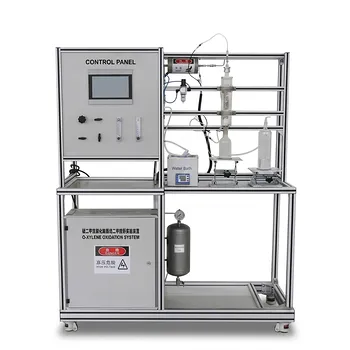
While both processes produce hydrogen, glycerol APR operates in the liquid phase at a mild 470–550 K, whereas ethanol steam reforming is a gas-phase reaction demanding 870–1200 K. This fundamental difference in phase behavior dictates the entire reactor design: APR requires a pressurized liquid system to keep water from boiling, while ethanol reforming needs a high-temperature vaporizer and gas-phase reactor. A single pilot plant must therefore combine liquid-phase pressurized components with a gas-phase high-temperature section to accommodate both chemistries.
Glycerol APR’s liquid-phase, low-temperature operation reduces energy input and kinetically suppresses coke formation, but it forces the pilot plant to maintain water in the liquid state under pressure—a stark contrast to the vapor-phase nature of ethanol steam reforming. A truly flexible unit operations pilot plant must integrate a pressurized liquid reactor loop with a gas-phase high-temperature train, allowing researchers to switch between the two modes safely and efficiently.
How Reaction Conditions and Phase Behavior Differ
The core of the difference lies in how you present the reactants and what state they are in during catalysis.
Temperature: Mild Liquid vs. Intense Gas
Glycerol aqueous phase reforming takes place at 470–550 K—temperatures at which water can remain liquid under modest pressure. This is intentionally mild to kinetically restrain unwanted side reactions such as methanation and excessive C–C cleavage.
Ethanol steam reforming operates at 870–1200 K, deep into the gas phase. This high heat input is required because ethanol is more stable than glycerol, and the steam reforming reaction is highly endothermic. The result is a gas-phase process where all species—ethanol, water, hydrogen, CO—are in the vapor state.
Pressure: Keeping Water Liquid vs. Atmospheric Vapor
In APR, the reactor must be kept at elevated pressure (typically 20–50 bar) to suppress boiling of the aqueous glycerol solution. Pressure control is not optional; it directly determines whether the reaction stays in the liquid phase.
Ethanol steam reforming is usually conducted at or near atmospheric pressure. Since both reactants are already vaporized, high pressure is unnecessary and would only shift equilibrium unfavorably, reducing hydrogen yield.
Reaction Pathways and By-product Profiles
APR’s liquid water participates directly in the water-gas shift reaction, rapidly converting CO into CO₂ and additional H₂. This produces a hydrogen-enriched stream with low CO, ideal for fuel cells after simple polishing.
Ethanol steam reforming at high temperatures tends to produce significant CO and methane as by-products, along with coke deposits that deactivate catalysts. The gas-phase environment makes it harder to drive the water-gas shift to completion, and the high temperatures accelerate thermal cracking, forming carbon on the catalyst surface.
Essential Pilot Plant Design Features
A unit operations pilot plant built to demonstrate both processes must fuse two distinct subsystems into one flexible platform.
Reactor Configuration and Materials
For APR mode, the pilot plant needs a fixed-bed or tubular reactor rated for liquid-full operation up to 550 K and at least 50 bar. A back-pressure regulator downstream keeps the reactor pressurized. The reactor material must withstand hot, pressurized aqueous mixtures—stainless steel (316L) or Hastelloy is typical.
For ethanol steam reforming mode, the pilot plant must include a high-temperature gas-phase reactor tube (often quartz or high-alloy steel) housed inside a tubular furnace with robust thermal insulation. The reactor and downstream lines must endure 900–1200 K, requiring materials like Inconel or ceramic-lined components to prevent oxidation and creep.
Feed Handling: Liquid Pump vs. Vaporizer
APR relies on a high-pressure liquid feed pump (HPLC-type or syringe pump) to deliver a precise glycerol/water mixture into the pressurized reactor. No vaporization is needed; the feed enters as a single liquid phase.
Ethanol reforming requires a vaporizer/pre-heater assembly. An ethanol/water liquid mixture is first pumped at low pressure, then fully vaporized in a heated zone before entering the reactor. Mass flow controllers for gases might also be needed if co-fed with inert carriers or air for catalyst activation.
Product Separation and Analysis
After the APR reactor, a gas-liquid separator (cooled knock-out pot) condenses water and unconverted glycerol, while the hydrogen-rich gas stream exits overhead for analysis or collection. The system must handle two-phase flow and prevent pressure surges that could disturb the liquid-level control.
For ethanol steam reforming, the entire product stream is gaseous. A simple condenser can knock out residual water, but the gas analysis (GC or MS) is more straightforward. The pilot plant should have valved sampling ports that can be switched between a liquid quench system (APR) and a dry gas line (steam reforming).
Integrated Control and Safety
A dual-mode pilot plant must include:
- Precise pressure control valves on the APR loop to maintain liquid-phase conditions.
- High-temperature limit switches and insulation on the steam reforming reactor to protect operators.
- Adjustable gas flow controllers allowing for purge, reduction, or co-feed.
- Interchangeable catalyst beds, since APR typically uses supported Pt or Ni catalysts, while ethanol steam reforming often uses Ni or noble metals with different supports optimized for high-temperature stability.
Understanding the Trade-offs
Designing for both chemistries in one skid forces compromise.
- Cost and complexity increase. You need a pressure-rated liquid reactor and a high-temperature furnace, plus dual feed systems. A single-reactor vessel that can be swapped between modes is possible but requires careful thermal management.
- Catalyst versatility is limited. APR catalysts often sinter or leach at ethanol steam reforming temperatures, so separate catalyst tubes or quick-change internals are necessary.
- Safety interlocks must cover two hazard profiles. High pressure (APR) and high temperature (ethanol SR) demand overlapping but distinct safeguards, making the control system more intricate.
Yet the payoff is significant: students and researchers can directly compare energy efficiency, hydrogen selectivity, and catalyst deactivation under fundamentally different regimes on a single platform.
Making the Right Choice for Your Pilot Plant
Your design priorities depend on the primary educational or research goal.
- If your primary focus is teaching biofuel valorization with safe, lower-energy operation: Opt for a glycerol APR system. Emphasize the liquid-phase pressurized reactor, the gas-liquid separator, and the lower temperature operation that minimizes coking and demonstrates waste-to-hydrogen concepts effectively.
- If your primary focus is showcasing traditional industrial hydrogen production from alcohols: Build a high-temperature ethanol steam reforming rig. The vaporizer, furnace, and insulation will dominate; the higher temperatures will illustrate the challenges of endothermic reforming and catalyst coking.
- If your goal is a flexible research platform for side-by-side comparisons: Integrate both modes. Use a common high-pressure liquid feed pump, then branch to either a pressurized liquid reactor (APR) or a vaporizer + high-temperature reactor (ethanol SR), with a single product analysis train. Accept the added complexity to give researchers a powerful tool for exploring the full spectrum of oxygenate reforming.
The best pilot plant design mirrors the core insight: glycerol APR’s liquid-phase, low-temperature nature fundamentally alters the energy and hardware landscape compared to gas-phase ethanol reforming—and a well-engineered system lets you experience that contrast firsthand.
Summary Table:
| Feature | Glycerol Aqueous Phase Reforming (APR) | Ethanol Steam Reforming |
|---|---|---|
| Reaction Phase | Liquid phase | Gas phase |
| Temperature | 470–550 K (Mild) | 870–1200 K (High) |
| Operating Pressure | 20–50 bar (Elevated to prevent boiling) | Atmospheric (~1 bar) |
| Reactor Material | Stainless Steel (316L) / Hastelloy | Inconel / Ceramic-lined steel |
| Feed System | High-pressure liquid pump | Vaporizer & pre-heater assembly |
| Main By-products | CO₂ (Low CO, high H₂ purity) | CO, CH₄, and catalyst coke |
Upgrade Your Lab with Custom Reforming Pilot Plants
Whether you are studying liquid-phase glycerol APR or high-temperature ethanol steam reforming, LABPARK provides state-of-the-art Educational and Vocational Unit Operations Pilot Plants in chemical engineering, bioprocess & biotech, and environmental & water treatment.
Designed specifically for universities, research institutes, and enterprises, our flexible systems allow researchers and students to safely compare reforming pathways, optimize catalytic performance, and scale up green hydrogen technologies.
Ready to enhance your research and training capabilities? Contact LABPARK today to customize your pilot plant.
Related Products
- Fixed Bed Gas Solid Catalytic Reaction Educational Pilot Plant
- Micro-Scale Gas-Solid Catalytic Reaction Educational Pilot Plant
- Internal Circulation Gradient Free Catalytic Reaction Educational Pilot Plant
- Fluidized Bed Gas Solid Catalytic Reaction Educational Pilot Plant
- Multi Functional Catalytic Reaction and Reactor Evaluation Educational Unit Operations Pilot Plant
People Also Ask
- How do reactor pilot plants safely study gas-solid reactions? Master kinetics with thermal & flow control.
- How does the Mears criterion evaluate transport resistance? Key Guide to Intrinsic Kinetics
- Fluidized vs. Fixed Bed Reactors: Comparing Heat & Complexity in Pilot Plants
- Why is a multibed configuration necessary for exothermic reactions? Optimize your pilot plant trajectory.
- How is the friction factor determined for fixed-bed pilot plants? Select the best pressure drop correlation.