Knowledge Chemical Engineering Education How do wavelength & power influence photochemical operations? Optimize selectivity & conversion
Author avatar

Tech Team · LABPARK

Updated 1 month ago

How do wavelength & power influence photochemical operations? Optimize selectivity & conversion


Spectral match and power output are not competing features—they're co-dependent dials that directly control how much of your reactants become desired product and how fast that happens. A radiation source with an emission spectrum that perfectly overlaps the reactant's absorption band drives highly selective excited-state chemistry, often achieving superior conversion per photon even at lower total wattage. Meanwhile, the total photon flux (power output) sets the reactor's throughput ceiling, dictating how long a reactor needs to be and how much material it can process while still hitting target exit conversions.

The core insight: Wavelength quality determines the efficiency of each photon—maximizing product selectivity and conversion per absorbed photon—while power output governs the capacity of the reactor, enabling the residence time required to reach a desired overall conversion. Optimizing a photochemical unit means matching the source's spectrum to the reaction's absorption, then supplying enough total power to make that efficiency work at production scale.

The Two Levers That Define Photochemical Performance

A photochemical reaction is a photon-limited process. Every molecule that transforms must first absorb a photon of the right energy. The radiation source therefore provides two independent but equally critical performance levers.

Wavelength Quality Dictates Photon Efficiency

The first lever is the spectral distribution of the emitted light. Photons are only useful if they can be absorbed by the reactant.

A source whose output tightly overlaps the reactant's absorption band—like a black-light lamp matched to a chlorine absorption profile—converts electrical power into chemically useful photons with minimal waste. Because the light is absorbed efficiently, almost every photon initiates the intended photochemical pathway.

This direct absorption drives higher product selectivity. Off-target reactions, which often require different activation energies or compete through thermal pathways, are suppressed when the system is populated exclusively with the right excited state.

Power Output Governs Reactor Throughput

The second lever is the total photon flux, or power output. Even a perfectly matched source will fail at scale if it cannot deliver enough photons to treat the flowing stream.

Higher total power allows the reactor to be physically longer or to operate at higher flow rates. A longer reactor provides greater mean residence time, which directly translates to higher single-pass conversion at the same throughput.

When a pilot plant must meet a specific exit conversion target, power output is the variable that turns a lab-scale observation into a production reality. Without adequate flux, the reactor simply cannot process enough material in the available time.

Understanding the Trade-offs

A common mistake is to treat higher wattage as a universal upgrade. It isn't. The relationship between wavelength quality and power output is full of hidden pitfalls.

High Power with Poor Spectral Match Wastes Energy

A high-power lamp with a broad or misaligned spectrum floods the reactor with photons the reactant cannot use. These unused photons may be absorbed by solvent, reactor walls, or byproducts, causing unnecessary heating and triggering thermal side reactions that erode selectivity.

In this scenario, the plant pays the full energy cost of the high-power source but gets no conversion benefit. Worse, it may actively degrade product quality through uncontrolled thermal chemistry.

A Perfect Match Can't Compensate for Insufficient Flux

Conversely, a spectrally ideal low-power source will yield excellent selectivity per converted molecule, but the overall conversion per pass may be too low to meet downstream requirements. The operator might be forced to recycle unreacted feed, increasing separation costs, or to accept a product stream that falls short of purity specifications.

The optimal design finds the intersection: a source whose spectral output aligns with the absorption peak, and whose total power provides the photon budget needed to reach target conversion at the desired flow rate.

Making the Right Choice for Your Goal

Your choice of radiation source must be driven by the specific performance metric that matters most to your operation. Use the following priorities to guide your evaluation.

  • If your primary focus is maximizing product selectivity: Prioritize spectral match above all else. Select a narrow-band source that exclusively populates the desired excited state, and accept a lower total power if necessary to avoid side reactions.
  • If your primary focus is achieving a high single-pass conversion with a compact reactor: First secure a spectrally compatible source, then scale up its total power output to drive the required conversion within your residence time limits.
  • If your primary focus is overall production throughput: Balance the two levers. Start with a pilot-scale assessment of the reactant absorption spectrum, then specify a source with both the spectral fit and the power capacity to sustain your target flow rate and exit conversion.

A photochemical unit's success is measured not by the power it consumes, but by how intelligently that power matches the chemistry's demands. Align the photon's energy to the reaction's need first, then let the power output handle the scale.

Summary Table:

Parameter Primary Influence Impact of Optimization Risk of Imbalance
Wavelength Quality Product Selectivity & Photon Efficiency Maximizes desired product; minimizes side reactions Wasted energy, heat generation, thermal side reactions
Power Output (Flux) Reactor Throughput & Conversion Achieves target conversion rate at scale Low conversion per pass, high recycle costs

Ready to scale up your photochemical processes and optimize reactor design? LABPARK provides premium Educational and Vocational Unit Operations Pilot Plants in chemical engineering, bioprocess & biotech, and environmental & water treatment. We help universities, research institutes, and enterprises bridge the gap between lab-scale chemistry and industrial production. Contact our experts today to find the perfect pilot plant solution for your institution!

Related Products

People Also Ask

Related Products

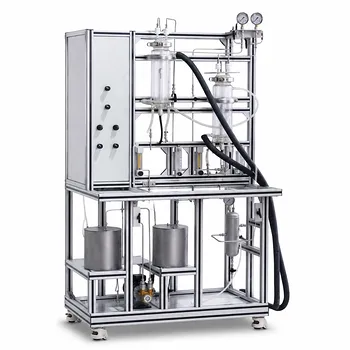
Photocatalytic Membrane Separation and Degradation Unit Operations Pilot Plant

Photocatalytic Membrane Separation and Degradation Unit Operations Pilot Plant

Bench-scale pilot plant integrating photocatalytic degradation with membrane separation for engineering education. Study advanced oxidation, microfiltration, and hybrid processes using industrial sensors. Features safety light-blocking curtain, low-noise compressor, and durable stainless-steel construction.

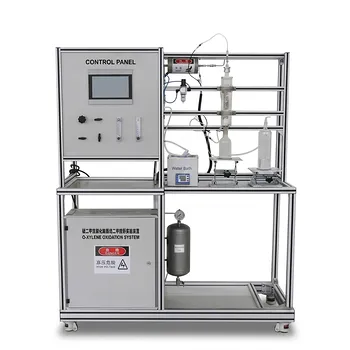
O-Xylene Oxidation to Phthalic Anhydride Educational Unit Operations Pilot Plant

O-Xylene Oxidation to Phthalic Anhydride Educational Unit Operations Pilot Plant

Explore our bench-scale educational pilot plant for o-xylene oxidation to phthalic anhydride, featuring a fixed-bed tubular reactor with visual observation, precise temperature control, and safety systems, ideal for chemical engineering hands-on training and industrial simulation, designed for university unit operations.

Rising and Falling Film Evaporation Educational Unit Operations Pilot Plant

Rising and Falling Film Evaporation Educational Unit Operations Pilot Plant

Hands-on educational pilot plant for studying rising and falling film evaporation, flow regimes, and heat transfer. Customizable for university labs with industrial instrumentation and data acquisition. Enables comparative evaluation of evaporation modes and energy efficiency.

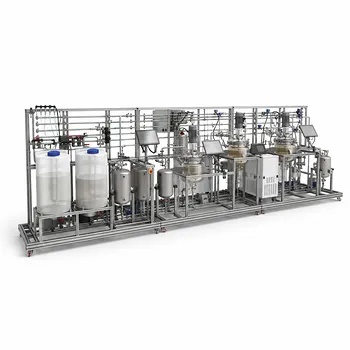
General Purpose Cosmetics Production Unit Operations Training Pilot Plant

General Purpose Cosmetics Production Unit Operations Training Pilot Plant

Integrated pilot-scale cosmetics production training plant for chemical engineering education featuring utility supply emulsification blending and filtration modules with dual touchscreen manual control customizable mobile design ideal for practical hands-on unit operations and advanced process control learning.

Educational Unit Operations Pilot Plant for Intraparticle Diffusion Effective Factor Measurement

Educational Unit Operations Pilot Plant for Intraparticle Diffusion Effective Factor Measurement

Designed for chemical engineering university labs, this pilot plant allows hands-on determination of catalyst particle intraparticle diffusion effective factors and gas-solid reaction kinetics using a fixed-bed tubular reactor with industrial touchscreen control, bridging theory and practical reactor design.

Fixed-Bed Chemical Reaction and Gas Dust Tar Removal Unit Operations Pilot Plant

Fixed-Bed Chemical Reaction and Gas Dust Tar Removal Unit Operations Pilot Plant

Integrated educational pilot plant for studying catalytic gas-solid reactions and downstream gas purification. Features dual fixed-bed reactor, three-stage heating, and touchscreen control for hands-on engineering training. Ideal for chemical and environmental engineering curricula.

Multi-Modal Distillation Unit Operations Training Pilot Plant

Multi-Modal Distillation Unit Operations Training Pilot Plant

Multi-modal distillation pilot plant for practical unit operations training in chemical engineering education. Features real, analog, and semi-physical simulation modes, industrial construction, customizable for university labs. Hands-on fractionation columns, SCADA control, safety systems. Includes sight glasses, sampling ports, closed-loop recycling.

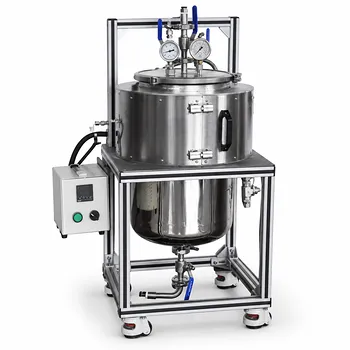
Hot Filtration Educational Unit Operations Pilot Plant Laboratory System

Hot Filtration Educational Unit Operations Pilot Plant Laboratory System

This integrated laboratory bench-scale hot filtration pilot plant enables students to study solid-liquid separation under thermal conditions, featuring a stainless steel vessel, removable heating jacket, and multi-layer filter plates for unit operations education, ideal for chemical engineering laboratory curriculum.

Multi-Functional Membrane Separation Educational Pilot Plant for Unit Operations Lab

Multi-Functional Membrane Separation Educational Pilot Plant for Unit Operations Lab

The Multi-functional Membrane Separation Educational Unit Operations Pilot Plant is an integrated bench-scale laboratory system designed for teaching undergraduate engineering education. It features Ultrafiltration, Nanofiltration, and Reverse Osmosis modules in a compact, mobile unit for practical hands-on learning.

Multi-Reactor Educational Pilot Plant for Reaction Engineering Unit Operations

Multi-Reactor Educational Pilot Plant for Reaction Engineering Unit Operations

Integrated bench-scale educational pilot plant for chemical engineering teaching featuring fixed bed fluidized bed and stirred tank reactors with web-based digital twin controls and safety interlocks for hands-on unit operations and reaction engineering comparative studies in one compact system.

Absorption and Desorption Educational Unit Operations Pilot Plant

Absorption and Desorption Educational Unit Operations Pilot Plant

Dual packed column absorption and desorption pilot plant for chemical engineering education, offering real-time mass transfer coefficient measurement, durable mobile frame, industrial touch-screen interface, and customizable design for varied laboratory curricula, enabling hands-on study of gas absorption and stripping.

Constant Pressure Filtration Educational Unit Operations Pilot Plant

Constant Pressure Filtration Educational Unit Operations Pilot Plant

Hands-on educational pilot plant for constant pressure filtration. Classic plate and frame filter press allows students to study kinetics, determine specific cake resistance, perform cake washing and evaluate washing rates. Ideal for chemical engineering curriculum. Mobile, customizable, safety-compliant design.

Polymerization Granulation and Pellet Processing Educational Unit Operations Pilot Plant

Polymerization Granulation and Pellet Processing Educational Unit Operations Pilot Plant

Integrated pilot plant for teaching polymer processing from polymerization to pelletizing. Includes 30L reactor, hydrolyzer, extruder-granulator, vibration dryer, crusher, and sieve. Atmospheric pressure operation for safety, corrosion-resistant SS, customizable for chemical and polymer engineering education. Ideal for university labs.

Dual Mode Heat Transfer Pilot Plant for Unit Operations Training

Dual Mode Heat Transfer Pilot Plant for Unit Operations Training

Engineering-scale dual-mode heat transfer pilot plant for hands-on unit operations training in chemical engineering. Features real and simulated modes, multiple heat exchanger types, comprehensive coefficient determination, and advanced process control with data acquisition for engineering students and researchers.

Natural Product Extraction Unit Operations Training Pilot Plant

Natural Product Extraction Unit Operations Training Pilot Plant

Integrated natural product extraction pilot plant for chemical engineering training bridges theory and industrial practice with modular extraction and evaporation/concentration units, hybrid touchscreen and manual control, realistic process simulation, and self-contained softened water and vacuum utilities.

Carbon Dioxide Hydrogenation Methanol Synthesis Educational Unit Operations Pilot Plant

Carbon Dioxide Hydrogenation Methanol Synthesis Educational Unit Operations Pilot Plant

Pilot-scale educational system for carbon dioxide hydrogenation to methanol. Designed for unit operations teaching, it features a fixed-bed reactor, three-stage heating, dual mass flow controllers, and a 15.6-inch touchscreen with data acquisition. Perfect for chemical engineering and sustainable energy courses.

Carbon Dioxide Hydrogen Methanol Synthesis Educational Unit Operations Pilot Plant

Carbon Dioxide Hydrogen Methanol Synthesis Educational Unit Operations Pilot Plant

Hands-on educational pilot plant for methanol synthesis from carbon dioxide and hydrogen. Enables practical study of high-pressure catalysis, unit operations, and process control. Features real-time data acquisition, safety systems, and customizable experiment modules for undergraduate and graduate chemical engineering laboratories.

Multi-Functional Drying Educational Unit Operations Pilot Plant

Multi-Functional Drying Educational Unit Operations Pilot Plant

Versatile multi-functional drying educational unit operations pilot plant integrating tunnel, fluidized bed, and spray drying. Enables hands-on study of drying curves, psychrometry, and gas-solid separation for chemical engineering curriculum in higher education labs.

Methanol Synthesis and Catalyst Performance Evaluation Educational Unit Operations Pilot Plant

Methanol Synthesis and Catalyst Performance Evaluation Educational Unit Operations Pilot Plant

Bench-scale methanol synthesis and catalyst evaluation educational pilot plant for chemical engineering labs to study catalytic kinetics, high-pressure operations, process control, and unit operations under realistic conditions with industrial safety features, precision gas delivery, data acquisition, and intelligent monitoring.

Dual-Mode Rectification Pilot Plant for Practical Training Unit Operations

Dual-Mode Rectification Pilot Plant for Practical Training Unit Operations

Industrial-scale dual-mode rectification pilot plant for chemical engineering practical training. Features real-material and simulated-material operation modes, sieve-plate column with sight glasses for visual observation of hydrodynamics, and customizable SCADA control for safe, hands-on learning of unit operations and mass transfer.


Leave Your Message