Knowledge Chemical Engineering Education How do pilot-scale reaction and absorption columns optimize the Ostwald process for nitric acid production?
Author avatar

Tech Team · LABPARK

Updated 1 month ago

How do pilot-scale reaction and absorption columns optimize the Ostwald process for nitric acid production?


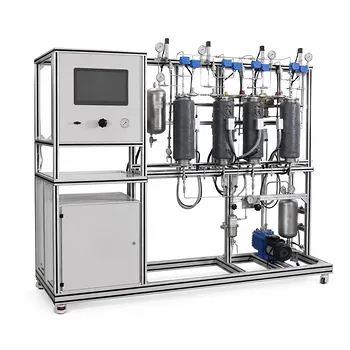
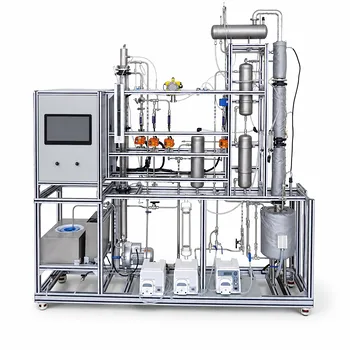
Pilot-scale reaction and absorption columns are the essential bridge between a flask and a full-scale plant. They allow you to break down the Ostwald process into controllable, measurable steps—from ammonia oxidation over a catalyst gauze to the final absorption of nitrogen dioxide in water—and then systemically manipulate temperature, gas flows, and residence times. By generating high-resolution data on conversion, selectivity, and thermal behavior in a low-risk environment, these units teach you exactly how to maximize nitric acid concentration, manage heat, and design efficient gas-recycling loops.

The Ostwald process depends on a delicate balance of reaction kinetics, mass transfer, and heat management. A pilot-scale column gives you the instrumented sandbox where you can isolate each variable, measure its impact without catastrophic cost, and build a process understanding that transfers directly to production.

The Ostwald Process at a Glance

Why the Chemistry Demands Careful Stewardship

The process begins with catalytic oxidation of ammonia over a platinum or platinum-rhodium gauze at 600–900 °C, producing nitric oxide (NO). That NO must then be cooled, oxidized to nitrogen dioxide (NO₂), and finally absorbed in water to yield nitric acid. Each step is energy-intensive and highly sensitive to operating conditions.

Why Scale Matters

At laboratory beaker scale, you see the reactions—but not the engineering. At full industrial scale, mistakes cost money and can be unsafe. Pilot-scale columns replicate the real-world physics of gas flow, catalyst contact, and falling-film absorption, while remaining small enough for safe, detailed experimentation.

The Reactor as an Experimental Engine

Controlling Temperature and Residence Time

In a pilot-scale reactor, you can set and hold a precise temperature profile along the catalyst bed. You then vary the ammonia-air mixture flowrate to alter gas residence time over the gauze. This lets you map the trade-off between high NO yield and unwanted side reactions that form nitrogen or N₂O.

Evaluating Catalyst Gauze Performance

By instrumenting the reactor with temperature sensors and sampling ports before and after the catalyst, you directly measure conversion efficiency. You can study how the platinum-rhodium gauze ages, how deposits form, and how temperature “hot spots” affect selectivity—insights that are practically invisible in a full-scale unit buried in insulation.

Managing Exothermic Heat Dissipation

The ammonia oxidation step is fiercely exothermic. Pilot reactors let you test different cooling strategies—external air, steam generation, or inter-stage heat removal—and see exactly how thermal management affects downstream NO oxidation rates. Stabilizing this heat flux is a core learning outcome.

The Absorption Column as an Optimization Tool

Gas-Liquid Contact and NO₂ Absorption

After the NO is oxidized to NO₂, the gas enters a counter-current absorption column where it contacts water. In a pilot-scale column, you can adjust liquid and gas flow rates to alter the mass transfer driving force and observe how absorption efficiency changes with pH, temperature, and pressure.

Fine-Tuning Oxygen Feed and Recycle Streams

The oxidation of NO to NO₂ requires oxygen. Pilot plants let you inject air or oxygen at multiple points and measure the resulting oxidation profile. You can also simulate gas-recycling systems—returning unabsorbed NO back to the process—and quantify how that recycle ratio improves overall nitric acid yield while reducing emissions.

Optimizing Acid Concentration

By sampling liquid from different tray or packing levels, you create a concentration gradient map. This reveals the sweet spot for product take-off: pulling acid too early gives dilute product; too late wastes energy. Pilot-scale columns show you exactly where to draw the stream for a target acid strength.

Data Collection and System Integration

Monitoring Conversion and Yield Holistically

A pilot plant integrates an entire process train. You can install on-line analyzers to track NO, NO₂, O₂, and acid concentration in real time. This integrated view lets you close a mass balance and verify that improvements at the reactor truly translate to higher overall yield—not just better oxidation numbers.

Testing Gas-Recycling System Design

Real plants recycle tail gas to recover NO and preheat reactants. Pilot-scale units let you build miniature hot-gas recycle loops, test the effects on flame stability in the reactor, and see how the column absorption kinetics shift when some NO is fed back. This is where you design the recycle logic that can make or break process economics.

Understanding the Trade-offs

The Limits of Small-Scale Simulation

Pilot columns cannot perfectly mimic the hydrodynamics of a 20-meter industrial tower. Wall effects become more pronounced, and catalyst deactivation patterns may differ. Always confirm that your scale-up correlations account for changes in flow regime and heat loss ratios. Otherwise, you risk over-optimizing a configuration that fails at full size.

The Risk of Over-Instrumentation

It is tempting to add sensors everywhere. But too many probes disturb flow and add thermal mass. A disciplined pilot study selects only the measurements needed to answer a specific hypothesis—temperature, pressure drop, key species concentrations—and uses them to build a robust kinetic model, not just a data lake.

How to Apply This to Your Process Development

  • If your primary focus is maximizing catalyst life: Use the pilot reactor to test temperature ramps and oxygen pulsing strategies that keep the gauze clean; measure pressure drop as an early indicator of fouling.
  • If your primary focus is raising acid concentration: Experiment with column staging, absorbent pre-cooling, and side-stream take-off points to pinpoint the configuration that delivers the highest strength without overloading the oxidation step.
  • If your primary focus is validating a recycle concept: Build a small hot-gas recycle loop and run long-duration tests to ensure that accumulated inerts and water vapor do not quench the catalyst or dilute the product.

A pilot-scale unit transforms the Ostwald process from a chemical curiosity into an engineering system you can see, touch, measure, and master—giving you the confidence to scale up with far fewer surprises.

Summary Table:

Process Stage Pilot-Scale Optimization Focus Key Measured Parameters
Ammonia Oxidation Catalyst gauze performance, heat dissipation, temperature profiles Gas residence time, conversion rate, selectivity
NO Oxidation Multi-point oxygen feed, cooling strategy, gas-recycling Oxidation profile, thermal flux
NO₂ Absorption Gas-liquid contact efficiency, water/acid flow rates, tray performance Acid concentration gradient, tail gas emissions

Bridge the Gap Between Lab Scale and Industrial Production

Ready to optimize your chemical processes and train the next generation of engineers? LABPARK provides premium Educational and Vocational Unit Operations Pilot Plants in chemical engineering, bioprocess & biotech, and environmental & water treatment.

Whether you are a university, research institute, or enterprise, our pilot systems deliver the high-resolution data and hands-on experience you need to scale up safely and efficiently.

Contact LABPARK today to discuss your custom pilot plant requirements!

Related Products

People Also Ask

Related Products

Absorption and Desorption Educational Unit Operations Pilot Plant

Absorption and Desorption Educational Unit Operations Pilot Plant

Dual packed column absorption and desorption pilot plant for chemical engineering education, offering real-time mass transfer coefficient measurement, durable mobile frame, industrial touch-screen interface, and customizable design for varied laboratory curricula, enabling hands-on study of gas absorption and stripping.

Multimodal Absorption and Desorption Pilot Plant for Unit Operations Training

Multimodal Absorption and Desorption Pilot Plant for Unit Operations Training

Multimodal absorption and desorption pilot plant for higher education labs. Bridges theory and industrial practice with transparent packed columns, three operational modes (real-material, simulated, semi-physical), and SCADA control. Students explore mass transfer, column hydraulics, and process control. Customizable.

Packed Bed Absorption Educational Unit Operations Pilot Plant

Packed Bed Absorption Educational Unit Operations Pilot Plant

Study gas-liquid absorption, pressure drop, flooding, and mass transfer coefficients with this pilot plant. Transparent packed column, industrial touchscreen, real-time sensor data, automated analysis. Investigate two-phase flow, loading points, column efficiency. Comprehensive data logging and assessment software included.

Pressure Swing Adsorption Educational Unit Operations Pilot Plant

Pressure Swing Adsorption Educational Unit Operations Pilot Plant

Integrated bench-scale pressure swing adsorption pilot plant for hands-on teaching of gas-solid separation, mass transfer, and process optimization using nitrogen-oxygen model, featuring dual-column design, industrial touchscreen control, digital assessment suite, and customizable hardware and software configurations for educational laboratories.

Bench Scale Dual Column Gas Separation and Capture Educational Pilot Plant

Bench Scale Dual Column Gas Separation and Capture Educational Pilot Plant

This dual-column educational pilot plant provides hands-on teaching of gas adsorption, separation, and capture processes. It features stainless steel columns, regeneration up to 400°C, and a 15.6-inch touchscreen PLC for TSA and PSA studies in chemical engineering curricula, process simulation.

Multi-Modal Distillation Unit Operations Training Pilot Plant

Multi-Modal Distillation Unit Operations Training Pilot Plant

Multi-modal distillation pilot plant for practical unit operations training in chemical engineering education. Features real, analog, and semi-physical simulation modes, industrial construction, customizable for university labs. Hands-on fractionation columns, SCADA control, safety systems. Includes sight glasses, sampling ports, closed-loop recycling.

Plate Column Hydrodynamics Tray Demonstration Educational Pilot Plant

Plate Column Hydrodynamics Tray Demonstration Educational Pilot Plant

Advanced transparent educational pilot plant for chemical engineering labs demonstrates plate column hydrodynamics with industrial sieve bubble cap serrated valve trays for visual observation of gas-liquid contact pressure drop measurement and operational limit analysis including flooding weeping entrainment

Micro-Scale Gas-Solid Catalytic Reaction Educational Pilot Plant

Micro-Scale Gas-Solid Catalytic Reaction Educational Pilot Plant

Explore heterogeneous catalysis with this micro-scale gas-solid catalytic reaction educational pilot plant. Designed for university labs, it enables hands-on study of reaction kinetics and transport phenomena in a benchtop packed bed reactor with high-precision flow control and touchscreen automation.

Continuous Batch Extractive Distillation Educational Pilot Plant

Continuous Batch Extractive Distillation Educational Pilot Plant

Versatile pilot plant for continuous, batch, and extractive distillation training. High-borosilicate glass column for visualizing hydraulics, 15.6-inch touchscreen with data logging, precise reflux ratio control 1-99, and durable corrosion-resistant frame. Ideal for chemical engineering education and process research.

Dual-Mode Rectification Pilot Plant for Practical Training Unit Operations

Dual-Mode Rectification Pilot Plant for Practical Training Unit Operations

Industrial-scale dual-mode rectification pilot plant for chemical engineering practical training. Features real-material and simulated-material operation modes, sieve-plate column with sight glasses for visual observation of hydrodynamics, and customizable SCADA control for safe, hands-on learning of unit operations and mass transfer.

Multi-Functional Special Distillation Educational Pilot Plant

Multi-Functional Special Distillation Educational Pilot Plant

Versatile multi-functional special distillation pilot plant for chemical engineering education. Supports continuous, vacuum, azeotropic, reactive, extractive distillation. Transparent glass columns enable real-time visual observation of hydrodynamics and separation processes.

Dual-Mode Gas Absorption and Desorption Unit Operations Training Pilot Plant

Dual-Mode Gas Absorption and Desorption Unit Operations Training Pilot Plant

Industrial-scale pilot plant for gas absorption and desorption training in chemical engineering. Features dual-mode operation with real and simulated materials, transparent columns for flow visualization, and customizable design. Supports independent or combined loops for hands-on unit operations experiments.

Educational Rotary Disc Liquid-Liquid Extraction Pilot Plant

Educational Rotary Disc Liquid-Liquid Extraction Pilot Plant

A transparent rotary disc column for educational liquid-liquid extraction experiments. This pilot plant enables students to study mass transfer, droplet dynamics, and flooding behavior, bridging theory and practice in chemical engineering unit operations education. Features variable-speed agitation and PLC control.

Comprehensive Liquid-Liquid Extraction Pilot Plant for Engineering Education

Comprehensive Liquid-Liquid Extraction Pilot Plant for Engineering Education

Comprehensive liquid-liquid extraction pilot plant for engineering education, integrating rotary and vibratory columns for hands-on observation of phase behavior, flooding limits, and mass transfer efficiency, enabling precise HTU and mass transfer coefficient calculations.

Bench Scale Carbon Dioxide Capture Educational Unit Operations Pilot Plant

Bench Scale Carbon Dioxide Capture Educational Unit Operations Pilot Plant

This bench-scale educational pilot plant simulates industrial CO₂ separation using a multi-tower adsorption system for hands-on engineering training. Students achieve ≥90% CO₂ purity while studying pressure swing adsorption, desorption kinetics, and process control in gas purification experiments.

Methanol Synthesis and Catalyst Performance Evaluation Educational Unit Operations Pilot Plant

Methanol Synthesis and Catalyst Performance Evaluation Educational Unit Operations Pilot Plant

Bench-scale methanol synthesis and catalyst evaluation educational pilot plant for chemical engineering labs to study catalytic kinetics, high-pressure operations, process control, and unit operations under realistic conditions with industrial safety features, precision gas delivery, data acquisition, and intelligent monitoring.

Carbon Dioxide Absorption and Desorption Educational Pilot Plant for Carbon Capture Studies

Carbon Dioxide Absorption and Desorption Educational Pilot Plant for Carbon Capture Studies

Explore carbon dioxide absorption and desorption with this educational pilot plant. Transparent columns visualize mass transfer; electric heating simulates industrial solvent regeneration; touchscreen interface enables data monitoring. Ideal for chemical engineering, bridging theory and practice.

Multi-Reactor Educational Pilot Plant for Reaction Engineering Unit Operations

Multi-Reactor Educational Pilot Plant for Reaction Engineering Unit Operations

Integrated bench-scale educational pilot plant for chemical engineering teaching featuring fixed bed fluidized bed and stirred tank reactors with web-based digital twin controls and safety interlocks for hands-on unit operations and reaction engineering comparative studies in one compact system.

Fixed-Bed Chemical Reaction and Gas Dust Tar Removal Unit Operations Pilot Plant

Fixed-Bed Chemical Reaction and Gas Dust Tar Removal Unit Operations Pilot Plant

Integrated educational pilot plant for studying catalytic gas-solid reactions and downstream gas purification. Features dual fixed-bed reactor, three-stage heating, and touchscreen control for hands-on engineering training. Ideal for chemical and environmental engineering curricula.

Multi Functional Catalytic Reaction and Reactor Evaluation Educational Unit Operations Pilot Plant

Multi Functional Catalytic Reaction and Reactor Evaluation Educational Unit Operations Pilot Plant

Bench-scale educational pilot plant for catalytic reaction and reactor evaluation, integrating fixed bed, fluidized bed, and stirred tank reactors. Students compare reactor designs, evaluate catalysts, and study reaction kinetics and hydrodynamics. Perfect for unit operations labs in chemical engineering curricula.


Leave Your Message