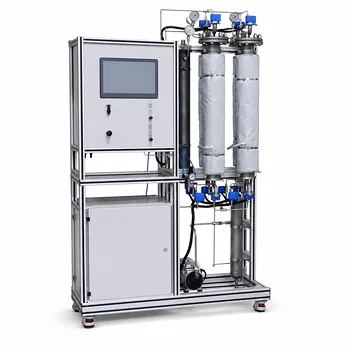
Solubility is a molecular handshake. The structure of a gas molecule and its specific intermolecular interactions with a liquid solvent directly determine how willing they are to mix. Gases capable of hydrogen bonding or strong dipole–dipole interactions, like ammonia, dissolve readily, while non-polar gases depend on weak dispersion forces and show much lower uptake. In environmental gas absorption pilot plants, this molecular insight is the critical bridge between raw science and practical optimization—it tells you whether to focus on gas turbulence, liquid distribution, or the chemical nature of your scrubbing medium.
The real power of understanding molecular interactions lies in translating solubility into pilot plant performance: highly soluble gases shift the mass transfer resistance entirely to the gas film, demanding turbulence in the gas phase, while sparingly soluble gases become liquid‑film controlled, requiring meticulous liquid distribution. This connection is what allows researchers and operators to select solvents, set operating conditions, and scale up with confidence.
Why Molecular Structure Dictates Gas Solubility
The answer begins with the types of intermolecular forces that form between a gas and a solvent. A molecule’s shape, polarity, and ability to polarize all dictate which forces dominate.
The Role of Polarity and Hydrogen Bonding
Water is a highly polar solvent. When a gas molecule also carries a significant dipole moment, orientation forces create strong attractions that massively boost solubility. Gases like ammonia form hydrogen bonds with water, which is the most powerful intermolecular interaction available. Even carbon dioxide, though linear and lacking a permanent dipole, engages in strong interactions partly through local quadrupole moments and chemical reaction, making it equally relevant in the "highly soluble" category for many pilot‑scale absorption studies.
Dispersion and Induction: When Non‑Polar Gases Dissolve
Non‑polar gases such as oxygen, nitrogen, or methane rely on weak dispersion forces. Their solubility in polar solvents is naturally low. However, polarizability matters: a larger electron cloud can be distorted more easily, strengthening the temporary induction force with a polar solvent like water. That’s why, moving from helium to xenon, the increasing size and polarizability of the noble gas atoms lead to a measurable rise in water solubility. In pilot plants, this seemingly subtle effect explains why mass‑transfer predictions shift for heavier trace gases.
From Solubility to Mass Transfer: The Two‑Film Roadmap
Solubility is not just a static equilibrium value; it actively re‑routes the main mass transfer resistance inside an absorption column. The classic two‑film theory makes this tangible.
Gas‑Film Control: When Solubility is High
For a highly soluble gas like ammonia in water, the liquid film offers almost no resistance—the gas rushes into the liquid phase so quickly that the bottleneck becomes the slow supply of fresh gas molecules to the interface. In this gas‑film controlled regime, the overall mass transfer coefficient ($K_G$) essentially equals the gas‑film coefficient ($k_g$). The practical takeaway: increasing gas velocity, turbulence, or modifying the gas inlet distributor will directly raise the absorption rate, while liquid‑side tweaks do little.
Liquid‑Film Control: When Solubility is Low
With sparingly soluble gases such as carbon dioxide in pure water, the situation flips. The liquid film now holds the dominant barrier because dissolved gas molecules are slow to penetrate and mix into the bulk liquid. Here the overall liquid‑side coefficient ($K_L$) approximates the liquid‑film coefficient ($k_l$), and the process is liquid‑film controlled. To enhance performance, you must focus on the liquid phase—improving liquid distribution, ensuring complete packing wetting, and optimizing the liquid‑to‑gas flow ratio. This is why CO₂‑water systems are the classic educational choice for demonstrating liquid‑side resistances.
Environmental Levers: Temperature, Pressure, and Salinity
Molecular interactions do not operate in a vacuum. In a pilot plant, three process variables directly modulate solubility and therefore the entire absorption performance.
Temperature: The Absorption–Stripping Switch
Gas solubility almost always decreases as temperature rises because the added thermal energy overcomes the attractive intermolecular forces that keep the gas in solution. In a pilot column, a cooled solvent stream dramatically improves absorption, while heating the same solvent later permits economical stripping and solvent regeneration. By installing heat exchangers on the inlet lines, students and engineers can record the shift in Henry’s coefficient and construct solubility curves, directly linking thermodynamics to separation efficiency.
Pressure: The Driving Force
Henry’s Law states that solubility is directly proportional to the partial pressure of the gas above the liquid. Raising the system pressure forces more gas molecules into contact with the solvent and increases the driving force for absorption. In an environmental pilot plant, studying variable‑pressure operation is essential when simulating high‑pressure industrial scrubbers or when evaluating how slight over‑pressures can boost capture rates without altering solvent chemistry.
Salting‑Out: When Electrolytes Interfere
Dissolved salts in the solvent reduce the available space for gas molecules and strengthen the solvent’s own ionic structure, a phenomenon called the salting‑out effect. The drop in solubility can be quantified using the van Krevelen and Hoftijzer equation, which correlates the change in Henry’s constant to the solution’s ionic strength and an overall salting coefficient ($h = h_g + h_+ + h_-$). When a pilot plant treats saline wastewater or brine, ignoring this effect leads to under‑designed columns—a direct, measurable consequence of intermolecular interactions on process scale‑up.
Understanding the Trade‑offs
No single molecular strategy is perfect, and pilot plants exist to navigate these balances.
Chemical solvents versus physical water. Switching from water to an amine‑based solvent enormously increases CO₂ solubility through chemical reaction. However, this brings higher solvent cost, regeneration energy, the risk of corrosion, and potential degradation products. The molecular gain in mass transfer must be weighed against the downstream complexity of the solvent loop.
Temperature optimization. Colder solvent means higher capacity, but it can also slow reaction kinetics if chemical absorption is involved and increase the liquid’s viscosity—imperilling the liquid film mass transfer you’re trying to boost. A pilot plant allows you to find the sweet spot between thermodynamic driving force and hydrodynamic performance.
Pressure versus equipment cost. Higher pressure boosts solubility directly, but it requires thicker column walls, stronger pumps, and more robust instrumentation. The molecular benefit is clear; the capital and safety burden must be evaluated side by side during scale‑up.
Saline process streams. Salting‑out reduces the equilibrium capacity, tempting you to simply over‑ventilate the column. Yet a better pilot‑plant lesson is to measure the salting coefficient and use it to adjust solvent choices—perhaps selecting a solvent with a lower sensitivity to ionic strength—rather than simply brute‑forcing the process.
Making the Right Choice for Your Pilot Plant Goal
Your specific research or operational objective determines which molecular lever you pull first. Use these guidelines to frame your experiments.
- If your primary focus is maximizing the capture of a highly polar gas (e.g., ammonia): Concentrate on enhancing gas‑side turbulence. Use higher gas velocities and gas‑entry designs that maximize interfacial shear, because the process is gas‑film controlled and liquid‑side improvements will yield minimal gains.
- If your primary focus is optimizing a sparingly soluble gas system (e.g., CO₂ in pure water): Prioritize liquid‑phase distribution. Invest time in testing different liquid distributors, verifying uniform packing wetting, and adjusting the liquid‑to‑gas ratio—the liquid film is the gatekeeper of mass transfer.
- If your primary focus is demonstrating thermodynamic principles in education: Select a pairing like ammonia‑water for gas‑film control and CO₂‑water for liquid‑film control, then actively vary inlet solvent temperature with heat exchangers to construct solubility curves and reinforce the inverse relationship between temperature and solubility.
- If your primary focus is scaling up for saline industrial effluents: Measure the salting‑out effect early. Use the van Krevelen and Hoftijzer approach to correct your Henry’s constant, then update the column design equations to avoid undersized units when moving from clean‑water lab data to real process streams.
By connecting the microscopic dance of molecules to the macroscopic performance of a packed column, you transform a pilot plant from a simple experimental rig into a precise tool for environmental process mastery.
Summary Table:
| Process Parameter | Highly Soluble Gas (e.g., Ammonia) | Sparingly Soluble Gas (e.g., CO₂ in Water) |
|---|---|---|
| Intermolecular Forces | Strong dipole-dipole, hydrogen bonding | Weak dispersion, induction forces |
| Dominant Resistance | Gas-film resistance ($K_G \approx k_g$) | Liquid-film resistance ($K_L \approx k_l$) |
| Optimization Focus | Increase gas velocity and turbulence | Improve liquid distribution and wetting |
| Key Lever | Gas inlet design & velocity | Packing wetting & liquid-to-gas ratio |
Bring Molecular Science to Life in Your Lab
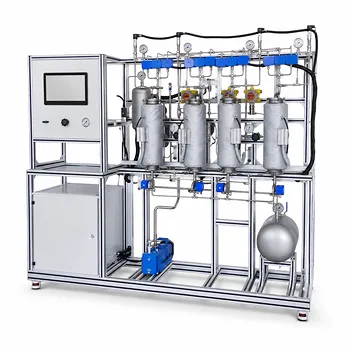
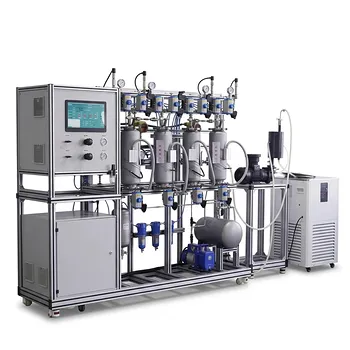
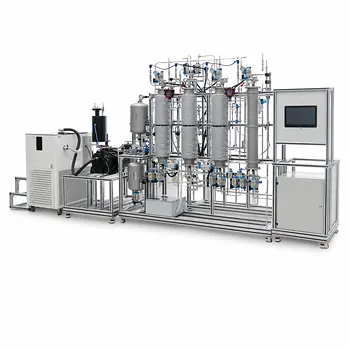
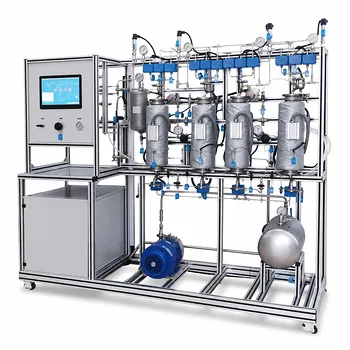
Ready to optimize your mass transfer research and chemical engineering curriculum? LABPARK provides state-of-the-art Educational and Vocational Unit Operations Pilot Plants in chemical engineering, bioprocess & biotech, and environmental & water treatment.
Designed specifically for universities, research institutes, and enterprises, our pilot plants enable students and researchers to precisely control temperature, pressure, and hydrodynamics to study complex gas absorption and stripping processes.
Contact LABPARK today to discover the ideal pilot-scale solution for your laboratory.
Related Products
- Dual-Mode Gas Absorption and Desorption Unit Operations Training Pilot Plant
- Carbon Dioxide Absorption and Desorption Educational Pilot Plant for Carbon Capture Studies
- Carbon Dioxide Adsorption and Capture Educational Unit Operations Pilot Plant
- Absorption and Desorption Educational Unit Operations Pilot Plant
- Packed Bed Absorption Educational Unit Operations Pilot Plant
People Also Ask
- How do temperature and pressure affect gas absorption and desorption? Optimize Pilot Plant Performance
- How do two-film & penetration theories apply to gas absorption pilot plant teaching? Key pedagogical insights.
- How is the direction and driving force of mass transfer determined in a gas absorption unit operations pilot plant?
- How does partial pressure behavior influence gas absorption pilot plants? Master Mass Transfer
- Why does increasing flow fail to enhance absorption in fast chemical reactions? Pilot Plant Insights