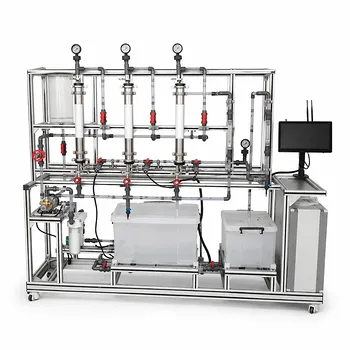
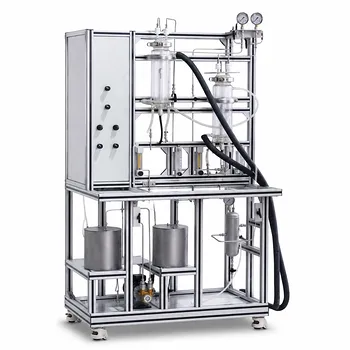
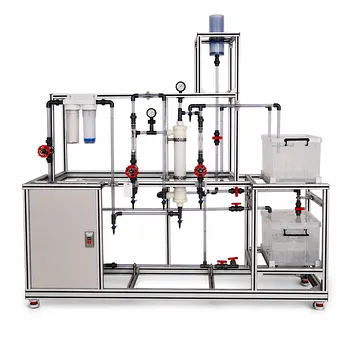
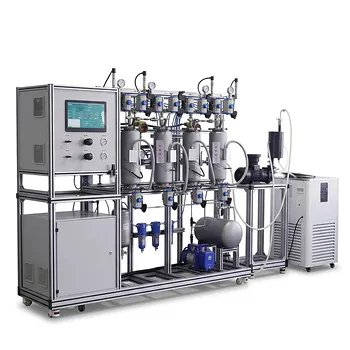
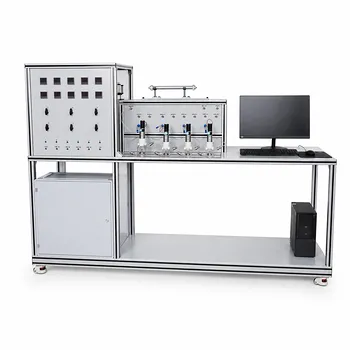
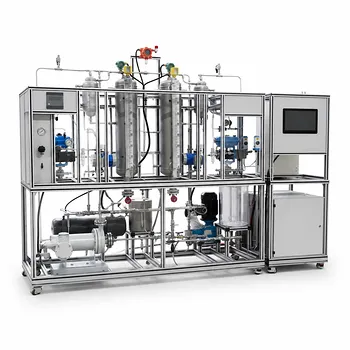
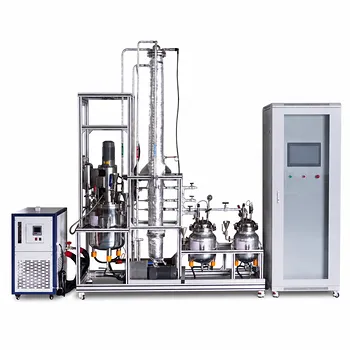
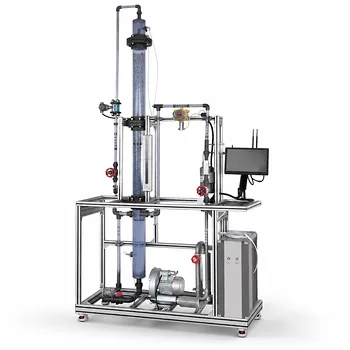
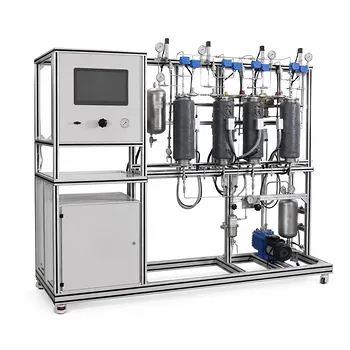
The performance of a gas separation membrane depends on a complex interplay between the gas species being separated, the physical thickness of the membrane, and the operating temperature. A laboratory unit operations training system brings these abstract principles to life. By precisely controlling feed temperature, pressure differentials, and gas compositions, you can directly measure how tiny changes in any one variable cascade into dramatically different flux rates and separation efficiencies.
Designing experiments in a pilot plant is not just about confirming theory—it is about internalizing the trade-offs that no textbook fully captures. The core insight is that gas permeation is rarely a simple size-sieving process, and the real value of a training system lies in learning how factors like solubility-driven transport, asymmetric membrane structure, and the Arrhenius relationship interact to make industrial separation possible.
How Gas Species Properties Dictate Transport
The identity of a gas molecule does more than determine its physical size; it governs how the molecule dissolves into and moves through the polymer matrix. Understanding this is the first step in analyzing any separation.
The Double Life of Permeability: Solubility and Diffusivity
Permeability is not a single property—it is the product of thermodynamic solubility and kinetic diffusivity. A gas that dissolves readily but moves slowly can end up with a higher flux than a small, fast-diffusing gas that barely enters the membrane at all.
For example, in polyetherimide, the smaller helium atom actually permeates slower than hydrogen. This counterintuitive behavior occurs because hydrogen’s solubility in that specific polymer outweighs helium’s diffusional advantage. A training system makes this visible by allowing you to run pure-component tests and calculate the individual sorption and diffusion coefficients.
Organic Vapors vs. Permanent Gases: A Solubility-Driven Race
The separation behavior flips depending on whether you are handling permanent gases or organic vapors. For rubbery membranes, organic vapor permeation is strongly solubility-driven. As the condensed organic species dissolves into the polymer, it plasticizes the material, increasing its own diffusion coefficient and boosting flux density even further.
This explains why a membrane can offer selectivity of organic compounds over nitrogen ranging from 10 to over 100 when the vapor pressure is high. A student operating a pilot plant can observe this firsthand by spiking a nitrogen stream with acetone and watching the permeate composition shift as the feed pressure changes, demonstrating that flux is not a linear function of partial pressure for the organic component alone.
The Critical Role of Membrane Thickness
Membrane thickness is the most intuitive lever for controlling flux, but its practical limits define the entire manufacturing process of separation modules.
The Inverse Relationship Between Thickness and Flux
Gas flux is inversely proportional to membrane thickness. Halve the thickness of the separating layer, and you double the throughput for the same driving force. This is the fundamental reason why industrial membranes are never thick, monolithic films.
A pilot plant allows you to test modules of different thicknesses and directly measure the mass transfer resistance. By plotting steady-state flux against inverse thickness, you can isolate the true membrane resistance from other system resistances like concentration polarization in the feed channel—a key diagnostic skill in process engineering.
The Tightrope Walk: Thin Skin, Porous Backing
The drive to reduce thickness hits a mechanical wall. Very thin, unsupported membranes cannot withstand the necessary operating pressures. The solution is an asymmetric structure: a dense, selective skin layer less than 1 µm thick deposited on a porous, open substrate that provides strength.
In a training environment, students can examine cross-sections of these layered membranes under a microscope and then correlate that structure with the module’s pressure drop and flux stability. This connects the materials science directly to unit performance and teaches why thinner is better only when the support is present.
Temperature as the Process Control Dial
Temperature is the variable you can change with a simple setpoint, yet it simultaneously affects solubility, diffusivity, and the polymer’s physical state. Its control is central to any rigorous laboratory analysis.
The Arrhenius Relationship in Action
Both gas solubility and diffusivity exhibit Arrhenius-type temperature dependencies. This means permeability changes exponentially with temperature, and the direction of that change depends on which activation energy is larger for a given gas–polymer pair.
A unit operations pilot plant equipped with jacketed modules or shell-and-tube heat exchangers allows you to collect precise data at multiple temperatures. By fitting that data to the Arrhenius model, you can extract the empirical activation barrier for permeation, a number that informs safe operating windows and scale-up calculations.
Balancing Selectivity and Flux Through Temperature Control
Temperature changes do not shift all gases equally. In rubbery membranes, decreasing the operating temperature increases the solubility of organic vapors significantly, raising their flux and selectivity over permanent gases. Conversely, at higher temperatures, the diffusion of smaller permanent gases accelerates faster than that of larger organics, collapsing selectivity.
This means there is often a temperature “sweet spot” where you achieve both acceptable flux and adequate selectivity. Students can map this trade-off by running the pilot plant across a thermal gradient, sampling the permeate stream, and generating a classic selectivity-versus-temperature curve.
The Hard Limit of Polymer Stability
All polymer-based membranes share a common Achilles’ heel: they must be operated at low temperatures, typically below 100°C, to avoid thermal degradation, loss of mechanical integrity, and permanent structural changes. A well-designed training system includes high-temperature interlocks and alarms precisely to teach this constraint. Attempting to push flux rates too high by overheating can instantly destroy a module, an expensive lesson in material limitations that is best learned in a controlled lab.
Analyzing Interactions in a Laboratory Unit Operations Training System
A purpose-built gas separation pilot plant is more than a demonstration device; it is a parametric sandbox for developing an engineering instinct.
Controlled Manipulation of Every Critical Variable
The system integrates mass flow controllers for gas mixing, back-pressure regulators for controlling the pressure differential across the membrane, and thermocouple-actuated heating or cooling for precise thermal control. Students can systematically vary the feed composition—introducing calibrated amounts of VOCs into a carrier gas—to see how a multicomponent mixture deviates from pure-component predictions.
The modular design also allows users to swap spiral-wound flat-sheet modules or membrane envelopes, comparing polyetherimide with rubbery silicone membranes under identical conditions. This head-to-head comparison is the most effective way to internalize why one material might release a VOC-enriched permeate while another excels at nitrogen drying.
Beyond Steady State: Studying Fouling and Scalability
The pilot plant also makes visible the hidden long-term challenges. By running the unit over several hours with a dirty feed gas, students can chart the progressive decline in flux and selectivity as fouling layers accumulate. Because membrane systems do not benefit from traditional economies of scale—they scale nearly linearly with membrane area (scale-up factor ≈ 1)—the training system demonstrates why large industrial plants simply replicate modules in parallel arrays rather than trying to build one giant module. This insight redefines how a student thinks about capacity expansion.
Understanding the Trade-offs
Optimizing a membrane separation is an exercise in managing contradictions. Ignoring these limits leads to conclusions that look good on a data sheet but fail in operation.
- Thinness vs. Durability: Chasing the highest possible flux with an extremely thin active layer creates a membrane that cannot survive pressure spikes. The laboratory system shows this through catastrophic failure when pressure is ramped up on an unbacked film.
- Temperature for Flux vs. Temperature for Selectivity: Running hot may double your throughput but can destroy the separation factor you need. The data you collect will inevitably show two different “optimal” temperatures for two different goals.
- Solubility-Generalization Pitfalls: The performance map you build for acetone/air may be entirely useless for propylene/air. The training system teaches the discipline of designing gas-specific experiments rather than assuming universal behavior.
- Neglecting Plasticization: For organic vapors, the membrane swells and its diffusivity becomes a moving target. Students who ignore this will see their model predictions drift over time, a real-world ambiguity that the pilot plant captures perfectly.
Making the Right Choice for Your Experimental Goals
The path you take in the lab should be guided by what you need to prove or learn. The instrumentation of a unit operations training system gives you the flexibility to match your approach to your objective.
- If your primary focus is maximizing throughput with an industrial high-flux membrane: Prioritize membranes with an ultra-thin, defect-free selective skin on a sturdy porous support. Then systematically increase driving force while monitoring for pressure-induced compaction.
- If your primary focus is optimizing organic vapor recovery from a mixed stream: Focus on rubbery membranes and experiment with lower operating temperatures to exploit the strong temperature-dependence of vapor solubility and plasticization.
- If your primary focus is fundamental research and model validation: Use the pilot plant’s ability to hold thickness and temperature constant while sweeping feed partial pressures, isolating the pure solubility contribution before adding diffusional complexity.
- If your primary focus is training operators on the limits of polymer stability: Design a series of runs that approach the 100°C ceiling while tracking pressure drop and selectivity, linking the material science lectures directly to the live-stream data.
The laboratory unit operations training system does not just answer your questions about gas properties, thickness, and temperature—it forces you to ask better questions about why the membrane behaves as it does, and what that means for the real process you one day must design.
Summary Table:
| Variable | Effect on Separation Performance | Key Practical Challenge / Trade-off |
|---|---|---|
| Gas Species Properties | Governs permeability via thermodynamic solubility and kinetic diffusivity. | Plasticization from organic vapors can make flux non-linear. |
| Membrane Thickness | Gas flux is inversely proportional to the active membrane thickness. | Ultra-thin membranes require a porous support to withstand pressure. |
| Temperature | Permeability changes exponentially (Arrhenius relationship). | Higher temperatures increase flux but can collapse selectivity and degrade polymers. |
Bring Membrane Separation Theory to Life in Your Lab
Are you looking to enhance your curriculum or research with hands-on process training? LABPARK provides premium Educational and Vocational Unit Operations Pilot Plants in chemical engineering, bioprocess & biotech, and environmental & water treatment. Designed specifically for universities, research institutes, and enterprises, our training systems empower students to bridge the gap between textbook theory and industrial practice.
Contact LABPARK today to customize your pilot plant training system!
Related Products
- Multifunctional Membrane Separation Educational Pilot Plant with Ultrafiltration, Nanofiltration, Reverse Osmosis
- Photocatalytic Membrane Separation and Degradation Unit Operations Pilot Plant
- Multi-Functional Membrane Separation Educational Pilot Plant for Unit Operations Lab
- Ultrafiltration Membrane Separation Educational Pilot Plant
- Gas-Solid Heterogeneous Separation Demonstration Educational Unit Operations Pilot Plant
People Also Ask
- Pervaporation vs. Vapor Permeation: Handling Suspended Solids in Membrane Pilot Plants
- How do PEI, PVDF, and PSU membranes compare in pilot plants? Find the best fit.
- What are the trade-offs of polymer vs inorganic membranes in teaching pilot plants? Key laboratory comparison.
- How can operators optimize operating conditions and cleaning protocols in membrane separation pilot plants to mitigate fouling?
- What are the advantages of membrane separation in pilot plants? Efficient Organic Vapor Recovery