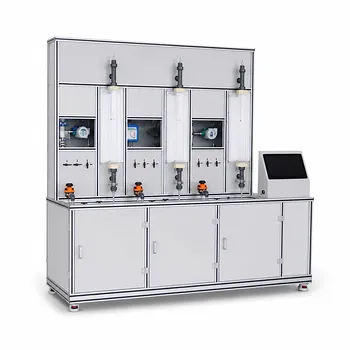
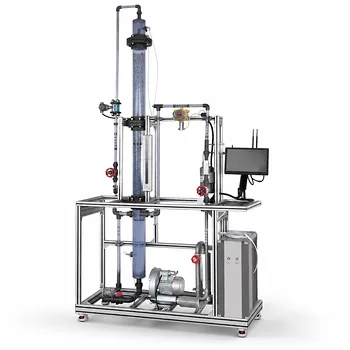
The gas flow rate and impeller speed form the critical axis around which motor safety and mechanical integrity pivot in a mechanically agitated pilot plant.
When gas is sparged into a stirred reactor, the power drawn by the impeller drops significantly compared to ungassed conditions. To prevent motor burnout if the gas supply suddenly fails, the agitator and drive system must be designed to handle the higher ungassed power load—a requirement that almost always calls for a two-speed motor and careful matching of impeller speed, gas flow number, and motor rating.
The central safety challenge is that gassing reduces impeller power demand, but a loss of gas flow instantaneously restores the full ungassed load. A pilot plant’s agitator motor must therefore be sized for the ungassed power peak, and a two-speed motor is the most reliable engineering solution to run efficiently under gassed conditions while surviving gas-out events without damage.
How Gas Flow Rate Transforms Impeller Power Demand
The Physics of Ventilated Cavities and Power Reduction
When gas is introduced behind an impeller blade, it forms ventilated cavities.
These cavities separate the liquid from the blade surface, drastically reducing the impeller’s pumping capacity and the power it transfers to the fluid.
As a result, the gassed power ((P_g)) can be 30–70% lower than the ungassed power ((P_{ug})) at the same rotational speed.
This drop is not linear. It depends on the gas flow number—a dimensionless ratio of gas velocity to impeller tip speed.
Higher aeration numbers (from larger gas flow rates or lower impeller speeds) produce deeper cavities and greater power suppression.
The Quantitative Link Between Speed, Gas Rate, and Safety Margin
The design process always starts with the gassed-to-ungassed power ratio, calculated from the impeller diameter, agitation speed, and volumetric gas flow rate.
This ratio determines how much “reserve” the motor must have.
Even though the pilot plant normally operates with gas on, the mechanical design must lock in the ungassed power requirement as the upper limit.
The Motor Safety Imperative: Designing for the Ungassed State
The Hidden Danger of Gas Flow Interruption
If the gas supply stops abruptly—due to a compressor trip, valve failure, or sparger blockage—the cavities collapse instantly.
The impeller suddenly faces liquid again and demands its full ungassed power within milliseconds.
If the motor was sized only for the lower gassed power, it will overload, trip the circuit breaker, or overheat and fail.
This scenario makes motor sizing the central safety concern.
The design must treat the ungassed condition as the design-basis load.
Simply oversizing a single-speed motor is possible, but it becomes electrically and thermally inefficient at the low-power gassed operating point.
Why a Two-Speed Motor Is the Standard Safeguard
A two-speed motor solves both problems elegantly.
Under normal gassed operation, the agitator runs at a lower rotational speed, drawing power comfortably within the motor’s rating.
If gas flow ceases, the control system can switch to a higher motor speed—at which the motor is robust enough to deliver the larger ungassed power without overloading.
This approach aligns the motor’s torque-speed curve with the two distinct operating states.
It prevents the need for a grossly oversized single-speed motor, reduces energy costs, and extends the agitator’s life.
The design then becomes a matter of selecting the correct two-speed combination and verifying that the impeller will still achieve the desired gas-dispersion scale at the lower gassed speed.
Understanding the Trade-offs
Energy Efficiency vs. Mechanical Complexity
A two-speed motor adds upfront cost, requires a more sophisticated starter and control logic, and introduces an additional failure mode.
A simpler alternative—a single-speed motor rated for ungassed power—may work in small pilot units but wastes energy continuously under normal gassed flow.
The decision often hinges on scale: for pilot plants over a few liters, the efficiency gain of a two-speed drive almost always outweighs the added complexity.
Maintenance of Mixing Quality
Running at a lower impeller speed under gas feed can compromise other process goals.
If the reactor also suspends solids, a reduced speed may fall below the just off-bottom suspension (JS) threshold, allowing particles to accumulate.
Gas flow itself can increase the required minimum speed for suspension, so the lower gear must still be fast enough to meet dispersion and suspension demands.
This interplay forces a careful balance—motor safety cannot be achieved at the expense of process failure.
Impact on Mass Transfer and Scale‑Up Data
Fast gas‑liquid reactions ((M \gg 1)) depend mainly on interfacial area, which is strongly influenced by impeller speed.
Operating at a lower speed to stay within motor limits can shrink the gas‑liquid interfacial area, potentially skewing the pilot-plant data used for scale‑up.
Researchers must therefore characterize the motor‑safe operating envelope and ensure it still covers the kinetic regime of interest, or switch to reactor modules like bubble columns or packed columns that are less speed‑dependent.
Making the Right Choice for Your Pilot Plant
Your design must match the motor strategy to your primary research or production priority.
- If your primary focus is motor safety and equipment longevity: Base the motor rating on the ungassed power peak and install a two‑speed motor with a proven gas‑out switching protocol. This ensures the agitator survives any loss‑of‑gas event.
- If your primary focus is maximizing mass transfer for fast reactions: Choose a motor and impeller combination that can safely run at the highest speed needed for interfacial area, even under gassed conditions, and verify that the power draw never exceeds the ungassed rating at that speed.
- If your primary focus is energy efficiency during continuous gassed operation: Use a two‑speed motor to run at a low‑speed, low‑power setpoint while maintaining the necessary dispersion scale, and rely on the high‑speed winding only for gas‑out startup or emergency conditions.
- If your primary focus is multi‑purpose research with solids suspension: Ensure the lower motor speed still meets the increased just‑off‑bottom suspension requirement caused by gassing, even if that means selecting a slightly larger motor to cover the overlap.
By treating the ungassed power as the non‑negotiable design floor and leveraging a two‑speed motor, you can create a mechanically safe, flexible pilot plant that delivers reliable data across the full range of gas‑liquid operation.
Summary Table:
| Operating State | Power Demand | Motor Safety Risk | Recommended Solution |
|---|---|---|---|
| Gassed State | Reduced by 30–70% | Low (normal operation) | Run at lower speed to save energy |
| Ungassed (Gas-out) | Peak load restored instantly | High (motor overload/burnout) | Size for peak load; use two-speed motor |
Optimize Your Pilot Plant Design with LABPARK
Ensure maximum safety, reliability, and precision in your scale-up research. LABPARK provides state-of-the-art Educational and Vocational Unit Operations Pilot Plants in chemical engineering, bioprocess & biotech, and environmental & water treatment tailored for universities, research institutes, and enterprises.
Ready to elevate your laboratory capabilities and prevent costly motor failures? Contact our engineering experts today to find the perfect pilot plant solution for your application.
Related Products
- Dual-Drive Stirred Gas-Liquid Mass Transfer Coefficient Determination Pilot Plant
- Fixed-Bed Chemical Reaction and Gas Dust Tar Removal Unit Operations Pilot Plant
- Methane Cracking Educational Unit Operations Pilot Plant
- Fixed Bed Gas Solid Catalytic Reaction Educational Pilot Plant
- Agitation and Mixing Educational Unit Operations Pilot Plant
People Also Ask
- How does column packing affect absorption intensification, and how is it evaluated experimentally?
- Why Compare Membrane-Reservoir Models with Pilot Plant Data? Ensure Successful Process Scale-Up
- Why is pilot plant gas absorption lower than isothermal model predictions? Interfacial heating explained.
- Which interphase forces dominate gas dispersion in stirred reactors? Master Gas Holdup Models
- What key factors influence the rate of diffusion in liquids? Optimize Mass Transfer Pilot Plant Design