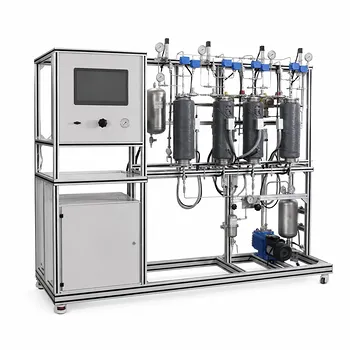
Photocatalytic pilot plants are the essential bridge between fundamental chemistry and real-world water treatment. These systems integrate UV light sources with engineered reactor vessels, allowing researchers to study how semiconductor nanoparticles like titanium dioxide (TiO2) degrade organic pollutants—such as dyes, pesticides, or pharmaceuticals—under precisely controlled conditions. By operating at a pilot scale, these plants enable the evaluation of critical scale-up factors that are impossible to assess in a simple beaker, from hydrodynamics and light distribution to catalyst recovery and process kinetics.
The true value of a photocatalytic pilot plant lies not just in demonstrating that a pollutant degrades, but in generating the engineering data—flow dynamics, photon efficiency, and catalyst lifecycle—needed to transform a laboratory reaction into an economically viable, industrial-scale treatment process.
Building the Foundation: What the Pilot Plant Reveals
A bench-top experiment can prove that TiO2 and UV light break down a target molecule. A pilot plant reveals how to make that reaction efficient, reliable, and scalable. It provides a controlled environment to systematically study the variables that govern advanced oxidation processes (AOPs).
The Controlled Environment for Kinetic Studies
Pilot plants recreate the physical realities of a flow reactor while maintaining tight control over operating parameters. Researchers can set and hold precise values for flow rate, pollutant concentration, catalyst loading, pH, temperature, and UV light intensity. This control allows them to isolate individual effects and build robust kinetic models.
Modern plants enrich kinetic analysis further by integrating online analytical tools. Inline or bypass UV-Vis spectrophotometers, for example, can track the absorbance of the target pollutant in real time. This continuous monitoring automatically constructs concentration-time curves under known conditions, making the calculation of reaction rate constants and the determination of true catalytic activity far more accurate than periodic manual sampling.
From Suspension to Immobilization: Mastering the Catalyst
A critical decision for scale-up is whether to use the photocatalyst as a suspended slurry or immobilized on a support. Pilot plants can be configured to test both approaches. In a suspended system, the researcher can study the impact of catalyst concentration on reaction rate, but must also grapple with the downstream challenge of separating and recovering the nanoparticles.
Immobilized systems eliminate the recovery step but introduce mass transfer limitations and reduced effective surface area. A pilot plant allows direct comparison: studying how flow dynamics over a coated surface affect degradation efficiency, and measuring the degradation rate per unit of irradiated surface, enabling informed engineering choices for full-scale designs.
The Physics of Light and Flow
Photocatalysis is a surface phenomenon governed by light absorption. Scaling up a reaction dramatically changes how photons are distributed. The pilot plant is the tool to study UV light penetration depth in opaque catalyst suspensions and to map the incident photon flux across reactor geometry. Parameters like the Local Volumetric Rate of Energy Absorption (LVREA) become central design metrics. Because the reactor's inner wall must be transparent—often quartz or glass—pilot plants must also solve the problem of managing heat when radiation can pass through but conduction is limited.
Translating Principles to Practice: Gas-Phase and Monitoring Synergies
While water treatment is a primary focus, the same pilot-scale philosophy applies to gas-phase remediation. A pilot plant with a photocatalytic reactor stage can model the degradation of volatile organic compounds (VOCs) or nitrogen oxides (NOx) using TiO2-coated nanomaterials or nanostructured filters. The physical intuition gained about flow distribution, light intensity, and catalyst durability translates directly between phases, accelerating research across environmental media.
Furthermore, the sensor integration developed for photocatalytic pilot plants mirrors that of other environmental systems. The same closed-loop monitoring used to track COD and BOD in a biological aerated filter pilot can be redeployed to measure the mineralization of an organic dye in a photoreactor, reinforcing a universal principle: engineering-relevant kinetics require continuous, automated data streams, not isolated snapshots.
Understanding the Trade-offs and Design Pitfalls
No pilot plant is a perfect miniature of an industrial unit. Choosing and operating one requires navigating inherent compromises with eyes open.
The Cost of Transparency and the Heat Problem
To let UV light in, reactor walls must be transparent. Quartz and specialized glasses offer excellent light transmission but are poor thermal conductors and can be fragile. Exothermic degradation reactions or simply the heat from UV lamps can raise temperatures rapidly. Pilot plants must therefore incorporate cooling mechanisms—such as an annular cooling jacket or reflective outer coatings—to prevent thermal damage and maintain isothermal kinetics, adding complexity and cost.
The Material Compatibility Gauntlet
Photocatalytic treatment often targets recalcitrant contaminants like chlorinated solvents, which are highly corrosive. The combination of reactive radicals, strong oxidants, and UV exposure creates an aggressive chemical environment. Every wetted and illuminated component—reactor seals, gaskets, tubing, and sensor probes—must be selected for long-term chemical resistance. Failing to do so leads to leaks, contaminated samples, and failed experiments, turning a research tool into a maintenance headache.
The Recovery Challenge at Scale
Slurry-based photocatalytic reactors achieve high surface-area-to-volume ratios and excellent degradation rates. Yet they create a separation problem orders of magnitude harder than filtering a beaker sample. Pilot plants allow researchers to test downstream unit operations—membrane filtration, centrifugation, or magnetic separation—under realistic conditions. The data will often show that the most chemically active configuration is not the most practical one, a crucial lesson for industrial deployment.
How to Leverage a Photocatalytic Pilot Plant for Your Research Goal
The choice of pilot plant configuration, instrumentation, and operating mode should be dictated by your primary objective.
- If your primary focus is kinetic modeling and reaction mechanism: Select a configuration with integrated, real-time spectroscopy (e.g., bypass UV-Vis). Operate in a well-mixed, low-conversion regime to generate clean, differential rate data that can be used to build predictive models.
- If your primary focus is catalyst development and durability (e.g., nano-TiO2 doping or immobilization): Design experiments that alternate between reaction cycles and recovery stages, while continuously monitoring photocatalytic activity. Use the pilot plant to compare fresh and reused catalysts under identical hydrodynamic conditions.
- If your primary focus is scale-up feasibility and process design: Emphasize the study of flow residence time distribution (RTD), light distribution under different lamp configurations, and the pressure drop and fouling behavior of catalyst recovery systems. The reactor's mechanical and material stability become as important as the chemistry.
- If your primary focus is education and training: Use the pilot plant to let future engineers experience the consequences of design choices. Let them see how a change in pumping rate disrupts light absorption or how a failed seal exposes an incompatibility—lessons that a textbook cannot teach.
A photocatalytic pilot plant is not a larger beaker. It is a decision-making tool that translates a promising chemical reaction into a teachable, scalable, and robust engineering process.
Summary Table:
| Key Parameter / Feature | Research Value / Application | Scale-Up Benefit |
|---|---|---|
| Kinetic Studies | Control flow rate, pH, & UV intensity | Build robust, predictive kinetic models |
| Catalyst State | Test suspended slurry vs. immobilized systems | Evaluate recovery methods & mass transfer limits |
| Light & Flow Physics | Map photon flux & UV penetration depth (LVREA) | Optimize reactor geometry & thermal control |
| Downstream Recovery | Integrate membranes, centrifuges, or magnets | Assess economic feasibility at scale |
Accelerate Your Water Treatment & Chemical Engineering Research with LABPARK
Transitioning from beaker-scale reactions to viable industrial processes requires robust, reliable data. LABPARK designs and manufactures state-of-the-art Educational and Vocational Unit Operations Pilot Plants in chemical engineering, bioprocess & biotech, and environmental & water treatment for universities, research institutes, and enterprises.
Whether you are researching advanced oxidation processes (AOPs), biochemical engineering, or environmental water treatment, our pilot plants deliver the precise hydrodynamic control, sensor integration, and material durability your project demands.
Ready to scale up your research? Contact us today to discuss your pilot plant needs and see how we can bring your laboratory innovations to life.
Related Products
- Photocatalytic Membrane Separation and Degradation Unit Operations Pilot Plant
- Methane Cracking Educational Unit Operations Pilot Plant
- Fixed-Bed Chemical Reaction and Gas Dust Tar Removal Unit Operations Pilot Plant
- Internal Circulation Gradient Free Catalytic Reaction Educational Pilot Plant
- Carbon Dioxide Hydrogenation Methanol Synthesis Educational Unit Operations Pilot Plant
People Also Ask
- What are the key differences in membrane configurations? Choose the Right Unit Operations Pilot Plant
- How do polymer membranes restrict gas separation? Key pilot plant limits.
- How do temperature and pH affect membrane conductivity? Pilot Plant Guide
- How Do Pervaporation, Vapor, and Gas Permeation Differ in Pilot Plants? Key Comparison
- How do membrane separation pilot plants teach RO limits? Master osmotic pressure dynamics.