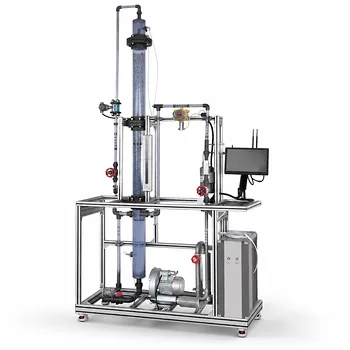
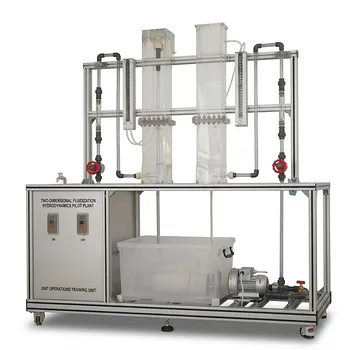
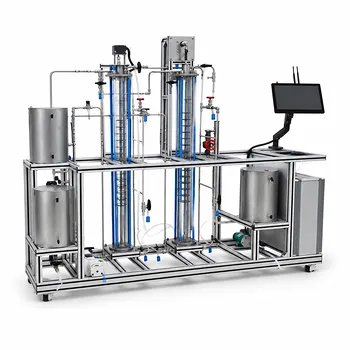
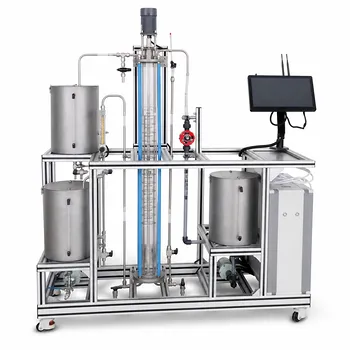
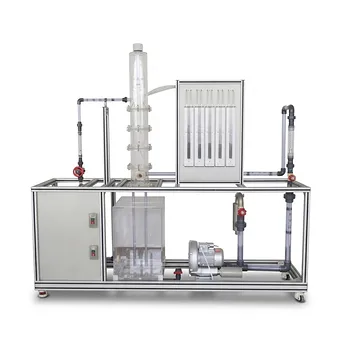
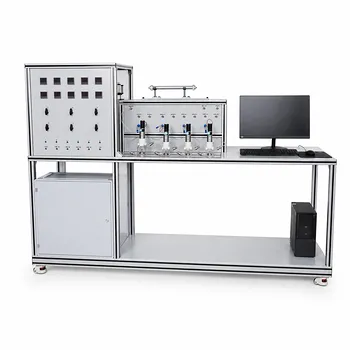
The sizing of a bubble column slurry reactor pilot plant is a classic iterative engineering challenge. Engineers determine the dispersion height ($h_t$) and column diameter by coupling mass transfer and reaction kinetics through a trial-and-error numerical integration. They first assume a dispersion height to compute dissolved gas concentrations and the average superficial gas velocity. This yields the gas–liquid mass transfer coefficient ($k_La$), which then feeds into the integrated material balance to calculate a new height. The process is repeated until the assumed and calculated heights converge. The column diameter is selected by balancing the volumetric gas flow rate against a chosen superficial gas velocity that maintains a desired flow regime and ensures the resulting dispersion height is practical for the pilot plant’s physical constraints.
The real sizing challenge isn’t just math—it’s understanding that the column diameter and superficial gas velocity lock you into a specific dispersion height. A wider column at low velocity gives a short, manageable height; a narrow column at high velocity forces an impractically tall column. The trial-and-error method reconciles these parameters with the chemical demand (mass transfer + reaction) to meet the pilot plant’s ceiling, residence time, and scale-up objectives.
The Fundamental Sizing Problem: Linking Kinetics and Hydrodynamics
A slurry reactor must provide enough volume for the gas–liquid–solid reaction to reach the required conversion. That volume—and thus the height—depends on how fast the gas dissolves and reacts.
The Role of the Material Balance
The core design equation is a differential material balance along the reactor height: $q_{vG} , dY_A = (-r_A) , A , dz$ Here, $Y_A$ is the gas-phase mole ratio of the reactant, $q_{vG}$ is the volumetric gas flow rate, and $A$ is the cross-sectional area. The reaction rate $(-r_A)$ is not a simple kinetic constant—it includes the enhancement factor, the liquid-side mass transfer coefficient ($k_L$), and the specific interfacial area ($a$). Integrating this equation from the inlet to outlet boundary conditions yields the required dispersion height.
Why Trial-and-Error Is Necessary
The mass transfer coefficient $k_La$ and the gas holdup (which sets the interfacial area) are not independent of the column height or diameter. They depend on the superficial gas velocity ($V_G$) and the flow regime, both of which are influenced by the hydrostatic pressure profile and gas expansion. Because you don’t know the height upfront, you can’t compute $V_G$ or $k_La$ exactly—so an iterative loop becomes essential.
Determining the Column Diameter
The diameter is the first geometric variable to fix, and it’s primarily driven by the gas throughput and hydrodynamic regime.
Selecting the Superficial Gas Velocity
The superficial gas velocity ($V_G$) is defined as the volumetric gas flow rate divided by the column cross-sectional area. In slurry pilot plants, this velocity directly controls gas holdup, bubble size, and mass transfer. The chosen velocity must place the reactor in the homogeneous (bubbly) or heterogeneous (churn-turbulent) flow regime—avoiding slug flow, which can cause operational instability. For columns with diameters larger than 0.15 m, the gas holdup becomes virtually independent of diameter and pressure (up to 1.6 MPa), making the data reliable for scale-up.
Using the Flow Regime and Practical Constraints
A common approach is to first select a $V_G$ that suits the intended mass transfer performance. Then, the column diameter follows from the gas flow rate: $D = \sqrt{\dfrac{4 q_{vG}}{\pi V_G}}$ However, this choice is not free. In a slurry system under pressure, the relationship between $V_G$ and diameter dramatically impacts the dispersion height. For example, at a constant top pressure of 15.0 atm, increasing $V_G$ from 0.5 cm/s to 2.0 cm/s forces the diameter to shrink from 112.6 cm to 56.3 cm—and the dispersion height skyrockets from 14.93 m to 59.13 m. If your pilot plant has ceiling limitations, maintaining a low superficial gas velocity (around 0.5 cm/s) keeps the column wide and the height practical.
Calculating the Dispersion Height: The Iterative Method
Once the diameter is tentatively set, the dispersion height is computed through a converging numerical loop.
Step 1: Initial Height Guess and Gas Concentration
Start by assuming a dispersion height. Using this guess, calculate the dissolved gas concentration at the reactor inlet and outlet, accounting for the hydrostatic pressure profile at the average gas holdup. This step is necessary because the driving force for mass transfer—the difference between the equilibrium and bulk liquid concentrations—varies with height.
Step 2: Computing the Mass Transfer Coefficient ($k_La$)
From the assumed column dimensions and the known gas flow rate, determine the average superficial gas velocity across the column (often taken as the arithmetic mean of the velocities at the bottom and top). Use empirical correlations—which are specific to the liquid type, solid loading, and sparger design—to calculate the volumetric mass transfer coefficient $k_La$ based on this $V_G$ and the column diameter.
Step 3: Solving the Integrated Design Equation
With $k_La$ and the concentration driving forces, compute the intermediate parameters (often denoted $\alpha$ and $\beta$ in design methods) that lump together hydrodynamics and reaction kinetics. Then integrate the material balance from the inlet $Y_{A1}$ to the outlet $Y_{A2}$ to obtain a new calculated dispersion height.
Step 4: Convergence Check and Iteration
Compare the calculated height to the initial guess. If they differ significantly, update the guess and repeat Steps 1–3. Because the dependencies are smooth, the iteration typically converges in a few cycles, yielding a height that simultaneously satisfies mass transfer and reaction requirements.
Understanding the Trade-offs: Diameter, Height, and Velocity
The iterative method reveals a hard physical constraint: you cannot independently select diameter, height, and $V_G$.
The Tall-Skinny vs. Short-Wide Dilemma
A small diameter forces a high linear gas velocity, which increases gas holdup and improves $k_La$—but it also stretches the dispersion height dramatically because the reaction volume must be provided in a narrow column. Conversely, a wide column at low $V_G$ reduces the required height, making fabrication and installation feasible, but may deliver lower mass transfer intensity. The design equation automatically captures this trade-off through the integrated mass balance.
Operating within Pilot Plant Ceiling Limitations
For educational or vocational pilot plants with tight height ceilings, the only way to achieve the necessary residence time is to lower $V_G$ and widen the column. This keeps the dispersion height short while maintaining the required volume. However, the diameter must still exceed the critical threshold of 0.15 m so that gas holdup correlations remain valid for scale-up.
Making the Right Choice for Your Pilot Plant
The final design parameters should align with your main operating goals.
- If your primary focus is minimizing height for a ceiling-limited lab: Target a low superficial gas velocity (e.g., 0.5 cm/s) and accept the resulting wider column. Verify the diameter stays above 0.15 m to ensure your holdup data transfers to larger units.
- If your primary focus is maximizing mass transfer per unit volume: Consider a higher $V_G$ (staying within the heterogeneous regime), but be prepared for a very tall column. Run the iterative method to see if the height remains buildable.
- If your primary focus is reliable scale-up data: Select a column diameter larger than 0.15 m and operate at a superficial gas velocity that mirrors the flow regime expected in the production reactor. Use the iterative calculation to confirm the pilot plant can achieve the required conversion at that scale.
By embracing the iterative nature of the design and understanding the physical link between diameter, velocity, and height, you can size a slurry reactor pilot plant that is both technically sound and practically buildable.
Summary Table:
| Parameter | Definition & Role | Key Sizing Strategy & Impact |
|---|---|---|
| Column Diameter ($D$) | Directs gas throughput and flow regime. | Selected based on superficial gas velocity ($V_G$). Must be >0.15 m for reliable scale-up data. |
| Dispersion Height ($h_t$) | Determines active reaction volume and residence time. | Calculated via iterative numerical integration. A lower $V_G$ reduces height for low-ceiling labs. |
| Superficial Gas Velocity ($V_G$) | Controls gas holdup, bubble size, and mass transfer. | Selected to maintain homogeneous or heterogeneous flow regimes while avoiding operational slug flow. |
Optimize Your Chemical Engineering Lab with LABPARK
Designing and sizing complex reactor systems requires precision, reliability, and the right equipment. LABPARK provides state-of-the-art Educational and Vocational Unit Operations Pilot Plants in chemical engineering, bioprocess & biotech, and environmental & water treatment.
Engineered specifically for universities, research institutes, and enterprises, our pilot plants bridge the gap between theoretical calculations and practical industrial scale-up, ensuring your students and researchers work with industry-standard technology.
Ready to elevate your training and research capabilities?
👉 Contact LABPARK today to discuss your project requirements!
Related Products
- Micro-Scale Gas-Solid Catalytic Reaction Educational Pilot Plant
- Fixed-Bed Chemical Reaction and Gas Dust Tar Removal Unit Operations Pilot Plant
- Fixed Bed Gas Solid Catalytic Reaction Educational Pilot Plant
- Fluidized Bed Gas Solid Catalytic Reaction Educational Pilot Plant
- Educational Unit Operations Pilot Plant for Intraparticle Diffusion Effective Factor Measurement
People Also Ask
- Why is a multibed configuration necessary for exothermic reactions? Optimize your pilot plant trajectory.
- Fluidized vs. Fixed Bed Reactors: Comparing Heat & Complexity in Pilot Plants
- Why is thermal management a major challenge in methane oxidative coupling? Reactor Solutions for Pilot Plants
- How does the Mears criterion evaluate transport resistance? Key Guide to Intrinsic Kinetics
- How do reactor pilot plants safely study gas-solid reactions? Master kinetics with thermal & flow control.