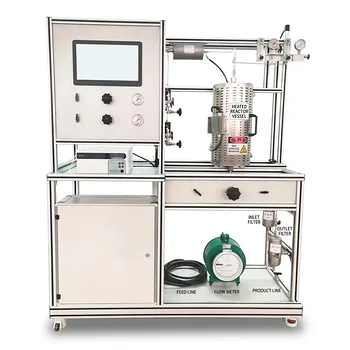
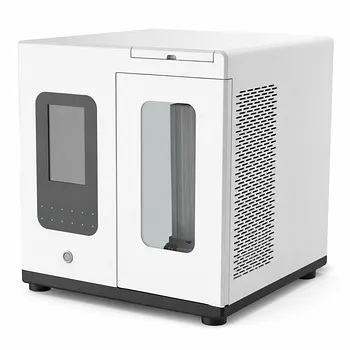
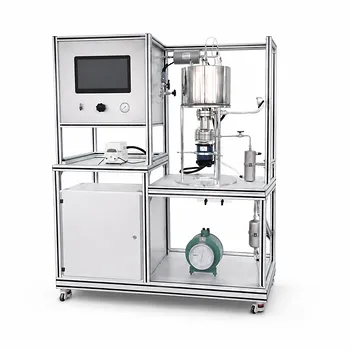
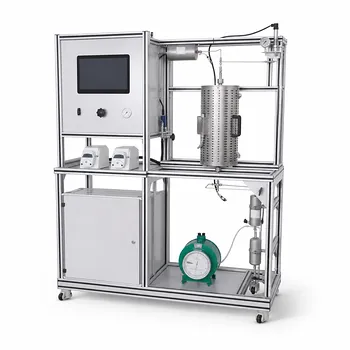
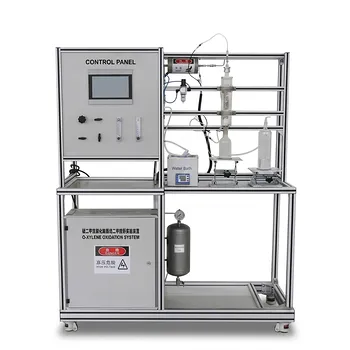
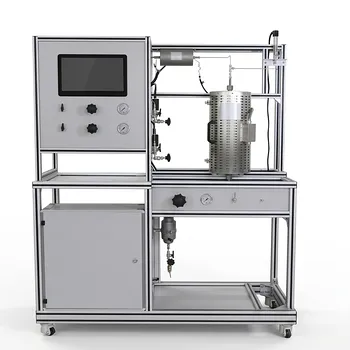
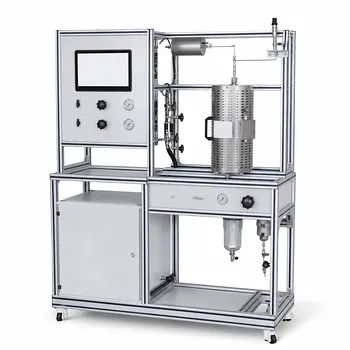
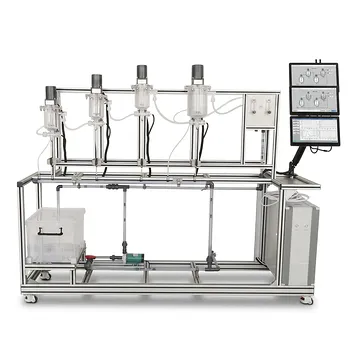
Safety through design: educational catalytic reactor pilot plants use a combination of scaled-down geometries, engineered heat removal, multi‑point temperature sensing, and automated shutdowns to turn dangerous exothermic behavior into a controllable, observable classroom experiment.
These plants safely reveal hot spots and parametric sensitivity by deliberately shrinking the reactor diameter, enhancing wall‑to‑bed heat transfer with high‑conductivity materials or cooling jackets, and installing axially spaced thermocouple arrays that map the thermal profile in real time. Integrated safety interlocks instantly cut the reactant feed when a temperature threshold is breached, allowing students to witness runaway spikes and recovery without equipment damage or personal risk.
The central principle is thermal leniency: a small reactor scale, rapid heat dissipation, and precise sensor feedback ensure that any temperature excursion remains localized and is arrested long before it can escalate into a dangerous, uncontrolled reaction.
The Core Design: Scaling Down Danger
The first layer of safety comes from the reactor’s physical dimensions and material choices, which fundamentally limit the amount of energy that can accumulate.
Why a Smaller Diameter is Safer
In a fixed‑bed reactor, heat generation scales with volume while heat removal scales with surface area. Reducing the tube diameter dramatically increases the surface‑to‑volume ratio, making it far easier to dissipate the reaction heat.
This means the same exothermic reaction that would run away in a large industrial tube can be tamed in a pilot‑scale system simply by shrinking the bed cross‑section. The smaller scale also lowers the total thermal mass, so any overshoot is inherently less violent.
Conductive Walls and Cooling Jackets: Removing Heat Efficiently
Pilot plants always use reactor walls made of highly conductive metals (like stainless steel or copper alloys) and often surround them with a temperature‑controlled cooling jacket.
The conductive wall rapidly draws heat away from the catalyst bed, while the jacket fluid (water, oil, or glycol) provides a constant heat sink. This turns the reactor into an effective heat exchanger, preventing the bed center from reaching ignition temperatures even during a deliberate process upset.
Thermocouple Arrays: Seeing the Invisible Temperature Profile
A single temperature reading at the reactor exit is useless for spotting a hot spot forming deep inside the bed. Educational pilot plants insert multiple thin thermocouples along the central axis, typically at 5–10 equally spaced positions.
These multi‑point probes produce a real‑time temperature profile, making the hot spot’s exact location and intensity visible. Students can watch a small, sharp peak develop, move, or fade as they adjust feed conditions, turning an abstract concept into a concrete observation.
Automated Interlocks: The Emergency Brake
Every safe demonstration relies on a hard‑wired safety layer. Programmable logic controllers monitor all bed temperatures continuously. If any thermocouple exceeds a pre‑set high‑limit value, the interlock immediately closes solenoid valves on the reactant feed lines and often opens inert purge valves to flush the bed.
This automatic response stops heat generation within seconds, before the temperature can escalate to a point that damages the catalyst or the equipment. The setup allows students to explore the very edge of runaway behavior while knowing the system will always “catch” them.
Preventing Flow Maldistribution: A Hidden Instigator of Hot Spots
Uneven gas flow is one of the primary causes of local hot spots and catalyst deactivation in fixed beds. Educational pilot plants incorporate industrial solutions to avoid this artifact, ensuring the observed thermal behavior is a true effect of reaction kinetics, not poor fluid dynamics.
Inlet Gas Distributors
Before the reactant stream touches the catalyst, it passes through a distributor—typically a single‑stage baffle plate or a multi‑layer perforated plate. This device breaks up the incoming jet and spreads the gas evenly across the entire bed cross‑section.
Without it, the gas would impinge directly on a small central region, creating a persistent hot spot that overwhelms the cooling capacity and misleads the interpretation of the experiment.
Inert Packing as a Flow Conditioner
A layer of inert ceramic balls is placed on top of the catalyst bed. This zone serves two purposes: it further redistributes the gas flow before it reaches the active particles and it acts as a thermal buffer that prevents a cold feed from directly quenching the top layer of catalyst.
This simple, low‑cost addition mimics industrial practice and guarantees that the temperature profiles the students measure are driven by the reaction, not by entry effects.
Demonstrating Parametric Sensitivity Under Controlled Conditions
With the safety foundations in place, the pilot plant becomes a precise laboratory tool for showing how tiny changes can trigger dramatic thermal responses.
Creating Controlled Perturbations
Parametric sensitivity is studied by deliberately adjusting one operating variable at a time—inlet reactant concentration, feed temperature, or coolant temperature—while closely monitoring the axial temperature profile.
Because the system is instrumented and the safety interlocks are active, instructors can push conditions to the brink of runaway. For instance, raising the coolant temperature by just a few degrees beyond a critical value can cause the bed center to spike, demonstrating the steep nonlinear relationship between wall temperature and peak bed temperature.
Observing Reversible Runaway and Hysteresis
A well‑designed pedagogical setup reveals both reversible runaway and true steady‑state multiplicity. When a small feed disturbance—a short pulse of higher concentration—causes a sharp temperature excursion that subsides once the disturbance is removed, students witness parametric sensitivity: the reactor is stable but highly responsive.
In contrast, by slowly raising and then lowering the coolant temperature, they can map a hysteresis loop. The bed “ignites” to a high‑temperature steady state at one condition, but to extinguish it and return to the low‑temperature state, the coolant must be dropped well below the ignition point. This visual demonstration of multiplicity and extinguish‑versus‑ignite conditions brings reactor stability theory to life.
Understanding the Limitations
No educational pilot plant is a perfect miniature of an industrial reactor. Acknowledging these trade‑offs makes the learning deeper.
Wall Effects and Scale‑Down Distortion
The high wall‑to‑catalyst area bias in small‑diameter tubes means heat transfer through the wall can dominate over heat transfer between particles. This can suppress hot spots that would appear in a larger bed, so the measured temperature profiles may under‑predict the industrial risk.
Sensor Placement Challenges
Certain catalyst supports, like foam monoliths, have irregular structures that prevent direct insertion of thermocouples into the active zone. In those cases, moveable thermocouples in the inert sections or the use of extruded alumina monoliths are necessary, which may alter the perceived temperature distribution.
Not a Substitute for Full‑Scale Hazard Assessment
The safety interlocks and small scale intentionally cap the maximum temperature. While this protects the user, it also means the runaway scenario in the pilot plant never reaches the adiabatic temperature rise that could occur in a poorly designed full‑scale vessel. The educational demonstration must be coupled with theoretical modeling to convey the real hazard.
Choosing the Right Demonstration for Your Learning Objectives
The specific configuration of the pilot plant should match what you need the students to understand.
- If your primary focus is process safety engineering: Use a system with redundant, hard‑wired interlocks and let students test the response threshold. Emphasize the role of automation in preventing human error.
- If your primary focus is heat transfer and reactor dynamics: Choose a high‑conductivity wall design with axially dense thermocouple arrays and a precise coolant circulator. The goal is to clearly map the axial temperature profile and measure the radial gradient.
- If your primary focus is flow distribution and catalyst deactivation: Incorporate a transparent‑window reactor or use a distributor‑and‑packing setup that can be visually inspected. Let students compare runs with and without the flow conditioning elements.
- If your primary focus is reaction kinetics and sensitivity analysis: Program the data acquisition to record rapid transients. Design a series of controlled step‑change experiments that slowly approach the predicted runaway boundary, using the interlock as a safety net, not as a planned stop.
A well‑designed educational pilot plant is a masterclass in turning potential danger into a teachable moment—when every sensor, interlock, and flow straightener works together, students can see engineering control triumph over chemical chaos in real time.
Summary Table:
| Safety Feature | Action Mechanism | Educational Impact |
|---|---|---|
| Reduced Reactor Diameter | Boosts surface-to-volume ratio for rapid heat dissipation | Inherently limits thermal runaway risk |
| Conductive Walls & Cooling | Uses conductive metals & jackets to draw heat away | Prevents center bed from reaching ignition |
| Multi-Point Thermocouples | Tracks axial temperature at 5–10 spaced positions | Displays real-time hot spot profile dynamics |
| PLC Safety Interlocks | Automatically cuts reactant feed at temperature limits | Provides a safety net for edge-of-runaway trials |
Bring Safe, Real-World Chemical Engineering to Your Lab
Teaching complex exothermic kinetics and reactor dynamics requires systems built with uncompromising safety. LABPARK provides state-of-the-art Educational and Vocational Unit Operations Pilot Plants in chemical engineering, bioprocess & biotech, and environmental & water treatment for universities, research institutes, and enterprises.
Our pilot plants feature industrial-grade safety interlocks, precise multi-point sensing, and modular designs that let students safely explore the boundaries of parametric sensitivity.
Ready to upgrade your lab's educational capabilities? Contact us today to discuss your custom pilot plant configuration.
Related Products
- Fixed Bed Gas Solid Catalytic Reaction Educational Pilot Plant
- Micro-Scale Gas-Solid Catalytic Reaction Educational Pilot Plant
- Internal Circulation Gradient Free Catalytic Reaction Educational Pilot Plant
- Fluidized Bed Gas Solid Catalytic Reaction Educational Pilot Plant
- Multi Functional Catalytic Reaction and Reactor Evaluation Educational Unit Operations Pilot Plant
People Also Ask
- How do reactor pilot plants safely study gas-solid reactions? Master kinetics with thermal & flow control.
- How does the Mears criterion evaluate transport resistance? Key Guide to Intrinsic Kinetics
- Fluidized vs. Fixed Bed Reactors: Comparing Heat & Complexity in Pilot Plants
- Why is a multibed configuration necessary for exothermic reactions? Optimize your pilot plant trajectory.
- What are the differences between pseudohomogeneous and heterogeneous models in pilot plants?