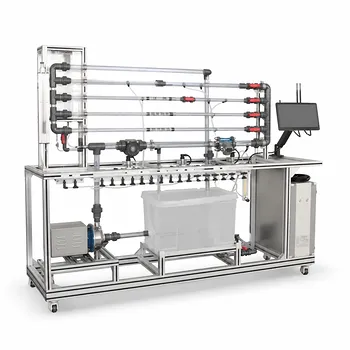
The interplay of mass transfer kinetics and fluid mixing fundamentally shapes the reactant concentration profile. The mass transfer coefficient directly controls the rate at which reactants are consumed at the electrode walls, steepening the concentration gradient along the reactor. Axial dispersion, by introducing back-mixing, flattens this gradient and causes upstream diffusion, making the inlet concentration inside the electrode lower than the bulk feed—a critical deviation from ideal plug-flow behavior.
In a flow-through porous electrode, the observed concentration decay is a tug-of-war between consumption and mixing. The mass transfer coefficient sets the local consumption rate, while axial dispersion spreads the reactant both backward and forward, smoothing out the profile and altering the effective inlet condition.
Untangling the Two Effects on Concentration Distribution
The primary reference establishes that the concentration distribution in a flow-through porous electrode reactor is governed by a balance of convection, diffusion, axial dispersion, and wall mass transfer. To understand how each parameter plays its role, it helps to first isolate the ideal case and then layer in the complexity.
The Ideal Plug-Flow Baseline: When Axial Dispersion is Neglected
When axial dispersion and molecular diffusion are ignored, the reactant concentration profile becomes a clean, exponential decay. This simplification directly links the profile to the mass transfer coefficient (k_m), the specific interfacial area (a), and the superficial fluid velocity (u).
- The mass transfer coefficient dictates the slope. A higher
k_mmeans the local flux of reactant to the pore walls is greater under limiting current conditions. This causes a steeper decline in reactant concentration per unit length. - The product
k_m * arepresents the volumetric mass transfer capacity. The larger this product, the faster the reactant is depleted, resulting in a more compact exponential tail. - This idealization is useful for rapid, first-order estimates and is often taught in educational pilot plants to establish the fundamental relationship between mass transfer and conversion.
The Intrusion of Real Flow: How Axial Dispersion Reshapes the Profile
Real fluid flow through porous electrodes deviates from the plug-flow ideal due to velocity profiles, turbulence, and molecular diffusion. The axial dispersion model superimposes a dispersion term—analogous to an effective diffusion coefficient—onto the plug-flow convection equation.
- Upstream diffusion lowers the effective inlet concentration. A defining consequence of including axial dispersion is that the reactant concentration just inside the electrode inlet is lower than the bulk feed concentration. This occurs because dispersion allows reactant species to migrate against the convective flow, a phenomenon completely absent in the simple exponential model.
- The profile loses its pure exponential shape. Dispersion acts to smooth concentration gradients. Where the simple model predicts a sharp drop, the dispersed profile shows a more gradual, S-shaped or stretched-exponential decay, especially near the inlet.
- The degree of dispersion shifts behavior between ideal limits. A small dispersion coefficient yields behavior approximating plug flow; a very large coefficient makes the reactor behave like a continuous stirred tank (CSTR), where the concentration becomes spatially uniform. This tunable behavior allows pilot plant students to observe how mixing directly alters reactor performance.
Synergistic Effects in Pilot Plant Reactors
The two parameters do not act in isolation. In a pilot plant, you frequently change one and inadvertently affect the other.
- A higher flow rate increases
k_m(by thinning the diffusion boundary layer) but also increases axial dispersion (due to higher turbulence and channeling). The net effect on the concentration profile can be non-monotonic. - Under mass-transfer-limited conditions, the local reaction rate is directly proportional to
k_m. While this steepens the local gradient, a high dispersion coefficient can simultaneously spread the reactant backward, extending the active zone further upstream. The resulting profile is a compromise between rapid consumption and aggressive back-mixing. - Measurement in educational pilots can reveal these interactions: if you measure a concentration at the inlet that is noticeably below the feed tank value, axial dispersion is significant and cannot be ignored in your kinetic analysis.
Understanding the Trade-Offs in Modeling and Scale-Up
Choosing how to account for these effects involves a clear set of trade-offs that impact both experimental analysis and reactor design.
- Model simplicity vs. accuracy. The exponential model is analytically tractable and requires only one parameter (
k_m * a). It rapidly provides an upper bound on conversion. However, it fails at predicting the inlet concentration and can overestimate overall conversion if dispersion is strong. The axial dispersion model adds a second adjustable parameter (the dispersion coefficient) and accurately captures inlet effects, but at the cost of more complex numerical solutions. - Flow rate as a confounding factor. Increasing flow boosts mass transfer (good for conversion) but increases dispersion (mixing flattens the profile, potentially reducing local driving force). In pilot-scale scale-up, the optimal flow is often a compromise that maximizes the product of conversion and throughput, not just the mass transfer coefficient.
- Educational clarity vs. real-world fidelity. For a chemical engineering pilot plant, starting with the ideal exponential model helps students grasp the direct role of
k_m. Introducing dispersion later illustrates how non-idealities create the differences between textbook predictions and experimental data, a foundational lesson in reactor engineering.
Making the Right Choice for Your Analysis Goal
Your decision to include or neglect axial dispersion should hinge on what you aim to achieve with the pilot plant data.
- If your primary focus is extracting mass transfer coefficients: Use the exponential model and restrict your data to the reactor’s midsection where dispersion effects at the inlet/outlet are minimized. Be aware that you are assuming an idealized boundary condition.
- If your primary focus is accurate conversion prediction and scale-up: Incorporate the axial dispersion model. Measure the inlet concentration experimentally to validate your dispersion coefficient, especially if the reactor length-to-diameter ratio is low.
- If your primary focus is demonstrating flow non-idealities: Intentionally vary the flow rate and chart how the measured concentration profile diverges from the exponential baseline. This vividly shows students the transition from plug-flow to dispersed behavior.
- If your primary focus is maximizing reactor throughput: Optimize both
k_m * aand the flow regime simultaneously, recognizing that high dispersion may require a longer electrode to achieve the same target conversion despite improved mass transfer.
By recognizing that the observed concentration distribution is a direct fingerprint of both the reaction kinetics and the fluid mechanics, you transform a simple concentration measurement into a powerful diagnostic tool for reactor health and performance.
Summary Table:
| Parameter/Feature | Ideal Plug-Flow Model | Axial Dispersion Model |
|---|---|---|
| Dispersion Effect | Neglected (ideal plug flow) | Included (back-mixing & diffusion) |
| Concentration Profile | Pure exponential decay | S-shaped / stretched exponential decay |
| Inlet Concentration | Equal to bulk feed concentration | Lower than bulk feed (upstream migration) |
| Best Used For | Quick mass transfer ($k_m$) estimation | Accurate conversion prediction & scale-up |
Optimize Your Reactor Dynamics with LABPARK Pilot Plants
Bridge the gap between theoretical calculations and real-world reactor performance. LABPARK provides high-quality Educational and Vocational Unit Operations Pilot Plants in chemical engineering, bioprocess & biotech, and environmental & water treatment for universities, research institutes, and enterprises.
Our advanced pilot systems empower students and researchers to visualize non-ideal flow, analyze mass transfer kinetics, and master reactor scale-up.
Contact LABPARK today to find the perfect pilot plant solution for your lab!
Related Products
- Constant Pressure Filtration Educational Unit Operations Pilot Plant
- Electrolyte Distillation Purification and Formulation Educational Pilot Plant
- Tubular Reactor Flow Characteristics Determination Educational Unit Operations Pilot Plant
- Centrifugal Pump Performance and Orifice Flowmeter Calibration Educational Pilot Plant
- Orifice and Venturi Flowmeter Calibration Educational Pilot Plant for Fluid Mechanics Laboratory
People Also Ask
- How do educational unit operations pilot plants bridge theory and design? Bridge the Engineering Gap
- How do educational unit operations pilot plants address safety and waste management when scaling up?
- Why splitting a filtration batch doesn't always reduce cycle time? Pilot Plant Insights
- Why Demo Constant-Rate to Constant-Pressure Filtration on a Pilot Plant? Key Practical Insights
- How can researchers identify and resolve filter medium blinding? Optimize Your Pilot Plant Runs