A single-minded industrial mindset—'just apply high pressure to speed things up'—can be the fastest way to ruin a batch.
Demonstrating the transition from constant-rate to constant-pressure filtration on a pilot plant teaches a pivotal operational safeguard. It shows exactly why you must start filtration with a controlled, constant flow to gradually build a cake layer, and only then switch to constant pressure once a protective structure is established. The practical significance lies in bridging the theoretical equations with the real-world decision-making that prevents blinding, controls cake compressibility, and maximizes throughput without damaging the filter medium.
The core takeaway is that industrial filtration is rarely a single‑mode operation. This demonstration makes the hybrid constant-rate → constant-pressure strategy visceral, showing how to inoculate a filter against premature clogging while still exploiting the efficiency of high‑pressure driving force. It transforms abstract math into an operational playbook, giving engineers the intuition to design, troubleshoot, and scale up robust filtration processes.
The Hidden Threat in Full-Pressure Startup
Jumping directly to a high constant pressure is dangerous because it can instantly force fine particles into the filter medium, causing permanent blinding. For compressible cakes, a sudden pressure spike also compresses the first layers into an almost impermeable skin, skyrocketing resistance.
Why a Single‑Mode Approach Fails Delicate Feeds
When you apply full pressure at the very start of a batch, the filter medium faces the total driving force with no cake to act as a depth filter. Particles are driven deep into the pores, and you get a rapid, irreversible loss of permeability.
If the solids are soft or colloidal—metal oxides, biological flocs, certain polymers—the high initial pressure compresses the cake’s void structure on contact. The porosity collapses, and the pressure drop becomes so severe that the filtrate rate drops to an uneconomic trickle.
The Industrial Workaround You Can’t Learn from a Textbook Alone
Real plants avoid these disasters by using a hybrid start‑up: a positive displacement pump with a bypass valve to limit flow. The system builds pressure gradually as the cake forms, shielding the medium and giving the cake a chance to develop an open, porous architecture.
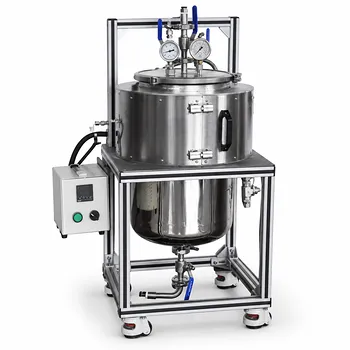
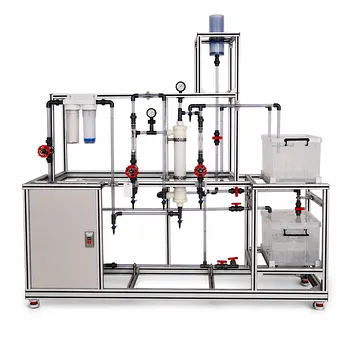
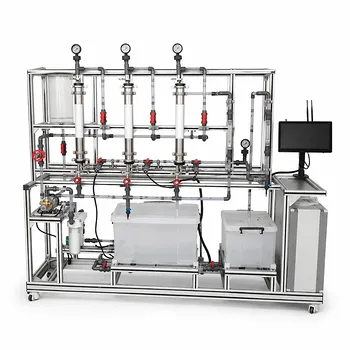
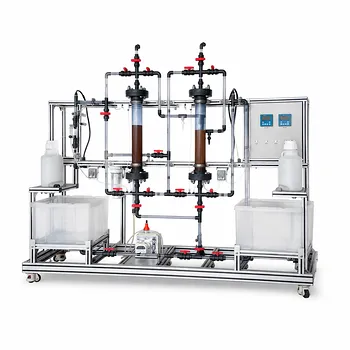
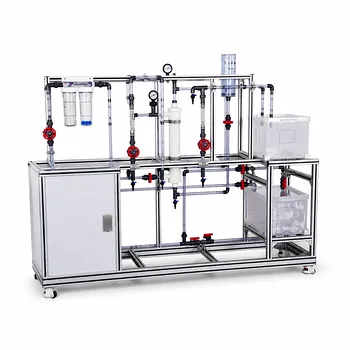
A pilot plant makes this sequence observable. Students see the pump’s constant flow, the rising pressure, and the moment when the operator flips to a constant‑pressure supply. That visual, hands‑on experience seals the concept in a way that spreadsheets cannot.
The Hybrid Strategy: Building a Protective Cake
At its core, the constant-rate phase acts like a gentle scaffold. By restricting the initial flow to a safe value, you give the first layer of solids time to bridge across the medium’s pores and form a homogeneous pre‑coat.
How a Gradual Cake Protects the Medium
During constant-rate filtration, the pressure climbs linearly as the cake thickens. The early cake performs two roles: it becomes a depth filter that traps subsequent fines, and it distributes the mechanical load evenly across the medium.
Once the system reaches a predetermined target pressure—often the maximum safe limit of the pump or the desired operating point—you switch to constant pressure. The cake is now established and resilient, so you can open the driving force without fear of sudden blinding or compaction.
The Teaching Value of Calculating V and θ
Pilot‑plant runs make the classic filtration equations tangible. Students measure the exact volume of filtrate collected and the time elapsed at the switchover point. They then use the constant-rate equation (pressure vs. volume) and the constant-pressure equation (t/V vs. V) to back‑calculate the specific cake resistance and medium resistance.
This exercise proves that the theoretical models actually predict performance—provided you respect the cake’s evolving structure. It transforms abstract parameters into numbers they have generated themselves.
Observing Theory in Action: When to Switch
The decision to transition isn’t arbitrary. You often switch when the pressure reaches a set value, or when the filtrate flow under constant‑rate begins to decay below a threshold. The demonstration makes clear that the switchover point can dramatically alter cycle time and final cake moisture.
The Risk of Switching Too Early
If you jump to constant pressure before a stable cake has formed, you essentially re‑create the full‑pressure startup problem. The medium still sees high local velocity, and the thin cake cannot protect it from particle impaction.
The pilot plant shows this visibly: pressure may spike chaotically, or filtrate clarity drops because solids are being forced through the weak cake and medium. It’s a memorable lesson that a robust cake is your best insurance.
The Waste of Switching Too Late
Conversely, holding constant-rate for too long drags out the cycle. The pressure rises high enough that the pump works harder and the cake experiences unnecessary compaction anyway. The sweet spot is where the cake has enough thickness to act as a filter but hasn’t yet become so resistive that it chokes the process.
Seeing the pressure curve flatline or the flow become frustratingly slow after a late switch drills home the economic cost of poor timing.
The Deeper Lesson: Cake Compressibility and Process Robustness
The supplementary point about compressible vs. incompressible cakes is critical. Incompressible solids (diatomite, sand) withstand pressure changes with little loss in porosity, so a full‑pressure start is less harmful. But many valuable products are compressible.
How the Pilot Plant Reveals Compressibility
By running constant‑pressure tests on previously formed cakes, students can measure how specific cake resistance changes with pressure. A compressible cake shows a rising resistance exponent; an incompressible one remains nearly flat.
This takes the demonstration beyond a simple switchover—it explains why the hybrid strategy exists in the first place. You can then discuss the use of filter aids, rigid body feeds, or pre‑coating to artificially create an incompressible layer that protects the medium.
Bridging the Gap Between Lab and Plant Operation
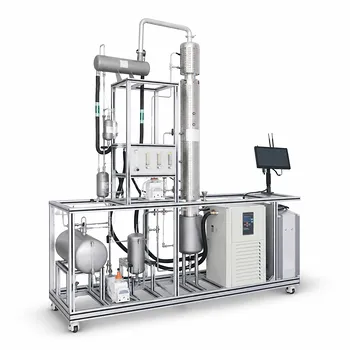
In a plant, operators can’t see inside the filter housing. The pilot plant’s transparent piping, pressure gauges, and graduated receivers make the invisible dynamics visible. This is the ultimate practical significance: it gives future engineers the mental model to diagnose a real process upset, identify whether blinding or compaction is the root cause, and adjust the startup procedure accordingly.
Understanding the Trade-offs of the Hybrid Approach
No strategy is without its downsides, and the constant‑rate‑to‑constant‑pressure transition is no exception. Acknowledging these limitations builds trust and rounds out the educational value.
Increased Complexity in Control
A hybrid system needs a positive displacement pump, a bypass loop, a pressure sensor, and a control valve or algorithm to maintain constant rate before switching. This is more maintenance‑intensive and costlier than a simple constant‑pressure centrifugal pump setup.
Potential for Premature Pump Wear
Running a positive displacement pump against a throttled bypass generates heat and can cause internal recirculation wear if not designed correctly. In pilot‑scale it’s safe, but in production it demands proper relief paths and cooling.
Not Always Necessary for Incompressible Feeds
If you are filtering crystalline salt or rigid bead catalysts, the medium blinding risk is low. The hybrid startup might simply lengthen the effective cycle time without giving a proportional benefit. The demonstration therefore also teaches the wisdom of matching the strategy to the material—not applying a one‑size‑fits‑all rule.
Applying the Demonstration’s Lessons to Your Process
Understanding the transition from constant‑rate to constant‑pressure operation gives you a framework for making smart, material‑driven filtration decisions. The pilot‑plant insight translates directly into process design choices.
- If your primary focus is a compressible, high‑value product (e.g., pharmaceutical crystals, biopolymers): Use the hybrid startup strategy to protect cake permeability, and consider adding a filter aid pre‑coat to further reduce sensitivity to pressure.
- If your primary focus is a coarse, incompressible solid (e.g., mineral slurries, washing sands): A direct constant‑pressure startup may be acceptable, but use pilot testing to confirm that the medium doesn’t blind over repeated cycles.
- If your primary goal is to minimize cycle time in an existing process: Identify the optimum pressure switchover point experimentally; the pilot‑plant demonstration shows that even a 5‑10% shift in timing can cut total filtration time noticeably without sacrificing final cake dryness.
- If you are scaling up from bench data: Never assume that a constant‑pressure lab test alone predicts plant behavior—incorporate a startup phase that mimics the plant’s actual hydraulic profile, and use pilot‑scale tests to validate your model.
The transition from constant‑rate to constant‑pressure filtration is far more than an academic exercise. It is the moment where theory confronts the stubborn reality of particle behavior, giving you the tools to operate a filter, not just design it.
Summary Table:
| Filtration Phase | Primary Objective | Key Control Parameter | Main Operational Risk |
|---|---|---|---|
| Constant-Rate Phase | Build a protective, porous cake layer | Controlled flow rate (pump bypass) | Pressure overload if held too long |
| Constant-Pressure Phase | Maximize throughput & efficiency | Constant driving pressure | Medium blinding & compaction if started too early |
Bring Industrial Filtration Theory to Life in Your Lab
Teaching complex concepts like the transition from constant-rate to constant-pressure filtration requires hands-on, visual learning that textbooks simply cannot replicate.
LABPARK provides premium Educational and Vocational Unit Operations Pilot Plants in chemical engineering, bioprocess & biotech, and environmental & water treatment. Designed specifically for universities, research institutes, and enterprises, our pilot plants empower students and researchers to master real-world process dynamics, prevent operational failures, and scale up processes with confidence.
Ready to upgrade your engineering laboratory? Contact LABPARK today to explore our custom pilot plant solutions!
Related Products
- Hot Filtration Educational Unit Operations Pilot Plant Laboratory System
- Constant Pressure Filtration Educational Unit Operations Pilot Plant
- Multi-Functional Membrane Separation Educational Pilot Plant for Unit Operations Lab
- Gas-Solid Heterogeneous Separation Demonstration Educational Unit Operations Pilot Plant
- Continuous Sieve-Plate Distillation Pilot Plant for Unit Operations Laboratory Education
People Also Ask
- How to Determine Specific Cake (r) & Filter Medium (Rm) Resistance Using Filtration Pilot Plant Data
- How to select solid-liquid separation equipment for pilot plants? A Step-by-Step Guide
- How can researchers identify and resolve filter medium blinding? Optimize Your Pilot Plant Runs
- How do Buchner funnels & leaf filters differ in filtration scale-up? Key Differences Explained
- What are the indicators of cake cracking in a filtration pilot plant & how to address it for efficient washing?