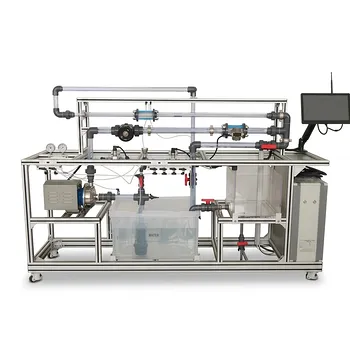
The key distinction lies in diagnostic depth: a Buchner funnel gives you a rough sketch, while a leaf filter provides the engineering blueprint for scale-up. Setting up a chemical engineering pilot plant for filtration experiments, Buchner funnels are vacuum-driven, simple devices used for basic solid-liquid separation—they can offer a rough first approximation of cake properties. Leaf filters, on the other hand, are specifically designed to characterize slurry filtration behavior under controlled, variable pressures, directly measuring specific cake resistance and compressibility index, the two critical parameters required for scalable equipment design.
Buchner funnels are invaluable for rapid, qualitative screening, but they cannot deliver the pressure-dependent filtration data necessary for accurate scale-up. To truly characterize a slurry’s filtration properties and predict how a full-scale unit will perform, a leaf filter is the essential tool — it quantifies the relationship between driving force, cake structure, and filtration rate, turning guesswork into a reproducible engineering calculation.
What Each Tool Actually Measures
A pilot plant’s value hinges on generating data that translate to production. The way these two devices gather information defines their role in scale-up.
The Buchner Funnel: A Qualitative Screening Tool
A Buchner funnel applies vacuum to pull liquid through a filter medium and forms a cake. It tells you, quickly, whether a slurry can be filtered and gives a rough sense of cake thickness and dryness. However, the driving force is fixed at vacuum level (typically ~0.8 bar differential pressure). You cannot systematically vary the pressure to observe how the cake compresses, and the filtration profile — the rate of filtrate collection over time — is rarely recorded with enough precision to calculate fundamental cake resistance. As a result, parameters you gather are at best a first-order filterability index, not engineering-scale constants.
The Leaf Filter: A Quantitative Scale-Up Instrument
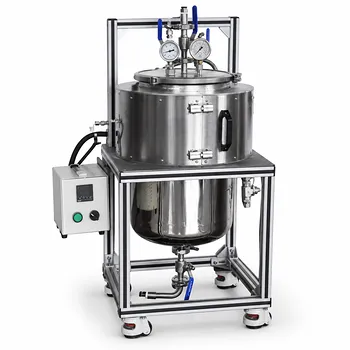
Leaf filters are larger benchtop or pilot-scale devices that hold a small filter leaf immersed in slurry. Compressed nitrogen or air imposes a precise, adjustable pressure on the slurry. The filtrate is collected and measured at timed intervals, generating a detailed filtration profile — volume versus time — under steady, known pressure drops. By repeating the test at multiple pressures, you obtain a family of curves that directly yield:
- Specific cake resistance (α): A measure of the cake’s resistance to flow, dependent on its structure and the applied pressure.
- Compressibility index (n): How much the cake compacts (and resistance rises) as the pressure increases.
These parameters are the language of filter design; without them, sizing a full-scale filter is little more than a guess.
Why Pressure Dependence Matters for Scale-Up
Moving from lab to production means scaling pressure drops across much thicker cakes. A slurry that behaves nicely under low vacuum may blind rapidly at industrial pressures. That sensitivity is exactly what a leaf filter probes.
Cake Compressibility and the Compressibility Index
The supplementary literature highlights compressibility as the first factor in equipment selection. Some cakes are nearly incompressible (resistance constant with pressure), but many slurries form highly compressible cakes that collapse under pressure, dramatically increasing resistance. The compressibility index n quantifies this behavior through the relationship α = α₀·ΔPⁿ. A leaf filter measures α at, say, 0.5, 1.0, and 2.0 bar, allowing a plot of log α vs. log ΔP to determine n. A Buchner funnel, locked at one pressure, can never reveal this slope, so you remain blind to how the cake will behave in a pressurized filter press or centrifuge.
Obtaining the Filtration Profile to Derive Specific Cake Resistance
For each constant-pressure run, a leaf filter provides a precise set of t/V vs. V data. Plotting this linearizes the classic Ruth filtration equation, giving you both the medium resistance (Rₘ) and the specific cake resistance (α). The slope of that line directly gives α, which can then be correlated with pressure. Buchner setups rarely capture enough timed volume points or maintain a perfectly constant vacuum to produce this level of accuracy. So while students can see the principles in a Buchner funnel, only a leaf filter delivers the numbers a process engineer trusts for equipment sizing.
Understanding the Trade-offs
Choosing between these tools is not about one being “better”; it is about matching the data quality to the task. Each approach has inherent limitations that a pilot plant designer must weigh.
The Case for Starting with a Buchner Funnel
Buchner funnels are fast, inexpensive, and require minimal setup. For early-stage work—like confirming that a precipitation yields filterable crystals, or selecting a filter cloth material—the rapid feedback is invaluable. They also serve as an educational stepping stone, letting students visually grasp cake formation before introducing the complexity of a leaf filter. However, they are a dead end for scale-up; supplementing qualitative observations with hard numbers always requires the next step.
The Price of Precision with a Leaf Filter
Leaf filters demand careful operation. Preparing a representative slurry, ensuring uniform suspension, and recording timed volumes under strict pressure control take time and skill. Cleaning between tests can be tedious, and the equipment itself is more costly. Moreover, factors such as cake cracking, solvent channeling, or attrition during agitation — mentioned in the supplementary references — become more apparent in a leaf filter test and must be managed, adding a layer of practical complexity that a simple Buchner test masks. Yet, this deeper realism is precisely what makes the leaf filter the definitive tool for scale-up characterization.
Making the Right Choice for Your Pilot Plant
Your selection should align with what question you need the data to answer. Use the guidance below to anchor your decision in the objective of your experiments.
- If your primary focus is rapid qualitative screening, teaching basic filtration theory, or choosing filter medium: A Buchner funnel is the pragmatic starting point. Use it to quickly judge filterability and observe cake appearance, but recognize that the numbers it yields are not scale-up grade.
- If your primary focus is generating reliable scale-up parameters (specific cake resistance, compressibility index) to design or specify a full-scale filter: Invest the time in leaf filter experiments across multiple pressure setpoints. This data makes sizing calculations possible and avoids costly over- or under-specification.
Focus your pilot plant on the data that will drive the next engineering decision. When scale-up is the goal, let the leaf filter be your quantitative anchor—it turns a mysterious slurry into a predictable, design-ready stream.
Summary Table:
| Feature | Buchner Funnel | Leaf Filter |
|---|---|---|
| Primary Use | Qualitative screening & basic teaching | Quantitative scale-up design & testing |
| Driving Force | Fixed vacuum (~0.8 bar drop) | Adjustable pressure (variable gas pressure) |
| Key Data | Basic filterability index | Specific cake resistance (α) & compressibility (n) |
| Scale-up Value | Low (rough approximation only) | High (predictive design calculations) |
Optimize Your Filtration Experiments with LABPARK
Are you looking to equip your laboratory with precise, scale-up ready equipment? LABPARK provides premium Educational and Vocational Unit Operations Pilot Plants in chemical engineering, bioprocess & biotech, and environmental & water treatment for universities, research institutes, and enterprises.
Whether you need hands-on teaching tools or advanced process characterization systems, we help you bridge the gap between classroom theory and industrial application. Contact us today to find the perfect filtration pilot plant for your institution!
Related Products
- Hot Filtration Educational Unit Operations Pilot Plant Laboratory System
- Constant Pressure Filtration Educational Unit Operations Pilot Plant
- Ultrafiltration Membrane Separation Educational Pilot Plant
- Hollow Fiber Ultrafiltration Membrane Separation Educational Pilot Plant
- Multifunctional Membrane Separation Educational Pilot Plant with Ultrafiltration, Nanofiltration, Reverse Osmosis
People Also Ask
- How to Determine Specific Cake (r) & Filter Medium (Rm) Resistance Using Filtration Pilot Plant Data
- How can researchers identify and resolve filter medium blinding? Optimize Your Pilot Plant Runs
- How to select solid-liquid separation equipment for pilot plants? A Step-by-Step Guide
- Why Demo Constant-Rate to Constant-Pressure Filtration on a Pilot Plant? Key Practical Insights
- What are the indicators of cake cracking in a filtration pilot plant & how to address it for efficient washing?