Knowledge Chemical Engineering Education How can SRK be applied in pilot plants to model and separate azeotropes? VLE Modeling Guide
Author avatar

Tech Team · LABPARK

Updated 3 months ago

How can SRK be applied in pilot plants to model and separate azeotropes? VLE Modeling Guide


In a pilot-scale distillation column separating a tricky azeotropic mixture, the difference between success and failure often comes down to the fidelity of your thermodynamic model. The Soave-Redlich-Kwong (SRK) equation is applied directly to model the vapor-liquid equilibria (VLE) of the mixture, predicting where an azeotrope will form and—crucially—the conditions under which an added entrainer or solvent will cause it to break. This allows operators and researchers to simulate column tray performance, then immediately compare those simulation outputs against live experimental data from the pilot plant.

The core value of applying an equation of state like SRK in a pilot plant isn’t just about phase prediction—it’s about creating a feedback loop. By modeling the azeotrope, testing a separation strategy in simulation, and then validating against physical column data, you expose the limitations of the model and refine your understanding of the real system.

Beyond Ideal Behavior: Why Cubic Equations Are Essential for Pilot Plants

Real mixtures deviate dramatically from ideal behavior, especially when they form azeotropes. A single equation of state provides self-consistent PVT and fugacity calculations across both vapor and liquid phases, avoiding the errors that come from using separate, mismatched activity-coefficient models for each phase. For azeotropic systems that refuse to separate by simple distillation, cubic equations like SRK become the foundation for understanding non-ideality.

The Azeotrope Challenge

An azeotrope occurs when the vapor and liquid phases have identical compositions—making conventional separation impossible. The SRK equation, a modified cubic EOS, incorporates the acentric factor to capture temperature-dependent attraction forces between molecules. That temperature dependence is what lets SRK predict the non-ideal VLE behavior that gives rise to an azeotrope and, equally important, predict how adding a heavy entrainer shifts the phase equilibrium enough to break it.

From Equation to Experiment: The Pilot Plant as a Validation Engine

In educational and research pilot plants, the SRK model is used to generate a simulated column profile: tray temperatures, compositions, and reflux requirements. The pilot plant then produces actual physical measurements.

When the column hits a pinch point at the predicted azeotropic composition, the model is validated. If the model says an entrainer will break the azeotrope but the real column stays stuck, operators know the binary interaction parameters need adjustment. This direct comparison transforms the pilot plant into a thermodynamic verification tool, not just a process demonstration.

Navigating the Limitations: When Standard Models Break Down

A cubic equation of state is a mathematical compromise. It will produce accurate results in some operating regions yet fail in others, and those failure zones can be hard to spot without experimental data. The pilot plant exposes these regional inaccuracies immediately.

Modeling Gaps: Beyond Pure Hydrocarbons

Standard SRK depends on critical properties and the acentric factor. For relatively simple hydrocarbon azeotropes—like carbon dioxide and ethane—that is often sufficient. But for polar or hydrogen-bonding substances, the underlying assumptions fall apart.

In those cases, you need an EOS framework that incorporates temperature- and pressure-independent binary interaction parameters based on size-shape or polarity factors. For a pilot plant separating alcohol-water mixtures, sticking to an unmodified SRK can lead to predicted azeotropic compositions that are dangerously far from reality.

The Role of Binary Interaction Parameters

Even within “simple” systems, the default (k_{ij}) values in process simulators are only estimates. To make SRK work reliably for azeotrope modeling, you must regress these interaction parameters against experimental VLE data—often the very data you are collecting in the pilot plant. The goal is not to force the model to match every tray perfectly, but to ensure it correctly captures the existence and disappearance of the azeotrope itself.

Understanding the Trade-offs: Speed, Simplicity, and Fidelity

A pilot plant environment demands that simulations run alongside operations without becoming a computational bottleneck. This is where cubic EOS like SRK and Peng-Robinson (PR) hold a clear advantage.

They require minimal input data—critical temperature, critical pressure, acentric factor—and their explicit derivatives allow for fast, stable convergence in iterative flowsheeting calculations. Multi-parameter equations like BWRS can deliver higher accuracy over a wider range of PVT data, but they slow down simulation and need far more experimental data to tune. In a teaching or research pilot plant, where you constantly test hypotheses and adjust operating conditions, the speed of a cubic EOS is rarely worth sacrificing.

When Complexity Is Warranted

There are exceptions. If the pilot plant is studying hydrate formation in LNG systems or needs extremely accurate predictions of critical pressure in methane-rich mixtures, you may need a more specialized method. But even then, that higher-fidelity model must be benchmarked against the simpler SRK and, above all, against the physical pilot plant data. Complexity without validation is just guesswork.

Making the Right Choice for Your Separation Goal

The right application of SRK depends on what you are actually trying to learn or achieve in the pilot plant. Use these guideposts to align your modeling approach with your objective.

  • If your primary focus is teaching thermodynamic fundamentals and model validation: Use SRK to simulate the column, then challenge students to reconcile the simulation-predicted azeotrope composition with actual measured data. The discrepancy is the lesson.
  • If you are operating a pilot plant to break an azeotrope with an entrainer: Rely on SRK with carefully regressed binary interaction parameters from experimental VLE data. Validate the simulated column temperature and composition profiles against your pilot plant to confirm the model is accurate enough for scale-up decisions.
  • If you are dealing with highly polar or hydrogen-bonding mixtures: Recognize that standard SRK may be insufficient. Consider an advanced EOS with specialized mixing rules, but always benchmark it against pilot plant measurements—never trust a model blindly just because it is more complex.

The true power of a cubic equation of state like SRK in a pilot plant lies not in its ability to give perfect answers, but in its ability to reveal the precise gaps between theory and reality, turning every experiment into a lesson in thermodynamic refinement.

Summary Table:

Thermodynamic Model Key Strengths Main Limitations Best Pilot Plant Use Case
Standard SRK Fast convergence, minimal input data needed Fails for highly polar or hydrogen-bonding mixtures Hydrocarbon separation & fundamental VLE teaching
Modified SRK (with regressed $k_{ij}$) Accurately predicts azeotropes & entrainer effects Requires VLE experimental data regression Azeotropic distillation & entrainer validation
Multi-parameter EOS (e.g., BWRS) High accuracy across wide PVT ranges Computationally heavy, complex tuning Specialized systems like LNG phase behavior

Bridge the Gap Between Thermodynamic Theory and Process Reality

Are you looking to equip your laboratory or facility with robust, hands-on validation tools? LABPARK provides state-of-the-art Educational and Vocational Unit Operations Pilot Plants in chemical engineering, bioprocess & biotech, and environmental & water treatment.

Designed specifically for universities, research institutes, and enterprises, our pilot plants allow you to easily validate complex thermodynamic models (like SRK), refine binary interaction parameters, and optimize real-world separation processes.

Ready to elevate your training and research capabilities? Contact LABPARK today to discuss your custom pilot plant requirements!

Related Products

People Also Ask

Related Products

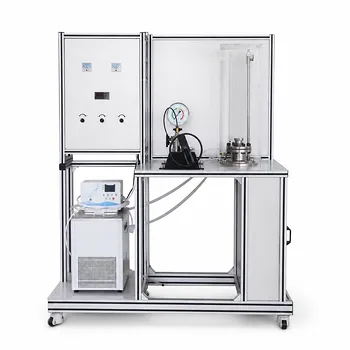
Carbon Dioxide PVT Curve Determination Educational Unit Operations Pilot Plant

Carbon Dioxide PVT Curve Determination Educational Unit Operations Pilot Plant

Enable hands-on learning of thermodynamic principles with this carbon dioxide PVT curve determination pilot plant. Students visualize critical opalescence, phase transitions, and generate P-V isotherms across liquid, gas, and supercritical regions. Robust safety features, adaptable for university engineering labs.

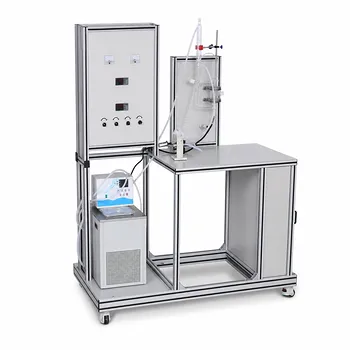
Binary System Vapor Liquid Equilibrium Data Determination Educational Unit Operations Pilot Plant

Binary System Vapor Liquid Equilibrium Data Determination Educational Unit Operations Pilot Plant

This educational pilot plant determines vapor-liquid equilibrium data for binary systems under atmospheric pressure. Students observe phase behavior, measure T-P-X-Y, and construct phase diagrams for unit operations labs. Features transparent cell, dual circulation. Ideal for chemical engineering curricula.

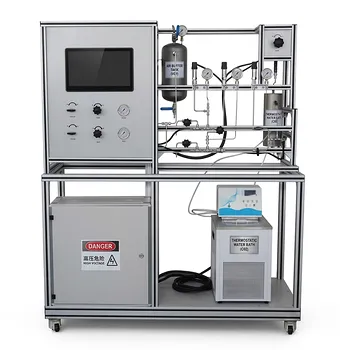
Throttling Effect Determination Educational Unit Operations Pilot Plant

Throttling Effect Determination Educational Unit Operations Pilot Plant

Investigate the Joule-Thomson throttling effect with this educational unit operations pilot plant. Designed for engineering students, it enables hands-on comparative analysis of adiabatic gas expansion using precise process control, interactive digital interface, and eco-friendly operation, ensuring safe repeatable thermodynamic experiments.

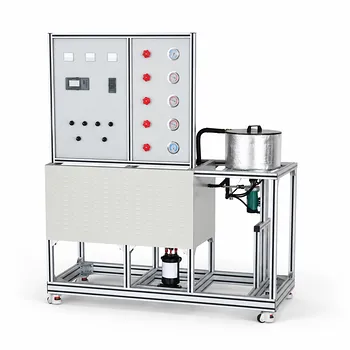
Educational Compression Refrigeration Performance Determination Unit Operations Pilot Plant

Educational Compression Refrigeration Performance Determination Unit Operations Pilot Plant

This educational pilot plant for compression refrigeration performance determination offers dual COP evaluation, regenerative cycle comparison, and calorimeter calibration. Customizable for curriculum integration, it features environmentally conscious design. Supports thermodynamic mapping on pressure-enthalpy diagrams and synchronous monitoring with centralized instrumentation.

Ternary Liquid-Liquid Equilibrium Educational Pilot Plant

Ternary Liquid-Liquid Equilibrium Educational Pilot Plant

An integrated laboratory training system for engineering students to determine ternary liquid-liquid equilibrium data, construct phase diagrams, and gain hands-on experience with industrial instrumentation, including Abbe refractometer and magnetic stirrers, for precise data acquisition and curriculum-aligned experiments.

Multi Functional Catalytic Reaction and Reactor Evaluation Educational Unit Operations Pilot Plant

Multi Functional Catalytic Reaction and Reactor Evaluation Educational Unit Operations Pilot Plant

Bench-scale educational pilot plant for catalytic reaction and reactor evaluation, integrating fixed bed, fluidized bed, and stirred tank reactors. Students compare reactor designs, evaluate catalysts, and study reaction kinetics and hydrodynamics. Perfect for unit operations labs in chemical engineering curricula.

Solid Spherical Heat Transfer Coefficient Determination Educational Chemical Engineering Pilot Plant

Solid Spherical Heat Transfer Coefficient Determination Educational Chemical Engineering Pilot Plant

This educational chemical engineering pilot plant enables students to determine convective heat transfer coefficients and observe transient thermal behavior of solid spheres under natural convection, forced convection, fixed beds, and fluidized bed regimes.

Comprehensive Heat Transfer Coefficient Determination Educational Unit Operations Pilot Plant

Comprehensive Heat Transfer Coefficient Determination Educational Unit Operations Pilot Plant

Advanced industrial-grade educational pilot plant for comprehensive heat transfer coefficient determination. Enables quantitative convective heat transfer analysis, evaluates double-pipe and shell-and-tube exchanger configurations, and includes digital data acquisition. Customizable for engineering curriculum. Ideal for engineering unit operations labs.

Rising and Falling Film Evaporation Educational Unit Operations Pilot Plant

Rising and Falling Film Evaporation Educational Unit Operations Pilot Plant

Hands-on educational pilot plant for studying rising and falling film evaporation, flow regimes, and heat transfer. Customizable for university labs with industrial instrumentation and data acquisition. Enables comparative evaluation of evaporation modes and energy efficiency.

Fluid Friction Resistance Determination Educational Unit Operations Pilot Plant

Fluid Friction Resistance Determination Educational Unit Operations Pilot Plant

Engineered bench-scale system for university engineering labs. Provides hands-on fluid mechanics experience: quantitative energy loss analysis, flow regime observation, friction coefficient determination. Features four-point pressure measurement, transparent sections, industrial touchscreen PLC, 3D virtual simulation. Ideal for chemical, mechanical, civil engineering.

100L Continuous Loop Hydrogenation Educational Unit Operations Pilot Plant

100L Continuous Loop Hydrogenation Educational Unit Operations Pilot Plant

This 100L continuous loop hydrogenation pilot plant is designed for chemical engineering education, featuring 316 stainless steel construction, advanced gas-liquid mass transfer components, explosion-proof safety systems, and a 15.6-inch touchscreen with 5G connectivity, cloud data logging, bridging theory and industry.

Three-Tube Heat Transfer Educational Pilot Plant for Unit Operations Training

Three-Tube Heat Transfer Educational Pilot Plant for Unit Operations Training

Three-tube heat transfer pilot plant for studying convective heat transfer enhancement and condensation. Allows comparison of smooth, corrugated, turbulent tubes, verifying empirical correlations. Ideal for chemical engineering education with safety and closed-loop steam recovery.

Circulating Wind Tunnel Drying and Convective Heat Transfer Coefficient Determination Educational Pilot Plant

Circulating Wind Tunnel Drying and Convective Heat Transfer Coefficient Determination Educational Pilot Plant

This educational pilot plant enables engineering students to study convective drying, air-water vapor systems, and heat transfer by determining drying curves, drying rate curves, and convective heat transfer coefficients under variable conditions.

Orifice and Venturi Flowmeter Calibration Educational Pilot Plant for Fluid Mechanics Laboratory

Orifice and Venturi Flowmeter Calibration Educational Pilot Plant for Fluid Mechanics Laboratory

Enhance fluid dynamics education with the Orifice and Venturi Flowmeter Calibration Educational Unit Operations Pilot Plant, featuring transparent orifice and Venturi meters, industrial sensors, touchscreen interface for real-time data analysis and automatic coefficient calculations in engineering student laboratories.

Bernoulli Equation Demonstration Unit Operations Pilot Plant

Bernoulli Equation Demonstration Unit Operations Pilot Plant

Laboratory pilot plant for Bernoulli's equation demonstration with transparent PVC pipes, 23 piezometer tubes for pressure measurement, and hands-on experiments. Designed for engineering education to study energy conservation, hydraulic grade line, and localized losses in fluid steady-flow systems.

Potassium Salt Thermal Dissolution and Crystallization Separation Educational Unit Operations Pilot Plant

Potassium Salt Thermal Dissolution and Crystallization Separation Educational Unit Operations Pilot Plant

This educational pilot plant allows chemical engineering students to perform potassium salt thermal dissolution and cooling crystallization experiments, integrating solubility studies, supersaturation control, and solid-liquid separation in a safe, compact, and customizable laboratory system for hands-on unit operations learning.

Tubular Reactor Flow Characteristics Determination Educational Unit Operations Pilot Plant

Tubular Reactor Flow Characteristics Determination Educational Unit Operations Pilot Plant

Educational pilot plant for investigating tubular reactor flow characteristics and residence time distribution Features adjustable recycle for plug flow and backmixing studies industrial touchscreen interface and real-time data acquisition Ideal for chemical engineering unit operations laboratory training and education

Educational Unit Operations Pilot Plant for Intraparticle Diffusion Effective Factor Measurement

Educational Unit Operations Pilot Plant for Intraparticle Diffusion Effective Factor Measurement

Designed for chemical engineering university labs, this pilot plant allows hands-on determination of catalyst particle intraparticle diffusion effective factors and gas-solid reaction kinetics using a fixed-bed tubular reactor with industrial touchscreen control, bridging theory and practical reactor design.

Educational Rotary Disc Liquid-Liquid Extraction Pilot Plant

Educational Rotary Disc Liquid-Liquid Extraction Pilot Plant

A transparent rotary disc column for educational liquid-liquid extraction experiments. This pilot plant enables students to study mass transfer, droplet dynamics, and flooding behavior, bridging theory and practice in chemical engineering unit operations education. Features variable-speed agitation and PLC control.

Two Phase Flow Pattern Velocity Resistance Measurement Educational Pilot Plant

Two Phase Flow Pattern Velocity Resistance Measurement Educational Pilot Plant

Benchtop educational pilot plant for university labs studying gas-liquid two-phase flow patterns, velocity, and resistance across circular, square, and rectangular conduits. Features 15.6-inch touchscreen, 5G connectivity, differential pressure sensors, safe water-air operation. Supports chemical engineering curricula.


Leave Your Message