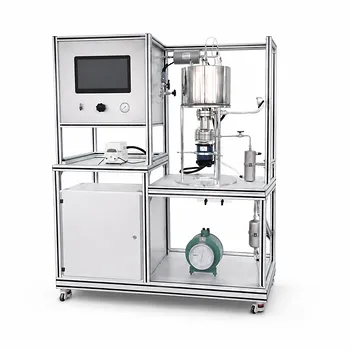
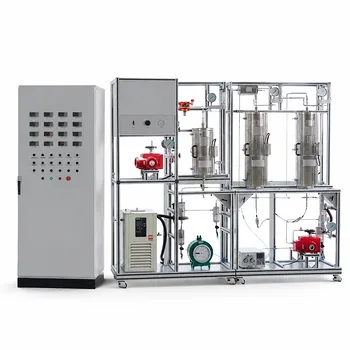
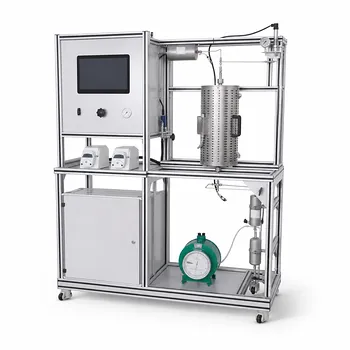
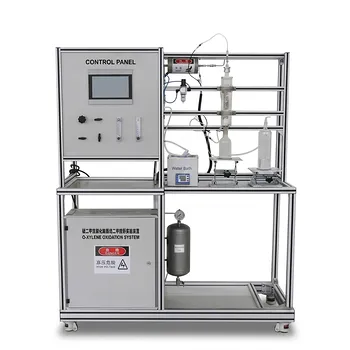
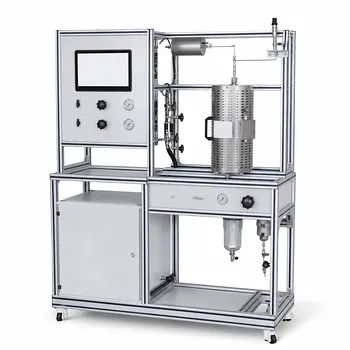
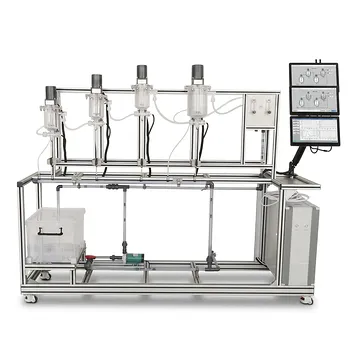
Temperature-programmed reduction (TPR) and desorption (TPD) techniques are demonstrated in catalytic reactor pilot plants by precisely programming a linear temperature ramp across a catalyst bed while continuously monitoring effluent composition with an online detector. Students and researchers adsorb a probe gas (for TPD) or flow a reducing mixture (for TPR), then record the gas consumed or released as the bed heats. This data directly yields reduction profiles, active site distributions, desorption activation energies, and even active metal surface areas, turning a unit operations pilot plant into a fully functional catalyst characterization lab.
The real educational power lies in the hands‑on bridge between molecular surface science and macro‑scale reactor operation. Beyond teaching characterization, TPR/TPD experiments in a pilot plant ingrain the critical role of temperature control, gas analysis, and safety—skills that translate directly to industrial catalyst activation, troubleshooting, and process development.
The Fundamentals of TPR/TPD in Pilot Plants
What Makes a Pilot Plant Ideal for TPR/TPD
A pilot‑scale catalytic reactor already contains the essential architecture for TPR/TPD: a tube reactor with a heated bed, mass flow controllers for gas delivery, and a downstream analytical system.
By adding a linear temperature programmer and a fast‑response detector close to the reactor exit, the same unit used for continuous reaction studies becomes a powerful characterization tool.
This integration eliminates the need for a separate benchtop TPR/TPD instrument, showing students how industrial R&D often co‑locates activation and testing.
The Core Measurement Principle
In TPD, a probe gas (CO, NH₃, or H₂) is first adsorbed at low temperature.
An inert carrier gas then sweeps the bed as the temperature rises linearly, causing desorption of bound molecules.
The detector signal versus time—or equivalently bed temperature—reveals peaks that correspond to different adsorption sites and binding energies.
In TPR, the catalyst is loaded in its oxidized form.
A dilute hydrogen/inert mixture flows while the temperature ramps linearly.
The consumption of hydrogen is tracked; peaks indicate the reduction of specific metal oxides or metal‑support interactions, teaching how calcination history and preparation methods influence reducibility.
Hardware Essentials for TPR/TPD Demonstrations
Precise Temperature Programming and Control
A furnace with a digital PID controller capable of linear ramps (often 1–20 °C/min) is mandatory.
The thermocouple must be placed directly inside the catalyst bed, not just in the furnace shell, to avoid lag and inaccuracies.
This placement teaches students why bed‑level temperature is critical—a principle that extends to controlling hotspots and deactivation in longer reaction runs.
Gas Delivery and Purification
High‑purity carrier and reactant gases require a purification train (oxygen/moisture traps) to prevent side reactions that would corrupt the reduction or desorption signal.
Mass flow controllers allow precise mixtures and the blank experiments (ramp without catalyst) that are subtracted from real data.
Students learn that gas impurity effects, often invisible at macro‑scale production, become dominant when quantifying monolayer‑level surface events.
Detection Systems: From TCD to Mass Spectrometry
A thermal conductivity detector (TCD) mounted near the reactor exit compares the carrier and effluent streams.
It is robust and inexpensive, making it excellent for teaching fundamentals.
For identifying multiple desorbing species or complex reduction intermediates, a quadrupole mass spectrometer is used.
The MS requires a heated capillary and a properly designed inlet to bridge the pressure gap between atmospheric reactor effluent and the high‑vacuum ionization chamber.
Reactor Design and Catalyst Bed Configuration
The reactor tube should minimize dead volume downstream of the bed to preserve peak sharpness.
Typically a quartz or stainless‑steel U‑tube packed with catalyst and held in place by quartz wool is used.
A bypass line allows the gas stream to be sent directly to the detector for calibration before the ramp begins, ensuring quantitative results.
Demonstrating the Techniques Step‑by‑Step
TPD: From Adsorption to Activation Energy
- Pretreat the catalyst (calcination/reduction) in situ to define the initial surface state.
- Cool the bed under inert flow and adsorb a known probe molecule at a controlled temperature until saturation.
- Switch to pure carrier gas and wait for a stable baseline on the TCD or MS.
- Start the linear temperature ramp and record the desorption spectrum.
- Analyze the position, area, and shape of desorption peaks to extract activation energies via variable heating rate methods (e.g., Kissinger analysis) and to map site heterogeneity.
TPR: Visualizing Reduction and Metal–Support Interactions
- Oxidize the catalyst precursor in situ (e.g., calcination in air or O₂) to guarantee a defined starting state.
- Cool to ambient temperature under inert gas, then switch to a 5‑10% H₂/Ar mixture.
- Initiate a linear temperature ramp and continuously measure H₂ concentration (via TCD) or mass spectrometry (m/z=2).
- The resulting H₂‑consumption peaks reveal reduction temperatures of different metal species and indicate the strength of metal‑support interactions.
- Calculate active metal surface area by calibrating the H₂ uptake against a known reference and assuming a stoichiometry.
Bridging Theory and Practice: What Students Learn
From Data to Catalyst Insight
The TPR/TPD spectrum is not just a chromatogram; it is a fingerprint of the catalyst surface.
By integrating peak areas, students calculate the number of active sites or the degree of reduction.
By running the same sample at multiple ramp rates, they determine the activation energy of desorption—directly applying Arrhenius kinetics to a real‑world solid‑gas interface.
Connecting to Unit Operations
These experiments naturally lead into discussions of reactor safety and longevity.
For example, the same temperature‑control discipline used in a TPR ramp is essential when mapping axial hotspots in a production‑scale fixed bed.
Students see how a catalyst’s reduction profile dictates the startup procedure: heating too fast could sinter the metal; insufficient reduction leaves inactive oxide.
This links directly to the study of catalyst deactivation and constant‑conversion variable‑temperature operation, where temperature is deliberately increased to counteract activity loss.
Understanding the Trade‑offs
Detection Sensitivity vs. Complexity
A TCD is simple and sufficient for strong H₂ consumption signals, but it suffers from baseline drift during rapid temperature changes and cannot distinguish between co‑desorbing species.
A mass spectrometer eliminates these issues but adds cost, maintenance, and a pressure‑reduction interface that can clog or discriminate against condensable molecules.
The right choice depends on the learning objective: clear teaching of basic principles (TCD) or in‑depth research‑grade analysis (MS).
Safety and Hydrogen Handling
TPR uses hydrogen at elevated temperatures, requiring explosion‑proof installations or safe venting of the reactor effluent.
Dedicated leak detection, H₂ sensors, and inert purging sequences must be practiced.
These safety protocols are themselves an educational module that mirrors industrial activation procedures.
Signal Artifacts and Bed‑Level Heat Transfer
If the thermocouple is not centered in the catalyst bed, the recorded temperature can lag the true reaction temperature, shifting peak maxima and corrupting kinetic calculations.
Pressure drop across the bed can also affect residence time and peak broadening.
Teaching students to identify and correct these artifacts builds an intuition for the physical limits of kinetic measurements.
Making the Right Choice for Your Goal
- If your primary focus is teaching fundamental surface science: Start with a TPD of CO on a standard supported metal catalyst, using a TCD and manual data logging, so students can calculate activation energies by comparing two ramp rates.
- If your primary focus is industrial relevance and catalyst activation: Design a TPR experiment that mimics a real startup—show the effect of calcination temperature on reducibility, then follow it with a test reaction to verify that activity correlates with reduction behavior.
- If your primary focus is research‑grade data: Equip the pilot plant with a quadrupole mass spectrometer and sophisticated temperature‑control logic to resolve overlapping desorption peaks and quantify trace intermediates, enabling advanced kinetic modeling.
By embedding TPR/TPD directly into a pilot‑scale reactor course, you transform a black‑box characterization tool into a tangible, unforgettable lesson on how the dials controlled—temperature, flow, and time—orchestrate the molecular dance at a catalytic surface.
Summary Table:
| Feature / Parameter | Temperature-Programmed Reduction (TPR) | Temperature-Programmed Desorption (TPD) |
|---|---|---|
| Primary Purpose | Measures metal oxide reducibility & metal-support interactions | Measures active site distribution & desorption activation energy |
| Gas Environment | Flow of reducing gas mixture (e.g., 5-10% $H_2$ in Ar) | Pre-adsorbed probe gas (e.g., $CO$, $NH_3$, $H_2$) under inert carrier flow |
| Analytical Signal | Rate of hydrogen consumption vs. temperature | Rate of gas desorption/release vs. temperature |
| Key Outcome | Optimal activation temperature, metal active surface area | Adsorption site heterogeneity, acid/base strength, binding energies |
Elevate Your Engineering Programs with LABPARK Pilot Plants
Bridge the gap between molecular surface chemistry and macro-scale process engineering. LABPARK designs and manufactures high-quality Educational and Vocational Unit Operations Pilot Plants in chemical engineering, bioprocess & biotech, and environmental & water treatment for universities, research institutes, and enterprises worldwide.
Our custom-engineered pilot plants empower students and researchers with hands-on experience in advanced reaction kinetics, process safety, and automated control systems.
Ready to upgrade your lab's capabilities? Contact LABPARK today to discuss your project requirements!
Related Products
- Fixed Bed Gas Solid Catalytic Reaction Educational Pilot Plant
- Micro-Scale Gas-Solid Catalytic Reaction Educational Pilot Plant
- Internal Circulation Gradient Free Catalytic Reaction Educational Pilot Plant
- Fluidized Bed Gas Solid Catalytic Reaction Educational Pilot Plant
- Multi Functional Catalytic Reaction and Reactor Evaluation Educational Unit Operations Pilot Plant
People Also Ask
- How do reactor pilot plants safely study gas-solid reactions? Master kinetics with thermal & flow control.
- How does the Mears criterion evaluate transport resistance? Key Guide to Intrinsic Kinetics
- Why is a multibed configuration necessary for exothermic reactions? Optimize your pilot plant trajectory.
- Fluidized vs. Fixed Bed Reactors: Comparing Heat & Complexity in Pilot Plants
- How is the friction factor determined for fixed-bed pilot plants? Select the best pressure drop correlation.