Acoustic chemometrics, calibrated with multivariate models, provides the most direct, non-intrusive way to track moisture trends in real time. Near-infrared (NIR) spectroscopy acts as a powerful complementary method, offering non-contact, rapid analysis even through sealed vessels. Together, these technologies transform pilot plants from simple teaching tools into dynamic, data-rich environments where process deviations are instantly visible and correctable.
While acoustic and NIR-based moisture predictions may not match the absolute precision of a laboratory Karl Fischer titration, their real-time trend data enables the immediate process adjustments that define true Process Analytical Technology (PAT). For pilot plant operators and students, seeing a moisture trend as it develops is far more valuable than waiting for a delayed, point-in-time lab result.
The Power of Acoustic Chemometrics for Real-Time Moisture Monitoring
The primary reference establishes acoustic chemometrics as a game-changing technique for pilot plants. It operates on a simple principle: the sound a process makes changes with its physical state. By mounting passive acoustic sensors on equipment, you can "listen" to moisture content.
How Acoustic Sensors Capture Process Signatures
Every granulator, fluidized bed, or crystallizer has a unique acoustic fingerprint. When particles collide with chamber walls or pass through an orifice plate, they generate characteristic vibrations. Changes in moisture content alter particle stickiness, density, and flow behavior, directly modifying that acoustic signature. A sensor mounted on the product discharge chute or the chamber wall captures these subtle shifts continuously.
Building a Predictive Model with PLS Calibration
The raw acoustic data must be translated into a meaningful moisture value. This is done by calibrating the acoustic signal against reference laboratory tests (like loss-on-drying). A multivariate calibration model, such as Projection to Latent Structures (PLS) regression, is built by taking acoustic spectra at the exact same time as physical grab samples. The model learns to correlate spectral features with measured moisture, creating a predictive algorithm. Once deployed, it outputs a new moisture reading every few seconds.
Understanding the Accuracy Trade-off
The primary reference is candid: these models exhibit a higher Root Mean Square Error of Prediction (RMSEP) than a high-precision lab analyzer. This means a single real-time reading may not be perfectly accurate. However, the model is exceptionally good at capturing critical production trend changes. If a spray nozzle begins to clog and moisture drifts downward, the acoustic model will sound an alarm long before an operator might notice. In a pilot plant, that trend visibility is the key to proactive control and teaching students about process dynamics.
NIR Spectroscopy as a Complementary In-Line Tool
The supplementary references highlight that water is an excellent absorber in the near-infrared region. This makes NIR spectroscopy a natural second method for non-invasive moisture monitoring, especially when direct contact with the product is undesirable.
NIR’s Sensitive Absorption Bands for Water
Water exhibits five strong absorption maxima, but the band at 1940 nm offers the highest sensitivity for moisture determination. The overtone band at 1450 nm is also useful, particularly when interfering solvents without O-H groups are present. By shining NIR light onto a process stream or through a borosilicate window, the reflected or transmitted spectrum reveals the moisture concentration with a simple, solvent-free measurement.
Implementing NIR in Pilot Plant Lines
A fiber-optic NIR probe can be inserted into a flowing slurry or positioned above a moving powder bed in a granulator. It can even measure moisture content through the wall of a sealed glass vial, preventing hygroscopic samples from absorbing ambient humidity. This makes it ideal for at-line quality checks and for teaching students modern PAT principles. The measurement is completed in seconds, offering a direct alternative to the time-consuming Karl Fischer titration—without generating any chemical waste.
Beyond Moisture: Using Real-Time Data to Master Process Understanding
The deep need behind moisture monitoring is often a desire to teach or achieve true process control. Real-time data unlocks that capability. By observing how a granulation's moisture level shifts during liquid addition, or how crystal form depends on the cooling rate, users connect theory to practice instantly.
Acoustic sensors can monitor more than just moisture. In a fluidized bed granulator, the same system can simultaneously predict fluidization airflow, temperature, and even chemical concentrations. In a crystallization unit, NIR or Raman spectroscopy can track polymorph conversion kinetics, showing how a change in isolation temperature completely alters the final crystal form. This allows pilot plant operators to set alarm conditions for manufacturing upset scenarios, studying how a delayed cooling step creates an undesired polymorph. The result is a practical, hands-on education in crystallization thermodynamics and process resilience.
Common Pitfalls and Trade-offs to Consider
Adopting real-time monitoring is powerful, but it requires absolute objectivity about the challenges.
- Robust Calibration Maintenance: An acoustic PLS model is only as good as its calibration. If a new batch of raw material has a different particle hardness, the acoustic signature can shift, requiring a model update or bias adjustment. Failing to do this erodes trust in the predictions.
- Sensor Placement is Everything: A poorly placed acoustic accelerometer (e.g., on a damped section far from product impact) will produce a weak signal buried in background noise. Similarly, an NIR probe exposed to ambient light or mounted where bubbles form on the lens will give erratic readings.
- Interfering Process Variables: Acoustic signals are holistic; a change in airflow rate can be misinterpreted as a moisture change if the model isn't trained to distinguish them. This is why multivariate statistical process control (MSPC) is essential—it helps separate the effects of different variables and prevents false alarms.
- The Precision Gap: Never promise lab-grade accuracy from a real-time system. Stakeholders must understand that the system detects a trend towards the edge of a specification limit, not the exact moisture value of a single pellet. The value is in reducing process variability, not in replacing every single lab test.
Making the Right Choice for Your Pilot Plant
Your specific goal will determine which technology—or combination—to prioritize.
- If your primary focus is teaching PAT and multivariate analysis: Lead with acoustic chemometrics. The process of building, validating, and maintaining the PLS model provides the deepest educational experience in data-driven process control.
- If you need to monitor moisture in a sealed, non-invasive way without any product contact: Invest in an NIR system with a fiber-optic probe or a through-glass measurement setup. It is ideal for hygroscopic samples and eliminates the hassle of grab sampling.
- If your goal is to study crystallization kinetics and polymorph risk: Combine NIR or Raman spectroscopy for solid-state chemistry with acoustic sensors to track physical load. This multi-sensor approach shows how thermal load and slurry fluidization directly impact the final crystal form.
- If you need to optimize granulator settings (like roller speed and pressure) for powder flow: Use real-time acoustic moisture trends to confirm that your combination of low roller speed and high roller pressure is producing a dense ribbon that resists attrition—without overdrying the granules.
Real-time moisture monitoring is not about finding the perfect laboratory number; it is about closing the feedback loop. When a pilot plant can instantly reveal the consequence of a process adjustment, it transforms from a piece of equipment into a true teaching reactor for modern manufacturing.
Summary Table:
| Technology | Measurement Principle | Key Advantage | Key Challenge |
|---|---|---|---|
| Acoustic Chemometrics | Captures changes in process sound/vibrations; calibrated using PLS models. | Direct, non-intrusive trend tracking and multi-variable prediction. | Requires robust calibration maintenance when raw materials change. |
| NIR Spectroscopy | Measures water absorption bands (typically at 1940 nm). | Non-contact; can measure through glass without sampling. | Sensitive to probe placement, ambient light, and sensor fouling. |
Elevate Your Pilot Plant Capabilities with LABPARK
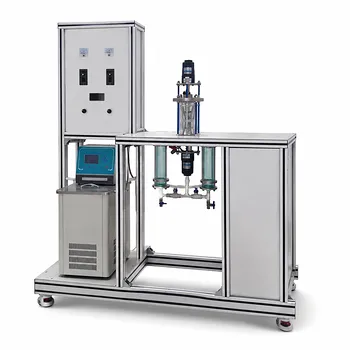
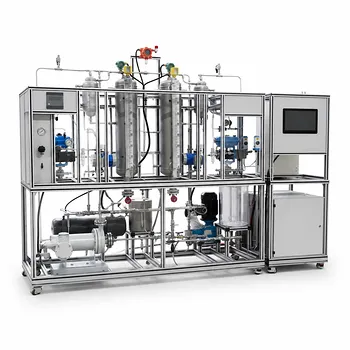
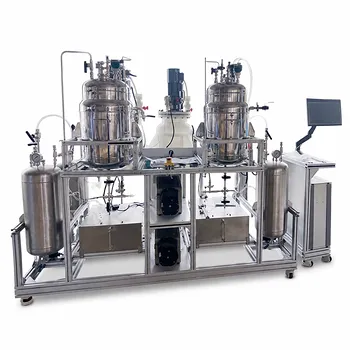
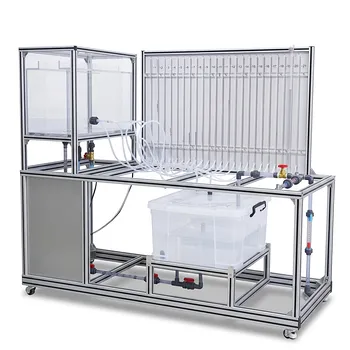
Bridge the gap between theoretical chemical engineering and modern industrial practice. LABPARK provides state-of-the-art Educational and Vocational Unit Operations Pilot Plants in chemical engineering, bioprocess & biotech, and environmental & water treatment.
Designed specifically for universities, research institutes, and enterprises, our pilot plants enable students and researchers to master real-time Process Analytical Technology (PAT) and data-driven process control.
Ready to upgrade your laboratory or training facility? Contact LABPARK today to discuss your custom pilot plant requirements!
Related Products
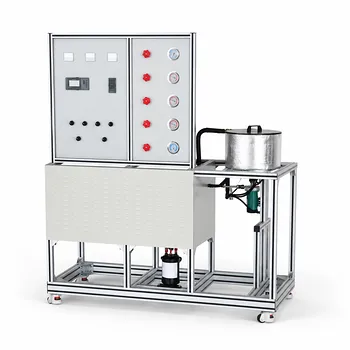
- Educational Compression Refrigeration Performance Determination Unit Operations Pilot Plant
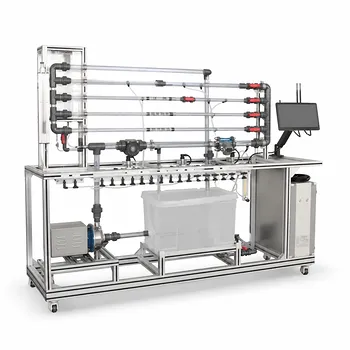
- Fluid Friction Resistance Determination Educational Unit Operations Pilot Plant
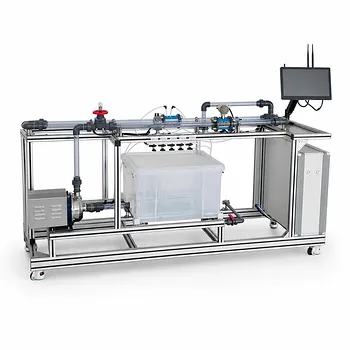
- Orifice and Venturi Flowmeter Calibration Educational Pilot Plant for Fluid Mechanics Laboratory
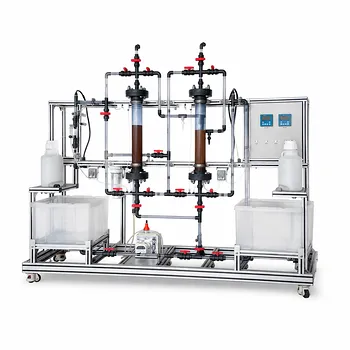
- Ion Exchange Water Purification Educational Pilot Plant for Engineering Unit Operations
- Rising and Falling Film Evaporation Educational Unit Operations Pilot Plant
People Also Ask
- Why Switch Unit Operations Flow Configurations? Impact on Experimental Measurements
- Why is distinguishing between elastic and plastic deformation critical? Prevent tablet capping.
- How is unsteady-state flow analyzed & taught? Master Transient Systems in Unit Ops
- What are the differences between set-point, servo, and program control? Master unit operations training.
- How to use pilot plants to estimate gas compression costs? Master scale-up economics.