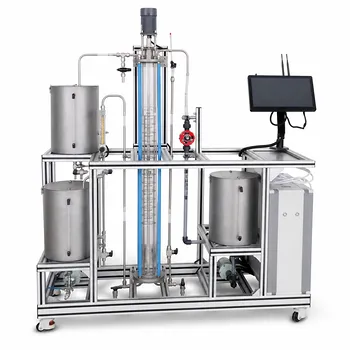
Laboratory-scale stirred cells simulate industrial packed columns by establishing a direct correlation between their mass transfer parameters. In this methodology, the agitator speeds in the liquid and gas phases of the stirred cell—which determine the liquid-side mass transfer coefficient ($k_l$) and gas-side mass transfer coefficient ($k_g$)—are systematically mapped to the liquid and gas superficial velocities in the industrial packed column. This allows researchers and engineers to extract fundamental physicochemical data, such as reaction kinetics, diffusivities, and solubilities, in a controlled, small-scale environment before committing to full-scale column design.
A stirred cell simulates a packed column by translating rotational speed into superficial velocity: the $k_l$ and $k_g$ values measured at specific agitator settings in the lab reflect the mass transfer performance one can expect at specific liquid and gas throughputs in the column. This mapping is the core of a simulation strategy used to isolate intrinsic kinetics and transport properties, which remain constant across scales.
The Principle of Mass Transfer Parameter Mapping
Translating Agitation to Superficial Velocity
The key insight is that mass transfer coefficients are not arbitrary – they respond to the hydrodynamic conditions in each equipment type. In a stirred cell, the liquid-side coefficient $k_l$ is a function of the agitator speed in the liquid phase, while the gas-side coefficient $k_g$ depends on the impeller speed in the gas headspace. The mapping works by identifying the agitator speeds that produce $k_l$ and $k_g$ values equal to those experienced by the liquid and gas phases at a specific set of superficial velocities in the packed column.
By varying agitator speeds, the stirred cell can sweep through a range of $k_l$ and $k_g$ values, essentially simulating the mass transfer environment of a packed column operating at different liquid and gas loads. This experimental flexibility makes the stirred cell a powerful screening tool before expensive pilot-plant runs.
Decoupling Transport and Kinetics
The primary purpose of this simulation is not to replicate every hydrodynamic detail of the packed column, but to decouple mass transport from intrinsic reaction kinetics. When a gas-liquid reaction is studied in a packed column, the observed reaction rate is a convolution of how fast the gas dissolves, how fast it diffuses to the catalyst, and how fast the chemical transformation occurs. The stirred cell allows the researcher to independently control the mass transfer resistances (via agitation) while measuring the overall reaction rate.
By performing experiments at multiple agitation speeds and fitting the data to a reaction-diffusion model, the intrinsic kinetic rate constant and the effective diffusivity can be extracted. These parameters are scale-independent—they belong to the chemical system, not the equipment—and can then be plugged into the design equations for the industrial packed column.
Beyond the Stirred Cell: Bridging to Industrial Realities
The Simulation as a Parameter Source
Once the stirred cell has delivered the true kinetic and transport parameters, the scale-up to a packed column follows a fundamentally different logic than simply making the cell larger. The industrial design relies on separate correlations for column internals: pressure drop, liquid holdup, effective interfacial area, and axial dispersion. The stirred cell does not simulate these; it merely provides the chemical constants that feed into those correlations.
In a typical chemical engineering laboratory workflow, the stirred cell identifies the rate law and the activation energy. The packed column is then designed using established hydrodynamic models, with the reaction term supplied entirely by the stirred-cell data. This decoupling of chemistry from equipment is the ultimate justification for the simulation.
What the Stirred Cell Does Not Replicate
A stirred cell cannot replicate the axial dispersion or backmixing patterns of a large packed column. In a mechanically agitated lab cell, the phases are usually well mixed, while in a packed column, the flow is closer to plug flow with some dispersion. Mass transfer coefficients alone cannot capture the impact of liquid maldistribution, channelling, or gas-phase backmixing that become significant at industrial scale.
Furthermore, the stirred cell operates at negligible hydrostatic head, whereas a tall packed column imposes a hydrostatic pressure gradient that changes gas solubility and equilibrium along the column height. These effects must be accounted for separately when moving from lab data to plant design.
Understanding the Trade-offs
Limitations of the Agitator-Superficial-Velocity Analogy
The mapping assumes that the mass transfer coefficient is the sole descriptor of performance, which is only valid when the reaction is truly kinetically controlled after accounting for mass transfer. If the reaction is so fast that it becomes entirely mass-transfer-limited, the stirred cell may produce data that are extremely sensitive to small imprecision in agitation, making the extracted kinetics less reliable.
Additionally, the correlation between agitator speed and superficial velocity is equipment-specific. A mapping developed for one stirred cell geometry cannot be blindly transferred to another without re-calibrating the fluid dynamics. This means laboratories must validate their own mapping with benchmark systems of known kinetics and solubility, such as the sulfite oxidation reaction for $k_l$ or the absorption of CO₂ in a standard solution.
Scale-Up Challenges Beyond Mass Transfer
Scaling up from lab to industrial packed columns introduces challenges the stirred cell cannot address. Heat transfer is a classic example: the heat transfer coefficient remains relatively constant with increasing column diameter, but the volumetric heat generation grows with the cube of the diameter while the heat exchange area grows only with its square. This means a packed column operating with an exothermic reaction may require internal cooling coils or inter-stage cooling, something a stirred cell simulation will never flag.
Another concern is maintaining uniform gas-liquid distribution. In a small stirred cell, agitation ensures intimate contact. In a large packed column, liquid distributors and redistributors are needed, and their design directly affects the effective interfacial area—a parameter the stirred cell implicitly treats as ideally maintained.
How to Apply This in Your Laboratory
A Stepwise Approach for Reliable Scale-Up
If you are using a stirred cell to support packed column design, the following recommendations will help you extract maximum value:
- First, validate your stirred cell mapping: Run a non-reacting absorption system with well-known $k_l$ and $k_g$ across a range of agitator speeds. Correlate these speeds to the desired superficial velocities through the measured coefficients, not through theoretical fluid dynamics alone.
- Isolate kinetics at high agitation: Perform reaction experiments at sufficiently high agitator speeds that the overall rate becomes insensitive to further increases. This ensures you are measuring the intrinsic kinetic regime. Only then reduce agitation to probe mass transfer effects.
- Use the extracted parameters in a rate-based column model: Do not attempt to extend the stirred cell directly to column geometry. Instead, feed the kinetic and transport parameters into a rigorous rate-based distillation/absorption model that includes hydrodynamic correlations for the specific packing you intend to use.
Matching Methodology to Your Goal
- If your primary focus is determining reaction kinetics: Run the stirred cell at maximum agitation to eliminate gas-liquid mass transfer resistance, and use a known $k_g a$ correlation from literature to design the packed column around that kinetic rate expression.
- If your primary focus is screening new solvents or catalysts: Use the stirred cell to quickly measure $k_l$ and $k_g$ trends as a function of formulation variables. The same mapping principle then lets you predict how a packed column will respond to those same formulations at different throughputs.
- If your primary focus is educational demonstration: Use the stirred cell to show how a single piece of laboratory equipment can conceptually represent an entire packed column, teaching students that scale-up is about retaining the right dimensionless groups, not just making things bigger.
The stirred cell remains an indispensable laboratory surrogate for industrial packed columns when you focus on what it does best: revealing the inherent rate of a chemical system, free from the confusing interplay of large-scale hydrodynamics. By using it wisely, you gain the kinetic insight that transforms a packed column from a mysterious black box into a rationally designed reactor.
Summary Table:
| Parameter | Lab-Scale Stirred Cell | Industrial Packed Column |
|---|---|---|
| Main Control | Agitator speed ($k_l$, $k_g$) | Gas/liquid superficial velocity |
| Flow Regime | Well-mixed | Plug flow with axial dispersion |
| Key Purpose | Isolate intrinsic kinetics | High-throughput mass transfer |
| Limitations | No heat/axial profiling | High design & operating cost |
Bridge the Gap from Lab to Industry with LABPARK
Transform your chemical engineering research and hands-on training. LABPARK designs and delivers high-performance Educational and Vocational Unit Operations Pilot Plants in chemical engineering, bioprocess & biotech, and environmental & water treatment tailored for universities, research institutes, and enterprises.
Ready to scale up your lab's capabilities? Contact us today to request a quote or expert consultation.
Related Products
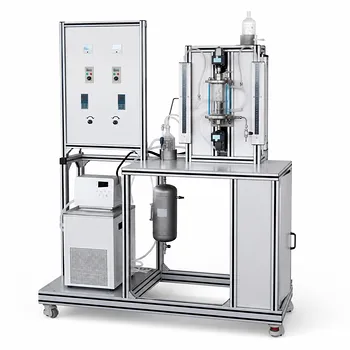
- Dual-Drive Stirred Gas-Liquid Mass Transfer Coefficient Determination Pilot Plant
- Micro-Scale Gas-Solid Catalytic Reaction Educational Pilot Plant
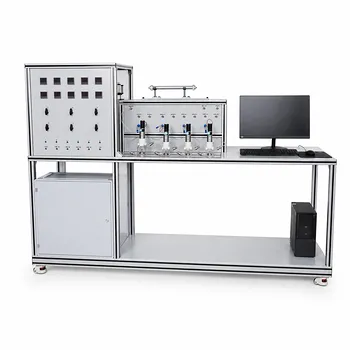
- Multi-Reactor Educational Pilot Plant for Reaction Engineering Unit Operations
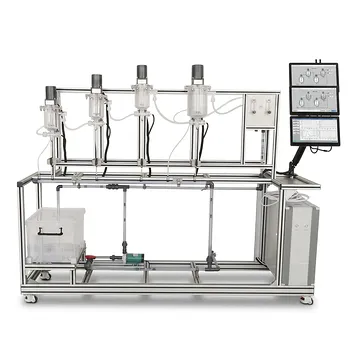
- Multi-Stage Stirred Tanks in Series Residence Time Distribution and Mixing Performance Determination Educational Pilot Plant
- Educational Unit Operations Pilot Plant for Intraparticle Diffusion Effective Factor Measurement
People Also Ask
- How does column packing affect absorption intensification, and how is it evaluated experimentally?
- Why Compare Membrane-Reservoir Models with Pilot Plant Data? Ensure Successful Process Scale-Up
- Why is pilot plant gas absorption lower than isothermal model predictions? Interfacial heating explained.
- Which interphase forces dominate gas dispersion in stirred reactors? Master Gas Holdup Models
- What operational factors must be considered in viscous gas-liquid mass transfer? Pilot Plant Guide