Knowledge Chemical Engineering Education How can Gibbs' phase rule guide pilot plant control? Master process variables for stable separation.
Author avatar

Tech Team · LABPARK

Updated 2 months ago

How can Gibbs' phase rule guide pilot plant control? Master process variables for stable separation.


Control isn't a guessing game—it’s a mathematical certainty. Gibbs' phase rule gives students and operators a definitive map for pilot-plant control by revealing the exact number of process variables (like temperature, pressure, or composition) that must be independently fixed to achieve a stable, predictable equilibrium.

Mastering pilot-scale separations is less about manipulating everything and more about intelligently identifying the few variables that truly matter. Gibbs' phase rule provides the fundamental logic to make that distinction, transforming plant operation from reactive adjustment into proactive, knowledge-based control.

Your Deep Need: From Theoretical Limits to Practical Control

Your real challenge isn't just memorizing an equation; it’s translating abstract thermodynamic boundaries into concrete, actionable control strategies on a live pilot plant. The Gibbs phase rule, correctly understood, bridges this gap. It defines the controllability of your system.

The Scalpel of Process Controllability

The rule's power is its ability to cut through complexity. For any non-reacting system, it states that F = C + 2 - P, where F is the degrees of freedom, C is the number of components, and P is the number of phases at equilibrium.

This tells you precisely how many variables you are "allowed" to control independently before you over-specify the system and make it mathematically impossible to solve—or physically impossible to stabilize.

Controlling Outcomes, Not Just Variables

In a binary distillation column (a classic teaching pilot plant), you have two components (C=2) and two coexisting phases—liquid and vapor—on each tray (P=2). The math is clear: F = 2.

This is the fundamental control theorem for your experiment. It means you have exactly two independent handles to turn.

  • The Primary Reference's Example Clarified: If you choose to fix the operating pressure and apply a specific heating duty that determines the temperature, you've used your two degrees of freedom. The composition of the liquid on every tray and the vapor rising to meet it are no longer independent choices; they are fixed outcomes. You achieve control not by grabbing every lever, but by strategically setting two.

The Hidden Curriculum: Why It Must Be at Equilibrium

Gibbs' phase rule is a law of equilibrium thermodynamics. Its direct predictive power is greatest at phase boundaries—where liquid and vapor are in full dynamic exchange.

This reveals a critical lesson for pilot-plant operation: a well-operated column is a series of controlled equilibrium stages. When a student applies the phase rule to set column pressure and a temperature profile, they are effectively forcing the real-world, dynamic process to conform as closely as possible to an ideal equilibrium model. The deviation from this ideal is a direct measure of process inefficiency.

Common Pitfalls: Where the Rule's Guidance is Misread

The most dangerous mistake is ignoring the rule's boundaries. Overconfidence in its simplicity leads to operational failure.

The Trap: Fixing the Wrong Type of Variable

The phase rule applies explicitly to intensive variables—those independent of system size, like temperature, pressure, and mole fraction. A common student error is trying to use an extensive variable, like the total liquid level in the reboiler, to meet the degrees of freedom.

While you must control the level for safety and mass-balance stability, it does not count toward the F that dictates phase compositions. Confusing the need to control a material balance with the need to define a thermodynamic state is a direct path to a column that is physically full but separating poorly.

The Pitfall of the Phase Boundary

The secondary reference wisely points to Gibbs criticality criteria and the spinodal surface—the absolute limit of phase stability. For operators, this is a stark safety and performance warning. In a supercritical fluid extraction pilot plant, for example, you can lose your two-phase system entirely by setting pressure and temperature beyond the mixture's critical point.

At that moment, the phase rule's governing logic for a P=2 system collapses because you no longer have two phases. A student who fails to understand this can eliminate the very phase interface that makes separation possible, all while believing they are in control.

Making the Right Choice for Your Operational Goal

Your thermodynamic command of the plant depends entirely on how you exercise your granted degrees of freedom.

  • If your primary focus is achieving a stable, reproducible separation: Fix column pressure and a thermal input (e.g., column top temperature or boil-up rate). This defines the entire phase equilibrium, allowing you to predict and then verify separation performance.
  • If your primary focus is exploring the limits of a phase diagram: Use one degree of freedom to fix a specific composition and the other to fix pressure. You can then experimentally determine the boiling point of that precise mixture, directly linking your plant data to thermodynamic theory.

Gibbs' phase rule doesn't tell you which variables to choose, but it gives you the ironclad logic to know that once you choose wisely, the complex behavior of your pilot plant becomes a predictable and controllable result.

Summary Table:

Concept Application in Pilot Plants Key Practical Takeaway
Gibbs' Phase Rule ($F = C + 2 - P$) Defines the degrees of freedom ($F$) in a non-reacting system. Determines the exact number of independent variables you must fix.
Intensive Variables Temperature, pressure, and phase composition. Only these variables satisfy $F$; do not confuse them with flow rates or levels.
Equilibrium Stages Liquid-vapor exchange on column trays. Setting $F$ forces dynamic processes to align with stable thermodynamic models.
Phase Boundaries Operating limits near critical or spinodal points. Crossing phase boundaries collapses phases ($P$), invalidating control logic.

Bridge Theory and Practice with LABPARK Pilot Plants

Are you looking to provide hands-on thermodynamic and process control training for your students, researchers, or operators?

LABPARK provides state-of-the-art Educational and Vocational Unit Operations Pilot Plants designed for universities, research institutes, and enterprises. Our systems cover key disciplines, including:

  • Chemical Engineering (Distillation, Extraction, Absorption, and Reaction)
  • Bioprocess & Biotech
  • Environmental & Water Treatment

Help your learners master real-world controllability and translate equations like Gibbs' phase rule into successful operations. Contact LABPARK today to discuss your lab requirements and get a customized solution!

Related Products

People Also Ask

Related Products

Multi-Functional Membrane Separation Educational Pilot Plant for Unit Operations Lab

Multi-Functional Membrane Separation Educational Pilot Plant for Unit Operations Lab

The Multi-functional Membrane Separation Educational Unit Operations Pilot Plant is an integrated bench-scale laboratory system designed for teaching undergraduate engineering education. It features Ultrafiltration, Nanofiltration, and Reverse Osmosis modules in a compact, mobile unit for practical hands-on learning.

Multifunctional Membrane Separation Educational Pilot Plant with Ultrafiltration, Nanofiltration, Reverse Osmosis

Multifunctional Membrane Separation Educational Pilot Plant with Ultrafiltration, Nanofiltration, Reverse Osmosis

An integrated laboratory bench-scale membrane separation system for higher education engineering labs combining Ultrafiltration, Nanofiltration, and Reverse Osmosis processes. Features industrial PLC control with touch-screen HMI, transparent piping, and academic assessment software. Ideal for chemical and environmental engineering curricula.

Gas-Solid Heterogeneous Separation Demonstration Educational Unit Operations Pilot Plant

Gas-Solid Heterogeneous Separation Demonstration Educational Unit Operations Pilot Plant

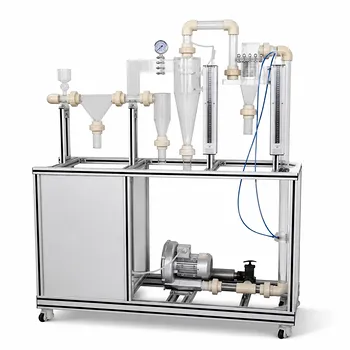
Comprehensive visual transparent gas-solid separation pilot plant for chemical engineering labs. Demonstrates gravity settling inertial settling cyclone and bag filter technologies. Enables real-time analysis of fluid-particle mechanics pressure drop and collection efficiency. Ideal for undergraduate unit operations courses.

Carbon Material Thermal Pretreatment Multiphase Separation Educational Pilot Plant

Carbon Material Thermal Pretreatment Multiphase Separation Educational Pilot Plant

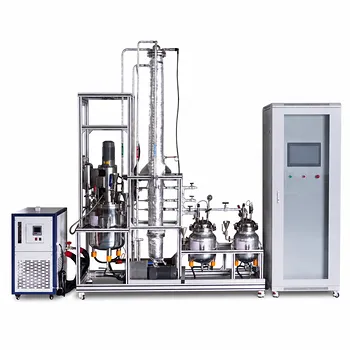
Educational pilot plant for carbon material thermal pretreatment and multiphase separation. Features jacketed agitated reactor, separation column, and modern controls for hands-on unit operations training in heat transfer, fluid flow, and process safety with industrial-grade materials and wireless data acquisition.

Bench Scale Dual Column Gas Separation and Capture Educational Pilot Plant

Bench Scale Dual Column Gas Separation and Capture Educational Pilot Plant

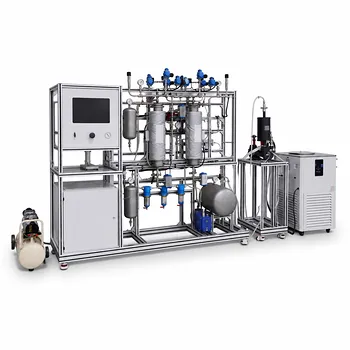
This dual-column educational pilot plant provides hands-on teaching of gas adsorption, separation, and capture processes. It features stainless steel columns, regeneration up to 400°C, and a 15.6-inch touchscreen PLC for TSA and PSA studies in chemical engineering curricula, process simulation.

Bio-fermentation Ethanol Production Practical Training Unit Operations Pilot Plant

Bio-fermentation Ethanol Production Practical Training Unit Operations Pilot Plant

Bio-fermentation ethanol production pilot plant for hands-on training in unit operations: fermentation, solid-liquid filtration, membrane separation, and distillation. Bridges theory with industrial practice using industrial-grade components, customizable for university labs. Hybrid automated and manual control for comprehensive learning.

Pressure Swing Adsorption Educational Unit Operations Pilot Plant

Pressure Swing Adsorption Educational Unit Operations Pilot Plant

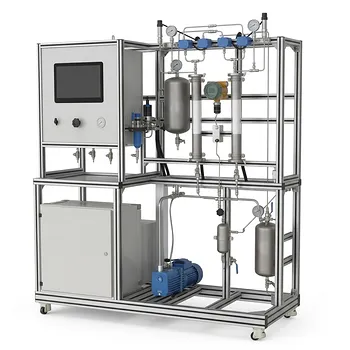
Integrated bench-scale pressure swing adsorption pilot plant for hands-on teaching of gas-solid separation, mass transfer, and process optimization using nitrogen-oxygen model, featuring dual-column design, industrial touchscreen control, digital assessment suite, and customizable hardware and software configurations for educational laboratories.

Internal Circulation Gradient Free Catalytic Reaction Educational Pilot Plant

Internal Circulation Gradient Free Catalytic Reaction Educational Pilot Plant

Internal circulation gradient free catalytic reaction educational pilot plant for chemical engineering unit operations. Provides isothermal gradient free operation and hands on study of heterogeneous catalysis kinetics and mass transfer with precise control. Ideal for academic labs.

Fixed-Bed Chemical Reaction and Gas Dust Tar Removal Unit Operations Pilot Plant

Fixed-Bed Chemical Reaction and Gas Dust Tar Removal Unit Operations Pilot Plant

Integrated educational pilot plant for studying catalytic gas-solid reactions and downstream gas purification. Features dual fixed-bed reactor, three-stage heating, and touchscreen control for hands-on engineering training. Ideal for chemical and environmental engineering curricula.

Educational Unit Operations Pilot Plant for Intraparticle Diffusion Effective Factor Measurement

Educational Unit Operations Pilot Plant for Intraparticle Diffusion Effective Factor Measurement

Designed for chemical engineering university labs, this pilot plant allows hands-on determination of catalyst particle intraparticle diffusion effective factors and gas-solid reaction kinetics using a fixed-bed tubular reactor with industrial touchscreen control, bridging theory and practical reactor design.

Multi-Reactor Educational Pilot Plant for Reaction Engineering Unit Operations

Multi-Reactor Educational Pilot Plant for Reaction Engineering Unit Operations

Integrated bench-scale educational pilot plant for chemical engineering teaching featuring fixed bed fluidized bed and stirred tank reactors with web-based digital twin controls and safety interlocks for hands-on unit operations and reaction engineering comparative studies in one compact system.

Fluidized Bed Gas Solid Catalytic Reaction Educational Pilot Plant

Fluidized Bed Gas Solid Catalytic Reaction Educational Pilot Plant

Our educational fluidized bed gas-solid catalytic reaction pilot plant is ideal for chemical engineering labs. Students study fluidization dynamics, catalyst evaluation, and process control hands-on. Features include a customizable reactor, touchscreen HMI, and safety interlocks for safe, curriculum-aligned experiments.

Multi-Functional Special Distillation Educational Pilot Plant

Multi-Functional Special Distillation Educational Pilot Plant

Versatile multi-functional special distillation pilot plant for chemical engineering education. Supports continuous, vacuum, azeotropic, reactive, extractive distillation. Transparent glass columns enable real-time visual observation of hydrodynamics and separation processes.

Dual-Mode Rectification Pilot Plant for Practical Training Unit Operations

Dual-Mode Rectification Pilot Plant for Practical Training Unit Operations

Industrial-scale dual-mode rectification pilot plant for chemical engineering practical training. Features real-material and simulated-material operation modes, sieve-plate column with sight glasses for visual observation of hydrodynamics, and customizable SCADA control for safe, hands-on learning of unit operations and mass transfer.

Micro-Scale Gas-Solid Catalytic Reaction Educational Pilot Plant

Micro-Scale Gas-Solid Catalytic Reaction Educational Pilot Plant

Explore heterogeneous catalysis with this micro-scale gas-solid catalytic reaction educational pilot plant. Designed for university labs, it enables hands-on study of reaction kinetics and transport phenomena in a benchtop packed bed reactor with high-precision flow control and touchscreen automation.

Residence Time Distribution and Reactor Flow Characteristics Determination Educational Pilot Plant

Residence Time Distribution and Reactor Flow Characteristics Determination Educational Pilot Plant

This versatile educational pilot plant is designed for comprehensive study of residence time distribution and reactor flow characteristics, featuring multiple CSTRs in series, a tubular reactor, variable recycle loop, and automated real-time data acquisition, perfect for hands-on chemical engineering education.

100L Continuous Loop Hydrogenation Educational Unit Operations Pilot Plant

100L Continuous Loop Hydrogenation Educational Unit Operations Pilot Plant

This 100L continuous loop hydrogenation pilot plant is designed for chemical engineering education, featuring 316 stainless steel construction, advanced gas-liquid mass transfer components, explosion-proof safety systems, and a 15.6-inch touchscreen with 5G connectivity, cloud data logging, bridging theory and industry.

Multi Functional Catalytic Reaction and Reactor Evaluation Educational Unit Operations Pilot Plant

Multi Functional Catalytic Reaction and Reactor Evaluation Educational Unit Operations Pilot Plant

Bench-scale educational pilot plant for catalytic reaction and reactor evaluation, integrating fixed bed, fluidized bed, and stirred tank reactors. Students compare reactor designs, evaluate catalysts, and study reaction kinetics and hydrodynamics. Perfect for unit operations labs in chemical engineering curricula.

Methanol Synthesis and Catalyst Performance Evaluation Educational Unit Operations Pilot Plant

Methanol Synthesis and Catalyst Performance Evaluation Educational Unit Operations Pilot Plant

Bench-scale methanol synthesis and catalyst evaluation educational pilot plant for chemical engineering labs to study catalytic kinetics, high-pressure operations, process control, and unit operations under realistic conditions with industrial safety features, precision gas delivery, data acquisition, and intelligent monitoring.

Tubular Reactor Flow Characteristics Determination Educational Unit Operations Pilot Plant

Tubular Reactor Flow Characteristics Determination Educational Unit Operations Pilot Plant

Educational pilot plant for investigating tubular reactor flow characteristics and residence time distribution Features adjustable recycle for plug flow and backmixing studies industrial touchscreen interface and real-time data acquisition Ideal for chemical engineering unit operations laboratory training and education


Leave Your Message