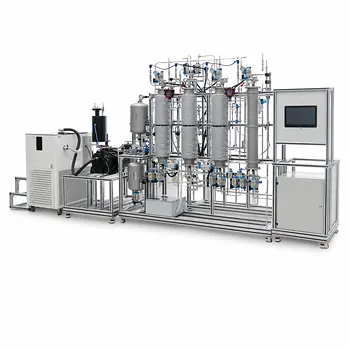
The core value lies in bridging the gap between paper spontaneity and real-world reality. Pilot plants directly demonstrate this by pairing a reaction’s innate thermodynamic drive with its kinetic stubbornness. They prove a reaction like using carbon monoxide to reduce toxic nitric oxide is theoretically favorable, while graphically revealing that without high heat and a catalyst, it grinds to a practical halt. These scaled-down systems transform abstract concepts into measurable operational limits.
A thermodynamic feasibility analysis tells you if a reaction can happen. An environmental pilot plant shows you how hard you must fight to make it happen. It is the ultimate teaching tool for understanding that industrial emission control is a battle against kinetic and mass-transfer resistance, not just a question of final equilibrium.
The Core Problem: When a Spontaneous Reaction Refuses to Happen
A classic example from the primary reference is the reduction of nitric oxide (NO) with carbon monoxide (CO). On paper, this is a dream—it’s thermodynamically spontaneous at room temperature. In a real exhaust stream, it’s a dud due to prohibitive kinetic barriers.
Defining Thermodynamic Feasibility vs. Kinetic Reality
The concept of "spontaneity" is purely thermodynamic. It speaks only to the initial and final energy states of the system, saying nothing about the pathway's speed. The pilot plant makes this distinction visceral. Students see that theoretical conversion efficiency at equilibrium is meaningless unless the reaction rate is commercially viable, which usually means manipulating temperature and catalytic activation energy.
The Digital vs. Physical Learning Gap
Classroom calculations using standard heats of formation create a false sense of security. The primary reference highlights that the pilot plant exposes the harsh reality: a favorable Gibbs free energy change is merely a driver’s license, not the vehicle itself. The supplementary references reinforce this, pointing out that real fluids and mixtures rarely behave ideally, requiring experimental P-V-T data to compute true energy balances. This marriage of thermodynamics and kinetics is only forged in a physical apparatus.
The Pilot Plant as a Diagnostic Platform for Reaction Engineering
An environmental unit operations pilot plant is not just a reactor. As detailed in the supplementary references, it is a fully instrumented platform that lets you dissect a reaction’s failure points, whether those are in the catalyst, the heat profile, or the fluid dynamics.
Isolating the Kinetic Bottleneck with Catalysts
The primary reference confirms that you can physically test different catalyst beds. A pilot plant equipped for gas-phase catalytic studies allows this direct comparison. By swapping substrates while holding flow and temperature constant, you map the specific role of activation energy. You move from simply knowing a catalyst is needed, to quantifying its surface reaction rate constant, a purely practical insight.
Mapping the Thermal Landscape
Measuring real-time temperature profiles is a critical diagnostic. The supplementary references explain that a pilot reactor’s sensors reveal the gap between theoretical enthalpy and actual heat management. You physically trace the heat loss, quantify the sensible heat absorbed by the reactor mass, and identify cold spots where the reaction effectively quits. The lesson is clear: reaching equilibrium temperature in a small hot spot doesn't equate to whole-vessel conversion.
Confronting Mass Transfer Limitations
The primary reference’s mention of adjusting gas flow rates directly targets this. At low flow rates, film diffusion might be your limit; at high rates, pore diffusion in a catalyst pellet can starve active sites. A pilot plant converts these esoteric concepts into a measurable drop in conversion efficiency as throughput increases. This is a fundamental demonstration of shifting rate-limiting steps, something no calculation can fully capture.
Understanding the Trade-offs and Practical Pitfalls
A trustworthy evaluation must confront the limitations these plants expose. The path from thermodynamic favorability to practical compliance is paved with difficult compromises.
The Purity Paradox
The primary reference focuses on a clean NO+CO reaction. The supplementary references reveal the true complexity of real gas streams containing particulates, condensable water, and competing compounds like ammonia or hydrogen sulfide. A pilot plant shows how these interlopers foul catalysts and generate problematic secondary waste streams, like tarry gas liquor. The practical limitation is not just the target reaction’s kinetics, but the holistic management of the system.
Scaling Down Non-Ideal Behaviors
Miniature plants struggle to replicate the profound temperature and pressure gradients of full-scale units. One critical learning outcome is observing where scaled-down predictions break. As noted in the supplementary references on thermodynamics, using equations of state to model non-ideal gas mixtures requires experimental validation. The pilot plant provides this data, but also reveals the inherent error margins that exist when extrapolating to larger volumes.
Instrumentation and Energy Balance Gaps
A sensor gives a precise number, which might be precisely wrong if calibration drifts or placement is poor. The supplementary references on measuring reaction enthalpy show that students must account for the heat capacity of the vessel itself. The practical limitation of a pilot plant is its own thermal inertia; you learn that what you measure is the signal processed by the system, not the pure reaction itself. This instills crucial skepticism about real-world data fidelity.
Making the Right Choice for Your Educational or R&D Goal
The specific insights you extract from an environmental pilot plant must align with your primary objective. The setup that perfectly illustrates kinetic limitation is not the same one optimized for waste stream management.
- If your primary focus is fundamental reaction kinetics: Prioritize a setup with precise gas flow control and analytical-grade gas supplies, as recommended in the primary reference. Use it to vary temperature, catalyst type, and residence time independently to isolate and model the rate equation for core reactions like NO reduction.
- If your primary focus is catalyst selection and deactivation: Run long-duration tests with a simulated complex exhaust matrix, including contaminants noted in the supplementary references. Measure conversion over time to directly study the practical limits of active-site poisoning and thermal sintering, moving beyond clean-room conditions.
- If your primary focus is integrated process technology: Combine a catalytic reactor with downstream scrubbers or absorbers. Focus on the overall system’s ability to not only clean the gas but also handle secondary wastewater streams, teaching the complete picture of thermodynamic and practical waste management trade-offs.
A pilot plant’s greatest lesson is that thermodynamics points the vessel toward a destination, but kinetics and mass transfer hold the rudder, demanding constant, hands-on attention to maintain the course.
Summary Table:
| Aspect | Thermodynamic Theory (On Paper) | Pilot Plant Reality (Practical) |
|---|---|---|
| Reaction Feasibility | Spontaneous if Delta G < 0 | Bound by kinetic activation energy & catalyst performance |
| Thermal Landscape | Idealized enthalpy calculations | Real heat losses, thermal inertia, and vessel cold spots |
| Gas Composition | Clean, binary gas streams | Complex streams with moisture, particulates, and poisons |
| Mass Transfer | Assumed negligible resistance | Shifting film and pore diffusion limits under variable flow |
Scale Up Your Process Learning with LABPARK
Bridging the gap between thermodynamic calculations and kinetic reality requires hands-on experimentation. LABPARK designs and manufactures premium Educational and Vocational Unit Operations Pilot Plants specializing in chemical engineering, bioprocess & biotech, and environmental & water treatment.
We help universities, research institutes, and enterprises equip their laboratories with fully instrumented systems to effectively analyze heat transfer, kinetics, and mass-transfer limitations.
Ready to enhance your training or R&D capabilities? Contact LABPARK today to discuss your customized pilot plant requirements!
Related Products
- Thermal Desorption Exhaust Gas and Tail Water Treatment Educational Pilot Plant
- Fixed-Bed Chemical Reaction and Gas Dust Tar Removal Unit Operations Pilot Plant
- Dual-Mode Gas Absorption and Desorption Unit Operations Training Pilot Plant
- Bench Scale Carbon Dioxide Capture Educational Unit Operations Pilot Plant
- Gas-Solid Heterogeneous Separation Demonstration Educational Unit Operations Pilot Plant
People Also Ask
- How is the number of transfer units (N_OL) calculated and verified? Master Desorption Mass Transfer
- Lime-Soda vs. Cation Exchange Softening: How Do Effluent Characteristics Compare in Pilot Plants?
- How is iron concentration monitored to evaluate corrosion and filtration efficiency in water treatment pilot plants?
- How do anodic & cathodic inhibitors protect heat exchangers? Optimize Your Water Treatment Pilot Plant
- How is P, M, and B alkalinity applied in pilot plants? Prevent Boiler Scaling & Corrosion