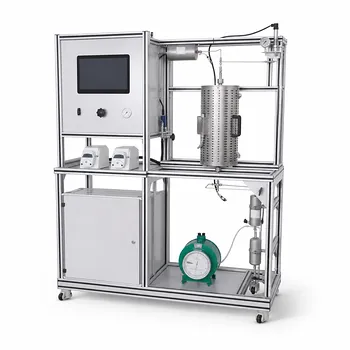
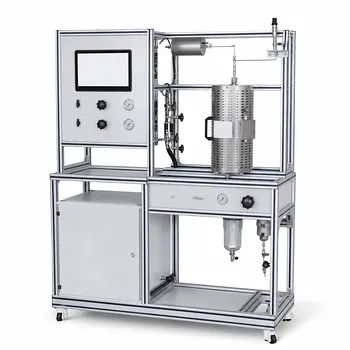
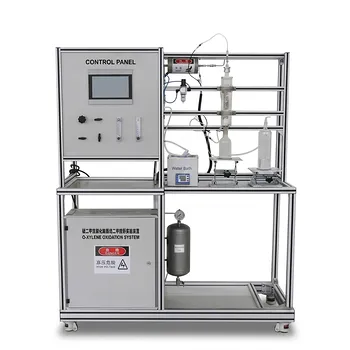
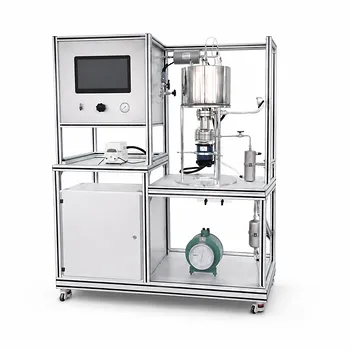
The cleanest way to distinguish parametric sensitivity from steady-state multiplicity is to let the reactor tell its own story through its temperature profile. An educational fixed-bed catalytic reactor pilot plant makes this possible. By equipping the reactor with multi-point temperature sensors and carefully manipulating feed conditions, students can observe a dramatic, yet fully reversible, temperature excursion (parametric sensitivity) and then map a distinct hysteresis loop where the reactor irreversibly jumps to a new operating state (multiplicity). The experiment transforms abstract stability theory into a clear, visual, and safe hands-on lesson.
Both phenomena can cause a sudden temperature rise, but the critical difference is reversibility. A parametrically sensitive system spikes and returns when the disturbance is removed; a system with multiple steady states ignites to a new stable high-temperature state and will only extinguish after conditions drop far below the original ignition point. A well-designed pilot plant demonstration isolates each behavior, giving students an intuitive grasp of process safety boundaries.
The Two Faces of Thermal Runaway
Understanding the difference between these two instability mechanisms is foundational for safe reactor operation. The pilot plant allows you to generate each pattern on demand.
Reversible Spikes: Parametric Sensitivity
Parametric sensitivity is an exaggerated but transient response. A tiny nudge in a feed parameter—such as raising the inlet temperature or reactant concentration by a few degrees or percent—causes a disproportionately large temperature surge inside the bed.
The key signature is that the spike vanishes when the perturbation is removed. Reduce the inlet temperature back to its original value and the bed temperature profile relaxes to its baseline. There is no lasting change in the operating state. The phenomenon is analogous to a tightly stretched elastic that snaps back.
Irreversible Jumps: Multiplicity of Steady States
Multiplicity represents a true state transition. Under identical external feed conditions, the reactor can exist in either a low-temperature/low-conversion state or a high-temperature/ignited state. A small increase in, say, feed temperature can push the system past its ignition point, causing the bed to light off and settle at a completely different stable operating temperature.
The hallmark is hysteresis. Once ignited, the reactor will not return to the lower steady state by simply reversing the triggering change. You must lower the feed temperature significantly below the original ignition point (the extinction point) before the bed collapses back to the cool state. The path forward and backward describe a loop, not a single line.
Designing the Demonstration Experiment
An effective pilot plant demonstration requires the right hardware and a methodical sequence. You are not just running a reaction; you are orchestrating a controlled physical argument.
Instrumentation: Multi-Point Temperature Sensing
The foundation of any demonstration is a thermocouple array. Place multiple sensors along the axial centerline of the catalyst bed—and ideally a few radially—to capture the steep gradients that develop.
These sensors allow you to plot real-time temperature-conversion profiles. The spatial resolution reveals the moving hot spot during a sensitivity event and the sharp, stable temperature jump at ignition. Without this data, the difference between a spike that decays and a state that locks in is invisible.
Crafting the Perturbation Test for Parametric Sensitivity
To isolate parametric sensitivity, operate the reactor at a stable but sensitive steady state—often near a steep portion of the heat generation curve.
Begin by establishing a steady axial temperature profile. Then introduce a short, deliberate pulse in inlet temperature or concentration. Use a step change of a few degrees or a small concentration bump, hold it for a short time, and then return to the original condition. The multi-point sensors will record a wave of elevated temperature that travels through the bed and then decays as the system settles back to its original profile. This reversible excursion demonstrates that no new stable state was created; the reactor simply overreacted temporarily.
Mapping the Hysteresis Loop for Multiplicity
To reveal steady-state multiplicity, you must trace the ignition-extinction pathway. This requires slow, quasi-steady changes to a control variable, most commonly the feed temperature or coolant flow rate.
Start from a low-temperature, low-conversion state. Ramp the feed temperature upward very slowly, letting the bed reach thermal equilibrium at each step. Monitor the maximum bed temperature. At a well-defined point, the temperature will abruptly jump to a much higher level—the ignition point. Continue the upward ramp to confirm the reactor stays ignited. Then slowly ramp the feed temperature downward. The bed will remain at the high-temperature state well below the ignition temperature, until it suddenly collapses at the extinction point. Plotting the maximum temperature versus the manipulated variable produces the classic hysteresis loop. This visual signature is the definitive proof of multiple steady states.
Understanding the Trade-offs and Practical Limits
While the pilot plant is a powerful teaching tool, its small scale introduces specific constraints you must manage to avoid misleading conclusions.
Scale-down effects blur boundaries. In a small-diameter educational reactor, enhanced radial heat transfer through the wall can dampen the very hot spots you are trying to create. To compensate, use conductive reactor walls or cooling jackets to mimic adiabatic-like operation, and select reactions with moderate exothermicity to ensure the thermal effect remains detectable.
Parametric sensitivity and multiplicity can overlap. Near the ignition threshold, a system that is parametrically sensitive may appear to light off permanently if the perturbation pushes it just past the tipping point. A disciplined experimental protocol—keeping perturbations extremely small and transient—is essential to prove the reversible nature of sensitivity. Always confirm that a spike fully decays before exploring the ignition boundary.
Safety interlocks are non-negotiable. The same sensors that make the demonstration possible must feed into automated shutdown systems. Set hard temperature limits to cut reactant flow instantly. This lets students operate close to runaway conditions with confidence, turning the plant into a safe sandbox for potential industrial disasters.
Making the Right Choice for Your Learning Goal
The best demonstration sequence depends on what you want the students to internalize. Use the pilot plant’s flexibility to tailor the experience.
- If your primary focus is process safety fundamentals: Run the parametric sensitivity test first. A single, reversible spike teaches the crucial lesson that a reactor can alarm violently without destroying itself—as long as the control system intervenes quickly.
- If your primary focus is understanding non-linear dynamics: Dedicating the session to a slow, manually executed hysteresis-loop experiment is unmatched. The hands-on tracing of ignition and extinction points makes the abstract concept of multiple steady states unforgettable.
- If your primary focus is reactor design and criteria evaluation: Use the plant to compare runaway boundaries. Adjust coolant flow rates and feed concentrations and overlay the resulting temperature-conversion data with theoretical lines from the Morbidelli-Varma or van Welsenaere-Froment criteria. This bridges the gap between textbook equations and physical reality.
By letting students directly witness the transient dance of a hot spot that returns and the irreversible snap of an ignited bed, you cement the distinction between sensitivity and multiplicity in a way no simulation ever could.
Summary Table:
| Feature | Parametric Sensitivity | Multiplicity of Steady States |
|---|---|---|
| Response Type | Exaggerated, transient temperature spike | True state transition (low to high conversion) |
| Reversibility | Fully reversible when perturbation is removed | Irreversible; exhibits hysteresis loop |
| Key Signature | Temperature returns to baseline | Abrupt jump at ignition/extinction points |
| Control Focus | Safe monitoring of transient hot spots | Tracing ignition-extinction pathways |
Bring Chemical Engineering Theories to Life with LABPARK
Ready to enhance your department's practical training? LABPARK provides premium Educational and Vocational Unit Operations Pilot Plants in chemical engineering, bioprocess & biotech, and environmental & water treatment for universities, research institutes, and enterprises.
Our fixed-bed catalytic reactor pilot plants feature advanced multi-point temperature sensors and automated safety interlocks, allowing students to safely explore complex thermal runaway phenomena, parametric sensitivity, and steady-state multiplicity.
Contact LABPARK today to find the perfect pilot plant solution for your lab!
Related Products
- Fixed Bed Gas Solid Catalytic Reaction Educational Pilot Plant
- Fixed-Bed Chemical Reaction and Gas Dust Tar Removal Unit Operations Pilot Plant
- Multi Functional Catalytic Reaction and Reactor Evaluation Educational Unit Operations Pilot Plant
- Ethylbenzene Dehydrogenation Educational Unit Operations Pilot Plant
- Educational Unit Operations Pilot Plant for Intraparticle Diffusion Effective Factor Measurement
People Also Ask
- How do reactor pilot plants safely study gas-solid reactions? Master kinetics with thermal & flow control.
- How does the Mears criterion evaluate transport resistance? Key Guide to Intrinsic Kinetics
- Why is a multibed configuration necessary for exothermic reactions? Optimize your pilot plant trajectory.
- Fluidized vs. Fixed Bed Reactors: Comparing Heat & Complexity in Pilot Plants
- How is the friction factor determined for fixed-bed pilot plants? Select the best pressure drop correlation.