Knowledge Chemical Engineering Education How can collocation methods be utilized for parameter estimation in tubular reactor pilot plants?
Author avatar

Tech Team · LABPARK

Updated 1 month ago

How can collocation methods be utilized for parameter estimation in tubular reactor pilot plants?


Collocation methods provide a powerful algebraic shortcut for reactor analysis. They transform the differential mass-balance equations of a tubular reactor into a set of algebraic equations that can be solved easily—even in a standard laboratory spreadsheet. By tuning the resulting algebraic model to match pilot-plant data, you can reliably estimate critical parameters like the reaction rate constant and radial diffusivity, bypassing the need for exact analytical solutions.

Collocation creates a practical bridge between rigorous reactor theory and real experimental data. In laminar-flow tubular reactors, it enables simultaneous estimation of kinetic and transport parameters—but the true breakthrough comes when the model is matched to a strategically chosen measurement point, such as the centerline concentration, which breaks the strong correlation between these parameters.

How Collocation Simplifies Tubular Reactor Modeling

Replacing Spatial Derivatives with Algebraic Approximations

The mass balance in a tubular reactor is a partial differential equation (PDE) describing how concentration changes along the radius and length.
Collocation eliminates the spatial derivatives by approximating the concentration profile as a polynomial.

You choose a few specific radial positions—called collocation points—and force the polynomial to satisfy the governing equation exactly at those points.
This turns the original PDE into a system of ordinary algebraic equations that directly give the concentration at each collocation point.

Application to a Laminar Flow Reactor

In a pilot plant with laminar flow, radial diffusion and reaction occur simultaneously.
The model often neglects axial dispersion, leaving a PDE that couples radial diffusion with a kinetic term.

With collocation, you pick, for example, two or three radial locations and write the mass balance at each one.
Solving the resulting algebraic equations yields approximate concentration profiles—and, more importantly, expressions that link the unknown kinetic constant k and radial diffusivity Dr to observable outlet readings.

Overcoming the Parameter Estimation Deadlock

Why Outlet-Averaged Data Fails

Measuring only the velocity‑averaged concentration at the reactor exit creates a deadlock.
The effects of k and Dr are so tightly entangled that the estimation algorithm returns huge standard deviations.

The data simply cannot tell you whether a lower outlet concentration came from faster reaction or slower radial mixing.
This parameter correlation makes it practically impossible to identify unique, trustworthy values.

The Centerline Sampling Breakthrough

A small-bore sampling tube placed exactly at the center of the reactor exit changes everything.
Measuring the centerline concentration instead of the cross‑sectional average radically decouples the parameters.

In such a setup, the collocation model predicts a centerline value that is highly sensitive to the reaction rate but far less sensitive to radial diffusion.
The standard deviation of the estimated parameters can drop to as low as 0.4 %, giving you laboratory‑grade precision in a pilot‑scale experiment.

The Broader Collocation Toolkit for Pilot Plants

One-Point Collocation for Catalyst Pellets

The same collocation philosophy extends to porous catalyst particles inside the reactor tube.
A single collocation point inside a pellet condenses the diffusion‑reaction PDE into a single algebraic equation.

This “one‑point” model has exactly the same mathematical form as a stirred‑tank reactor—an invaluable conceptual bridge for students.
When fed into the overall reactor model, it allows rapid estimation of effectiveness factors and internal temperature/concentration profiles without solving the full pellet equations numerically.

Trade-offs and Practical Considerations

Sensitivity to Measurement Position

Centerline sampling requires precise alignment of the sampling probe.
Even a small radial offset can reintroduce parameter correlation and bias your estimates.

Model Assumptions Must Hold

Collocation gives you fast answers, but only if the underlying physics are respected.
Your pilot plant must operate in true laminar flow with negligible axial dispersion and constant physical properties for the estimates to be meaningful.

Accuracy vs. Number of Collocation Points

Using only one or two points is computationally cheap but may miss steep concentration gradients near the wall.
A few additional collocation points improve accuracy, yet they also enlarge the algebraic system—you must balance simplicity with the required precision for your experiment.

Making the Right Choice for Your Pilot Plant Experiment

  • If your primary focus is accurate kinetic parameter estimation: Combine a collocation model with centerline concentration measuring. This strategy breaks the correlation between rate constant and diffusivity, delivering low‑error estimates suitable for scale‑up and detailed kinetic studies.
  • If your primary focus is teaching model reduction in unit‑operations labs: Introduce one‑point collocation to show how a distributed reactor becomes a simple algebraic system. Students can rapidly iterate parameters and see the direct link between model structure and experimental data.
  • If your pilot plant uses a solid catalyst: Extend the collocation approach to the pellet scale. A one‑point pellet model, integrated with the tubular reactor model, provides a seamless path from microscopic diffusion to overall reactor performance.

When collocation and a clever measurement strategy meet in your laboratory, parameter estimation shifts from a frustrating guessing exercise into a precise, reproducible scientific tool.

Summary Table:

Method / Approach Application Key Benefit
Spatial Derivative Replacement Tubular reactor mass balance Converts complex PDEs into solvable algebraic equations
Centerline Sampling Laminar flow reactors Decouples reaction rate and diffusivity, reducing error to 0.4%
One-Point Collocation Porous catalyst pellets Simplifies pellet diffusion-reaction equations to a CSTR-like model

Elevate Your Laboratory Training with LABPARK

To effectively teach advanced reactor theory and parameter estimation, students need hands-on experience with reliable, high-performance equipment. LABPARK provides premium Educational and Vocational Unit Operations Pilot Plants in chemical engineering, bioprocess & biotech, and environmental & water treatment for universities, research institutes, and enterprises.

Our pilot plants are designed to bring complex mathematical models to life. Contact us today to find the perfect pilot plant solution for your lab!

Related Products

People Also Ask

Related Products

Tubular Reactor Flow Characteristics Determination Educational Unit Operations Pilot Plant

Tubular Reactor Flow Characteristics Determination Educational Unit Operations Pilot Plant

Educational pilot plant for investigating tubular reactor flow characteristics and residence time distribution Features adjustable recycle for plug flow and backmixing studies industrial touchscreen interface and real-time data acquisition Ideal for chemical engineering unit operations laboratory training and education

Educational Unit Operations Pilot Plant for Intraparticle Diffusion Effective Factor Measurement

Educational Unit Operations Pilot Plant for Intraparticle Diffusion Effective Factor Measurement

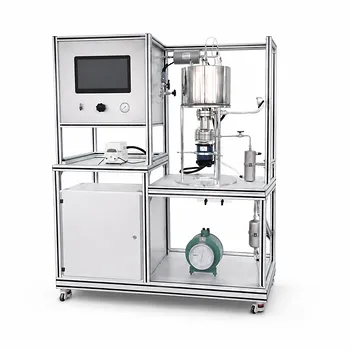
Designed for chemical engineering university labs, this pilot plant allows hands-on determination of catalyst particle intraparticle diffusion effective factors and gas-solid reaction kinetics using a fixed-bed tubular reactor with industrial touchscreen control, bridging theory and practical reactor design.

O-Xylene Oxidation to Phthalic Anhydride Educational Unit Operations Pilot Plant

O-Xylene Oxidation to Phthalic Anhydride Educational Unit Operations Pilot Plant

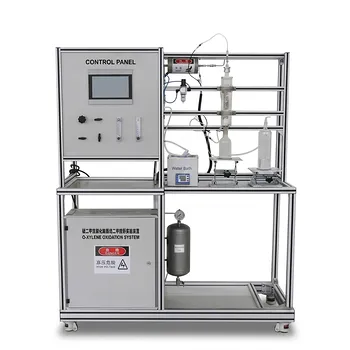
Explore our bench-scale educational pilot plant for o-xylene oxidation to phthalic anhydride, featuring a fixed-bed tubular reactor with visual observation, precise temperature control, and safety systems, ideal for chemical engineering hands-on training and industrial simulation, designed for university unit operations.

Residence Time Distribution and Reactor Flow Characteristics Determination Educational Pilot Plant

Residence Time Distribution and Reactor Flow Characteristics Determination Educational Pilot Plant

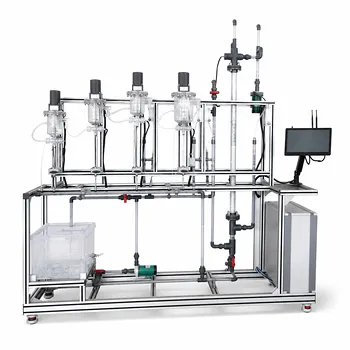
This versatile educational pilot plant is designed for comprehensive study of residence time distribution and reactor flow characteristics, featuring multiple CSTRs in series, a tubular reactor, variable recycle loop, and automated real-time data acquisition, perfect for hands-on chemical engineering education.

Fixed-Bed Chemical Reaction and Gas Dust Tar Removal Unit Operations Pilot Plant

Fixed-Bed Chemical Reaction and Gas Dust Tar Removal Unit Operations Pilot Plant

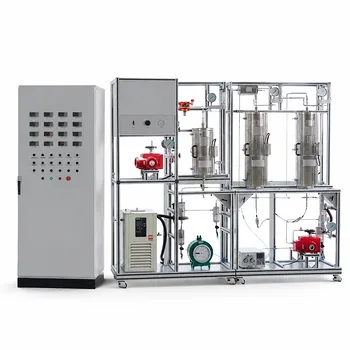
Integrated educational pilot plant for studying catalytic gas-solid reactions and downstream gas purification. Features dual fixed-bed reactor, three-stage heating, and touchscreen control for hands-on engineering training. Ideal for chemical and environmental engineering curricula.

Multi-Reactor Educational Pilot Plant for Reaction Engineering Unit Operations

Multi-Reactor Educational Pilot Plant for Reaction Engineering Unit Operations

Integrated bench-scale educational pilot plant for chemical engineering teaching featuring fixed bed fluidized bed and stirred tank reactors with web-based digital twin controls and safety interlocks for hands-on unit operations and reaction engineering comparative studies in one compact system.

Fixed Bed Gas Solid Catalytic Reaction Educational Pilot Plant

Fixed Bed Gas Solid Catalytic Reaction Educational Pilot Plant

Fixed-bed gas-solid catalytic reaction unit operations pilot plant for chemical engineering education. Features split-furnace, mass flow controllers, PID control, safety interlocks. Ideal for heterogeneous catalysis, reactor dynamics, catalyst evaluation studies. Fully customizable configurations for university laboratories and academic research.

Fluidized Bed Gas Solid Catalytic Reaction Educational Pilot Plant

Fluidized Bed Gas Solid Catalytic Reaction Educational Pilot Plant

Our educational fluidized bed gas-solid catalytic reaction pilot plant is ideal for chemical engineering labs. Students study fluidization dynamics, catalyst evaluation, and process control hands-on. Features include a customizable reactor, touchscreen HMI, and safety interlocks for safe, curriculum-aligned experiments.

Internal Circulation Gradient Free Catalytic Reaction Educational Pilot Plant

Internal Circulation Gradient Free Catalytic Reaction Educational Pilot Plant

Internal circulation gradient free catalytic reaction educational pilot plant for chemical engineering unit operations. Provides isothermal gradient free operation and hands on study of heterogeneous catalysis kinetics and mass transfer with precise control. Ideal for academic labs.

100L Continuous Loop Hydrogenation Educational Unit Operations Pilot Plant

100L Continuous Loop Hydrogenation Educational Unit Operations Pilot Plant

This 100L continuous loop hydrogenation pilot plant is designed for chemical engineering education, featuring 316 stainless steel construction, advanced gas-liquid mass transfer components, explosion-proof safety systems, and a 15.6-inch touchscreen with 5G connectivity, cloud data logging, bridging theory and industry.

Crude Benzene Hydrogenation Educational Unit Operations Pilot Plant

Crude Benzene Hydrogenation Educational Unit Operations Pilot Plant

Advanced pilot plant for higher education, enabling hands-on study of crude benzene hydrogenation and gas-liquid catalytic reactions. Triple-stage reactor system with precision flow and temperature control, AI-driven PID, remote monitoring, and comprehensive safety interlocks. Customizable for curriculum integration.

Methanol Synthesis and Catalyst Performance Evaluation Educational Unit Operations Pilot Plant

Methanol Synthesis and Catalyst Performance Evaluation Educational Unit Operations Pilot Plant

Bench-scale methanol synthesis and catalyst evaluation educational pilot plant for chemical engineering labs to study catalytic kinetics, high-pressure operations, process control, and unit operations under realistic conditions with industrial safety features, precision gas delivery, data acquisition, and intelligent monitoring.

Multi Functional Catalytic Reaction and Reactor Evaluation Educational Unit Operations Pilot Plant

Multi Functional Catalytic Reaction and Reactor Evaluation Educational Unit Operations Pilot Plant

Bench-scale educational pilot plant for catalytic reaction and reactor evaluation, integrating fixed bed, fluidized bed, and stirred tank reactors. Students compare reactor designs, evaluate catalysts, and study reaction kinetics and hydrodynamics. Perfect for unit operations labs in chemical engineering curricula.

Methane Cracking Educational Unit Operations Pilot Plant

Methane Cracking Educational Unit Operations Pilot Plant

This bench-scale methane cracking educational pilot plant provides hands-on catalytic conversion training with a 1000°C furnace, seven mass flow controllers, and real-time automation for safe, curriculum-aligned experiments. Designed for university teaching of unit operations and reaction engineering.

Natural Product Extraction Unit Operations Training Pilot Plant

Natural Product Extraction Unit Operations Training Pilot Plant

Integrated natural product extraction pilot plant for chemical engineering training bridges theory and industrial practice with modular extraction and evaporation/concentration units, hybrid touchscreen and manual control, realistic process simulation, and self-contained softened water and vacuum utilities.

Micro-Scale Gas-Solid Catalytic Reaction Educational Pilot Plant

Micro-Scale Gas-Solid Catalytic Reaction Educational Pilot Plant

Explore heterogeneous catalysis with this micro-scale gas-solid catalytic reaction educational pilot plant. Designed for university labs, it enables hands-on study of reaction kinetics and transport phenomena in a benchtop packed bed reactor with high-precision flow control and touchscreen automation.

Three-Tube Heat Transfer Educational Pilot Plant for Unit Operations Training

Three-Tube Heat Transfer Educational Pilot Plant for Unit Operations Training

Three-tube heat transfer pilot plant for studying convective heat transfer enhancement and condensation. Allows comparison of smooth, corrugated, turbulent tubes, verifying empirical correlations. Ideal for chemical engineering education with safety and closed-loop steam recovery.

Multi-Stage Stirred Tanks in Series Residence Time Distribution and Mixing Performance Determination Educational Pilot Plant

Multi-Stage Stirred Tanks in Series Residence Time Distribution and Mixing Performance Determination Educational Pilot Plant

Explore residence time distribution and mixing performance in series stirred tanks with this educational pilot plant. Real-time conductivity sensors, interactive 3D simulation, and industrial-grade PC for chemical engineering lab training. Customizable to curricula.

Dual-Mode Rectification Pilot Plant for Practical Training Unit Operations

Dual-Mode Rectification Pilot Plant for Practical Training Unit Operations

Industrial-scale dual-mode rectification pilot plant for chemical engineering practical training. Features real-material and simulated-material operation modes, sieve-plate column with sight glasses for visual observation of hydrodynamics, and customizable SCADA control for safe, hands-on learning of unit operations and mass transfer.

Multi Pump Fluid Transport Process Piping Unit Operations Training Pilot Plant

Multi Pump Fluid Transport Process Piping Unit Operations Training Pilot Plant

Industrial-scale multi-pump pilot plant for unit operations training in fluid transport and process piping, featuring real-material and semi-physical simulation modes, comprehensive pump and flowmeter calibration, and safety-enhanced two-tier platform, bridging academic theory and industrial practice for chemical engineering education.


Leave Your Message