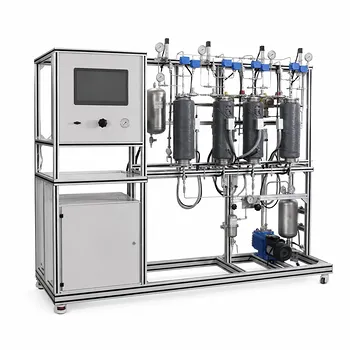
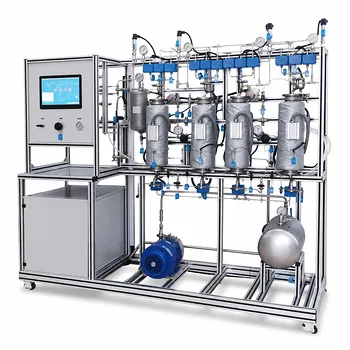
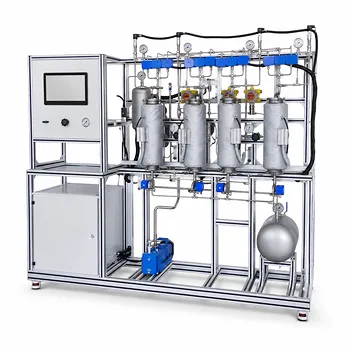
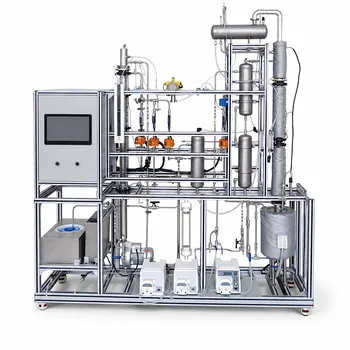
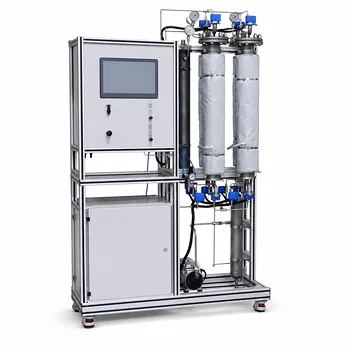
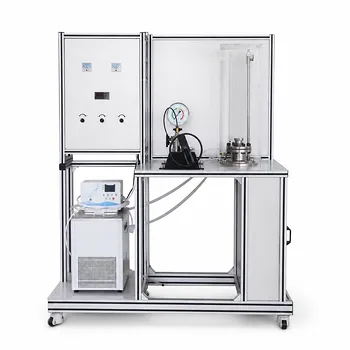
Supercritical carbon dioxide (scCO₂) is not just a theoretical green solvent—it’s a practical replacement for toxic organics, and pilot plants are the proving ground. Chemical engineering unit operations pilot plants configured for supercritical fluids allow you to move beyond textbook diagrams and directly operate high-pressure extraction or reaction systems. This hands-on experience teaches students how scCO₂ eliminates hazardous VOCs, drastically reduces water and waste, and still delivers the separation or reaction performance industry demands.
Most green chemistry principles seem straightforward until you try to scale them. A pilot plant turns the “safer solvents” principle into a measurable design problem—showing how thermodynamics, mass transfer, and energy integration come together to replace toxic solvents with supercritical CO₂ in a way that is both educational and industrially relevant.
The Need: From Toxic Solvents to Green Chemistry
Solvents often account for the largest share of process mass intensity in chemical manufacturing. Traditional volatile organic compounds (VOCs) create serious health, safety, and environmental liabilities. The green chemistry principle of safer solvents directly tackles this by promoting benign, recoverable alternatives like scCO₂. But understanding the principle in a lecture hall is not the same as making it work under pressure, at scale, with real heat and mass transfer constraints. That’s where a pilot plant becomes essential.
How a Pilot Plant Brings Safer Solvents to Life
A well-designed unit operations pilot plant transforms scCO₂ from an abstract concept into a testable, optimizable process. You don’t just learn that scCO₂ is safer—you prove it while dealing with the same engineering decisions faced in industry.
Hands-On Thermodynamics and Mass Transfer
Operating a high-pressure pilot system lets users directly map the solubility of target compounds in scCO₂ as pressure and temperature change. Students can quantify how near the critical point, small adjustments dramatically alter density and solvating power. They measure mass transfer coefficients, observe extraction or dyeing rates, and compare them against conventional solvent benchmarks—exactly the data needed to justify replacing a toxic solvent in a real process.
Demonstrating Waste Elimination in Real Time
When you run an extraction with scCO₂, you don’t generate a solvent-laden waste stream. After depressurization, CO₂ returns to the gas phase and can be recovered, recompressed, and recycled in a closed loop. Pilot plants equipped with a separator system make this visible: students watch the CO₂ cycle, measure solvent recovery efficiency, and calculate the near-zero solvent waste profile. This is a powerful, tangible contrast to processes that burn or incinerate spent organics.
Teaching Scale-Up for Industrial Relevance
Moving from bench‑top glassware to commercial production involves a steep drop in material intensity—from a median of 185 kg materials/kg API preclinically to 45 kg/kg at commercial scale. A pilot plant bridges that gap. Students learn to manage raw material feeding rates, heat integration, and high‑pressure safety—constraints that do not exist in a fume hood. This exposure installs the habit of lifecycle thinking early, so safer solvent choices are evaluated not just for their chemistry, but for their total process footprint.
Inside the Supercritical CO₂ Pilot Plant
To teach the safer solvents principle effectively, the pilot plant must integrate specific unit operations tailored to scCO₂.
Essential High-Pressure Unit Operations
Based on waterless dyeing and extraction processes, a typical scCO₂ pilot plant includes:
- CO₂ storage and supply – liquefied gas under controlled conditions.
- High-pressure pumps – to raise CO₂ above its critical point (31 °C, 73.8 bar).
- Heating systems – to maintain supercritical temperature precisely.
- Autoclave or extraction vessel – where the solvent contacts the solid or liquid substrate.
- Separator system – for controlled depressurization, solute recovery, and CO₂ recycling. Running this train trains engineers on pressure-rated equipment selection, process control, and energy management, all while demonstrating that the only “waste” solvent is a vented gas with minimal environmental impact.
Experimental Design for Green Metrics
A pilot plant is a measurement platform. You can design experiments to directly quantify green chemistry metrics:
- Elimination of VOCs: Measure air emissions and compare with equivalent organic solvent runs.
- Atom economy and E‑factor: Track total materials in versus product out, showing how recovered CO₂ slashes the solvent‑related waste factor.
- Energy consumption: Use embedded sensors to compare heating/cooling loads for scCO₂ versus distillation of organic solvents, linking solvent choice to carbon footprint.
Understanding the Trade-offs
ScCO₂ is not a magic bullet, and a good educational pilot plant must reveal its limitations as clearly as its strengths. Ignoring these fails to prepare students for honest sustainability assessments.
Energy Input vs. Solvent Hazard
Compressing CO₂ to supercritical conditions requires work, and maintaining temperature demands heat. In some cases, the energy per kilogram of product can be higher than a conventional solvent system. The educational value lies in analyzing the full trade‑off: a higher energy input weighed against zero VOC emissions, no residual solvent in the product, and elimination of post‑process incineration. Students learn to use lifecycle assessment tools to see if the net environmental impact genuinely shifts downward.
Material and Safety Challenges
High‑pressure operation demands robust engineering controls. Pilot plants introduce students to real safety hazards: vessel pressure ratings, relief systems, and CO₂ asphyxiation risk. Additionally, scCO₂’s non‑polar nature limits its solvency for many polar compounds; students must investigate the need for cosolvents or higher pressures. These constraints are not drawbacks of the principle but are critical lessons in how to implement safer solvents without creating new process risks.
Making the Right Choice for Your Educational Goal
How you configure and use a pilot plant depends on what you most need to teach. Use the following heuristics to guide your program.
- If your primary focus is demonstrating green waste reduction: Design experiments around closed‑loop CO₂ recovery and run direct comparisons with an organic solvent extraction, measuring waste mass and solvent loss.
- If your primary focus is teaching industrial scale‑up: stress the high‑pressure engineering challenge, integrate heat exchange networks, and require students to calculate the true energy cost per unit product.
- If your primary focus is introducing lifecycle thinking: have students collect data on solvent production, compression energy, and end‑of‑life CO₂ release, then compare it to the cradle‑to‑grave burden of a conventional solvent like hexane.
- If your primary focus is safer chemistry fundamentals: let students map solubility landscapes and mass transfer coefficients, seeing how scCO₂ selectivity avoids toxic solvent residues in final products.
A well‑executed pilot plant exercise transforms the safer solvents principle from a checklist item into a deep, quantitative skill set. By feeling the pump vibrations, adjusting the back‑pressure regulator, and seeing the solvent cycle nearly endlessly, future engineers internalize that sustainability is an engineering decision—not just a chemical one.
Summary Table:
| Educational Focus | Key Lesson / Metric | Equipment Involved |
|---|---|---|
| Waste Elimination | Closed-loop CO2 recovery & E-factor reduction | Separator system & recovery loop |
| Thermodynamics | Pressure/temperature effects on solubility | High-pressure pumps & autoclave |
| Process Trade-offs | Energy consumption vs. solvent hazard mitigation | Integrated sensors & flowmeters |
Bring Green Chemistry and Sustainable Engineering to Life
At LABPARK, we empower universities, research institutes, and enterprises with advanced Educational and Vocational Unit Operations Pilot Plants across chemical engineering, bioprocess & biotech, and environmental & water treatment. Our high-pressure systems allow students and researchers to gain hands-on experience with green chemistry principles—such as supercritical CO2 processes—bridging the gap between theory and industrial application.
Ready to elevate your engineering curriculum or research capabilities? Contact LABPARK today to explore our tailored pilot plant solutions.
Related Products
- Bench Scale Carbon Dioxide Capture Educational Unit Operations Pilot Plant
- Carbon Dioxide Capture and Utilization Educational Pilot Plant for Unit Operations
- Carbon Dioxide Adsorption and Capture Educational Unit Operations Pilot Plant
- Carbon Dioxide Absorption and Desorption Educational Pilot Plant for Carbon Capture Studies
- Low Concentration Carbon Dioxide Capture Pressure Swing Adsorption Educational Pilot Plant
People Also Ask
- What unit operations are critical for CCUS training pilot plants? Build hands-on engineering expertise.
- What are the differences between post- and pre-combustion carbon capture training pilot plants?
- How can pilot plants show tail gas vs flue gas CO2 capture differences? Key educational insights.
- How do temperature variations affect CO2 transport models in pilot plants? Model vs Reality
- How does operating pressure influence the transition between absorption and desorption in a CO2 pilot plant?