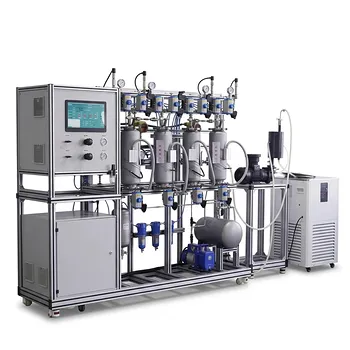
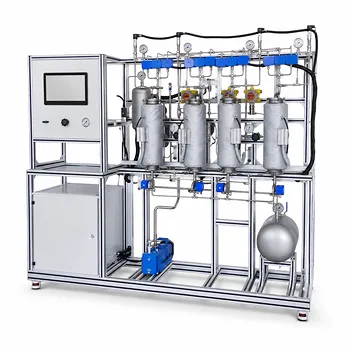
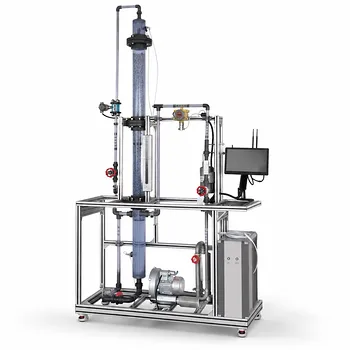
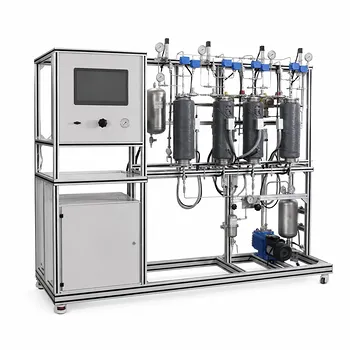
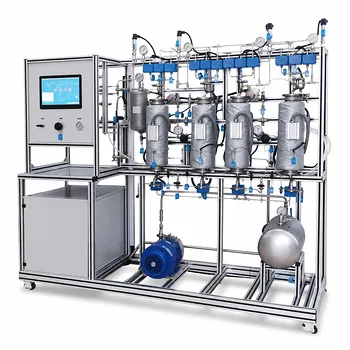
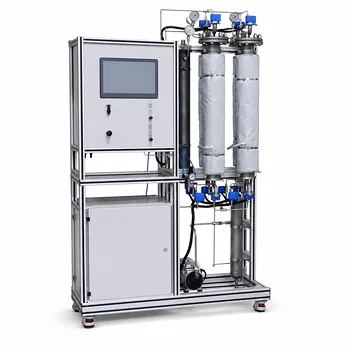
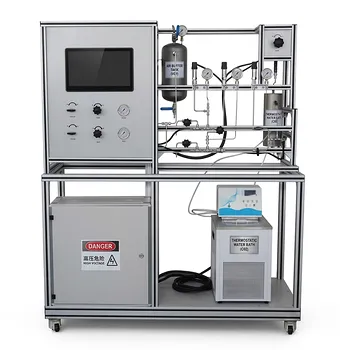
Chemical engineering unit operation pilot plants can evaluate autoxidation kinetics by treating oxygen uptake as a measurable gas absorption process. A sealed, gas-tight reactor containing the liquid substrate is charged with oxygen at a controlled pressure and temperature, while a precision pressure transducer continuously records the pressure decrease caused by oxygen entering the liquid and being consumed by oxidation. Converting that pressure change into moles of oxygen consumed produces oxygen uptake curves, from which engineers can determine reaction rates, induction periods, temperature effects, and substrate stability.
The essential measurement is the rate of oxygen disappearance from a known gas-liquid system. Reliable kinetics require separating chemical oxygen consumption from physical dissolution and gas-liquid mass-transfer limitations.
How the Pilot-Plant Method Works
Establishing a Controlled Gas-Liquid System
The substrate may be tested neat, dissolved in a solvent, or prepared as a complex organic sample. It is placed in a gas-tight reaction vessel with a known headspace volume and exposed to oxygen at a controlled initial pressure, typically within approximately 100 to 760 Torr.
The vessel must be sufficiently sealed that measured pressure changes arise from oxygen uptake rather than leakage. Temperature control is equally important because both oxygen solubility and reaction rate are temperature-dependent.
Measuring Oxygen Disappearance
As autoxidation proceeds, oxygen moves from the headspace into the liquid and participates in free-radical chain reactions. The resulting pressure decrease is recorded continuously by the transducer.
For an oxygen atmosphere, the pressure data can be converted into gas-phase oxygen loss using the ideal-gas relationship:
[ n_{\mathrm{O_2,gas}}=\frac{P_{\mathrm{O_2}}V_g}{RT} ]
where (P_{\mathrm{O_2}}) is oxygen partial pressure, (V_g) is headspace volume, (T) is absolute temperature, and (R) is the gas constant.
The total oxygen uptake must also account for oxygen dissolved in the liquid. When the liquid remains near oxygen saturation, the dissolved concentration can be related to oxygen partial pressure through an appropriate solubility or Henry's-law relationship.
Using Air Instead of Pure Oxygen
When air is used, total pressure alone does not directly represent oxygen uptake because nitrogen and other gases remain in the headspace. In that case, gas chromatography or another gas-composition measurement can track changes in oxygen concentration.
The gas-phase oxygen balance is then based on both pressure and composition:
[ n_{\mathrm{O_2}}=\frac{y_{\mathrm{O_2}}PV_g}{RT} ]
where (y_{\mathrm{O_2}}) is the measured oxygen mole fraction.
Converting Uptake into a Kinetic Rate
The oxygen uptake curve is expressed as oxygen consumed per unit time, liquid mass, liquid volume, or reactive substrate amount. A general rate expression is:
[ r_{\mathrm{O_2}}=-\frac{1}{V_L}\frac{dn_{\mathrm{O_2}}}{dt} ]
where (V_L) is the liquid volume.
The resulting rate data can be fitted to a kinetic model. Depending on the substrate and experimental design, useful outputs may include an initial oxygen uptake rate, an apparent reaction-order relationship, a rate constant, an induction period, or an effective activation energy from tests at multiple temperatures.
Designing the Experiment for Meaningful Kinetics
Maintaining Oxygen Saturation
The liquid should remain adequately supplied with oxygen throughout the measurement. If oxidation consumes oxygen faster than it can be transferred from the headspace, the measured rate will reflect oxygen transport rather than intrinsic autoxidation kinetics.
A practical design response is to minimize the liquid-volume-to-gas-liquid interfacial-area ratio. Controlled stirring can also improve gas-liquid contact, but the agitation must not create vortexing, surface waves, or changing interfacial area.
Controlling the Headspace
The headspace volume should be known accurately because it determines how strongly oxygen consumption changes the measured pressure. A very small headspace can produce large pressure changes but may also deplete oxygen rapidly.
A larger headspace provides a more stable oxygen reservoir, although the pressure signal for a given amount of uptake becomes smaller. The chosen volume should therefore provide a measurable signal while avoiding substantial oxygen starvation.
Selecting Pressure and Temperature
Initial oxygen pressure affects the oxygen concentration available to the liquid and may influence the observed rate. Pressure should be treated as an experimental variable and reported with the kinetic results.
Temperature control should be precise and stable. A temperature increase generally affects both oxygen solubility and reaction kinetics, so temperature-dependent experiments must distinguish those effects during data interpretation.
Checking the Instrument and Vessel
Before collecting kinetic data, the system should be checked for leaks, transducer drift, and temperature equilibration. A blank experiment containing the solvent or an oxidation-inactive liquid can identify pressure changes caused by physical dissolution, thermal expansion, or apparatus artifacts.
The pressure transducer should be calibrated over the operating range. Gas chromatographic measurements require equivalent checks for sampling losses, detector response, and changes in gas composition caused by sampling.
Separating Absorption from Autoxidation
Physical Absorption Is Not Chemical Uptake
Oxygen first dissolves physically in the liquid before it reacts. The measured pressure drop therefore contains contributions from gas dissolution and chemical consumption.
A blank or nonreactive reference establishes the physical-absorption contribution. Subtracting or modeling that contribution helps isolate the oxygen consumed by autoxidation.
Avoiding Mass-Transfer-Controlled Measurements
For intrinsic kinetic measurements, the chemical reaction should occur within a regime where oxygen transfer is sufficiently fast relative to reaction. In gas-liquid reaction engineering, the Hatta modulus is commonly used to assess the relative importance of reaction and diffusion.
Very slow reactions, generally associated with a low reaction modulus, produce little enhancement over physical absorption and make the absorption signal insensitive to reaction kinetics. At the opposite extreme, an effectively instantaneous reaction is limited by mass transfer, so the observed rate does not provide a reliable intrinsic kinetic constant.
The operating window should therefore be established experimentally and, where appropriate, checked using diffusivity, concentration, stoichiometry, and reaction-rate estimates. The exact criterion depends on the kinetic model and reactor configuration; a single numerical range should not be applied without verifying its definitions and units.
Using Residence Time Correctly
In a continuous absorption column, a first-order reaction may be negligible relative to physical absorption when:
[ k_i^*\tau \ll 1 ]
where (k_i^*) is the effective liquid-phase reaction rate constant and (\tau) is liquid residence time.
This criterion is useful for deciding whether a column experiment can be simplified to physical absorption. It is not, by itself, a substitute for the sealed-vessel oxygen-uptake method, which is generally better suited to measuring autoxidation kinetics in a defined liquid sample.
Integrating the Method into a Pilot Plant
Using a Stirred Absorption Cell
A stirred gas-liquid cell can provide a practical intermediate scale between a laboratory flask and a continuous pilot unit. The cell should have a known liquid volume, controlled interfacial area, temperature regulation, calibrated pressure measurement, and reproducible agitation.
Its main value is controlled comparison. Engineers can vary oxygen pressure, temperature, agitation, substrate composition, and liquid depth while monitoring the resulting oxygen uptake profile.
Connecting to Packed or Tray Columns
Packed and tray columns are primarily useful for studying continuous gas-liquid mass transfer, solvent performance, and scale-up behavior. They can expose the substrate to a controlled oxygen-containing gas stream and provide inlet and outlet gas measurements for an overall oxygen balance.
However, a column oxygen balance alone generally combines reaction, physical absorption, axial mixing, interfacial area, and residence-time effects. For autoxidation kinetics, column data should therefore be paired with sealed-cell measurements or a validated reactor model.
Using Modular Configurations
A modular pilot plant can connect absorption columns in series or vary packing height and tray count. These changes help determine how contact area and residence time affect oxygen transfer and substrate conversion.
Such configurations are valuable for assessing whether a kinetic model developed in a sealed vessel remains consistent under continuous-flow conditions. They also reveal whether scale-up introduces mass-transfer limitations that were absent in the smaller reactor.
Performing Material Balances
For a continuous unit, measure the oxygen concentration and flow rate at the inlet and outlet, along with liquid flow, temperature, and pressure. The difference between inlet and outlet oxygen molar flow provides the overall oxygen removal rate, subject to correction for gas holdup and sampling effects.
The material balance can then be compared with the expected oxygen consumption from the autoxidation model. A persistent mismatch may indicate incomplete gas-liquid contact, oxygen accumulation in the liquid, changing substrate composition, or transport control.
Understanding the Trade-offs
Pressure Measurement Versus Gas Chromatography
Pressure transducers provide continuous, high-resolution monitoring and are well suited to sealed experiments. They require accurate knowledge of headspace volume, temperature, gas behavior, and physical oxygen dissolution.
Gas chromatography can distinguish oxygen from other gas components and is useful when air or mixed gases are used. It is less inherently continuous and introduces sampling, calibration, and possible composition-disturbance errors.
Batch Testing Versus Continuous Operation
A sealed batch vessel gives a relatively clear oxygen-uptake profile and simplifies the material balance. It does not directly reproduce the residence-time distribution, hydrodynamics, or gas-flow behavior of a packed or tray column.
A continuous pilot unit provides more realistic process information but makes intrinsic kinetics harder to identify. Reaction and mass transfer must be estimated together unless the system is carefully designed and modeled.
High Oxygen Availability Versus Representative Conditions
Increasing oxygen pressure can improve signal strength and help maintain liquid oxygen availability. It may also move the chemistry away from the conditions relevant to the intended process or alter the apparent oxidation behavior.
The test pressure should therefore be selected according to the process question. A convenient pressure is not automatically a representative pressure.
Agitation Versus Interfacial Stability
Stirring improves oxygen transfer and helps preserve saturation. Excessive agitation can create a vortex, entrain gas, change the effective interfacial area, or introduce pressure fluctuations unrelated to reaction.
Agitation should be reported and held constant across comparative experiments. Visual inspection and blank tests are useful for detecting unstable hydrodynamics.
Interpreting Apparent Kinetic Constants
A fitted rate constant is only intrinsic when temperature, oxygen concentration, mixing, physical absorption, and sampling effects have been addressed. Otherwise, it is more accurately described as an apparent kinetic parameter.
This distinction is important when transferring results from a stirred cell to a pilot column or from a pilot column to industrial equipment.
Making the Right Choice for Your Goal
Select the reactor and measurement method according to the decision the pilot plant must support.
- If your primary focus is intrinsic autoxidation kinetics: Use a thermostated, gas-tight stirred vessel with a calibrated pressure transducer, blank corrections, controlled oxygen pressure, and sufficient gas-liquid contact to maintain saturation.
- If your primary focus is oxygen-transfer performance: Use a packed or tray absorption unit and determine inlet-outlet oxygen balances, gas-liquid mass-transfer coefficients, flow effects, and interfacial behavior.
- If your primary focus is process scale-up: Combine sealed-vessel kinetic data with continuous pilot-column experiments so that reaction parameters and mass-transfer parameters are evaluated separately.
- If your primary focus is substrate or solvent comparison: Keep headspace, temperature, agitation, oxygen pressure, liquid volume, and sampling procedures constant, then compare oxygen uptake curves and derived rates.
- If your primary focus is educational demonstration: Use the sealed vessel to show pressure-based oxygen uptake, then use a modular column to demonstrate how flow, packing, and residence time affect gas-liquid absorption.
A well-designed pilot plant turns oxygen disappearance into defensible kinetic data by controlling and quantifying every major source of gas-liquid transfer and measurement error.
Summary Table:
| Method or focus | Key measurement | Primary application | Essential controls |
|---|---|---|---|
| Sealed stirred vessel | Pressure decrease converted to oxygen moles consumed | Intrinsic autoxidation kinetics | Gas-tight system, calibrated transducer, stable temperature, known headspace |
| Gas chromatography | Oxygen concentration and gas composition | Experiments using air or mixed gases | Sampling calibration, inlet/outlet gas analysis, flow measurement |
| Blank experiment | Physical oxygen dissolution and system artifacts | Correcting chemical uptake data | Nonreactive liquid, leak testing, temperature equilibration |
| Packed or tray column | Inlet–outlet oxygen molar balance | Continuous absorption and scale-up studies | Flow rates, residence time, gas holdup, interfacial area |
| Kinetic analysis | Uptake rate, induction period, rate constant, activation energy | Comparing substrates and operating conditions | Control oxygen pressure, agitation, temperature, and liquid volume |
| Mass-transfer assessment | Oxygen transfer versus reaction rate | Determining whether data are intrinsic or apparent | Maintain oxygen saturation and evaluate transport limitations |
Need reliable gas absorption and reaction data for teaching, research, or process development? Contact LABPARK to discuss a customized Educational or Vocational Unit Operations Pilot Plant. LABPARK provides integrated pilot plants for chemical engineering, bioprocess and biotechnology, and environmental and water treatment applications. Our systems help universities, research institutes, and enterprises evaluate oxygen uptake, autoxidation kinetics, gas–liquid mass transfer, reactor performance, and scale-up conditions with controlled pressure, temperature, flow, agitation, and sampling. We can help you select the right sealed stirred vessel, absorption column, or modular configuration for generating repeatable, defensible results.
Related Products
- Multi-Component Gas Pressure Swing Adsorption Pilot Plant for Unit Operations Education
- Carbon Dioxide Adsorption and Capture Educational Unit Operations Pilot Plant
- Dual-Mode Gas Absorption and Desorption Unit Operations Training Pilot Plant
- Packed Bed Absorption Educational Unit Operations Pilot Plant
- Absorption and Desorption Educational Unit Operations Pilot Plant
People Also Ask
- How does Pressure Swing Adsorption (PSA) technology operate? Optimize gas separation with pilot plants.
- How is the direction and driving force of mass transfer determined in a gas absorption unit operations pilot plant?
- How do two-film & penetration theories apply to gas absorption pilot plant teaching? Key pedagogical insights.
- How does partial pressure behavior influence gas absorption pilot plants? Master Mass Transfer
- What are the limitations of Henry's Law in gas absorption pilot plants? Avoid critical lab errors.