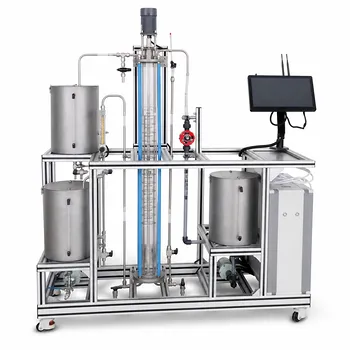
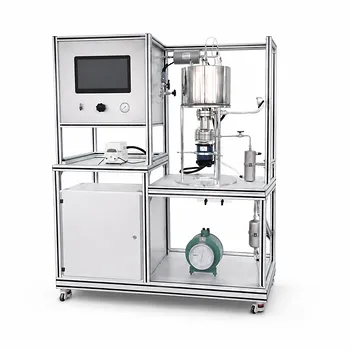
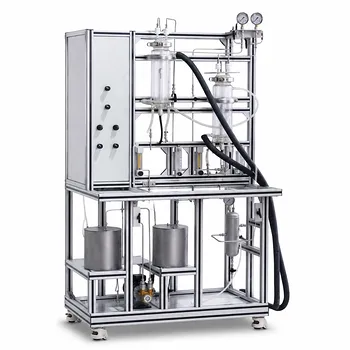
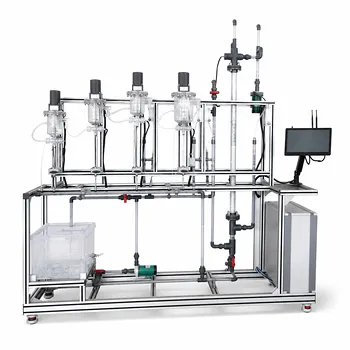
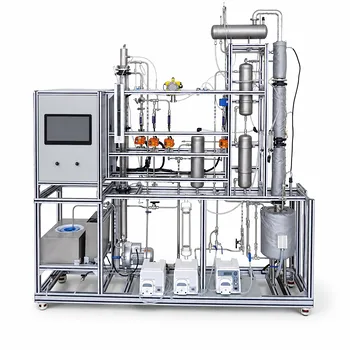
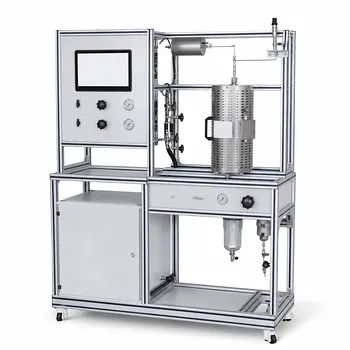
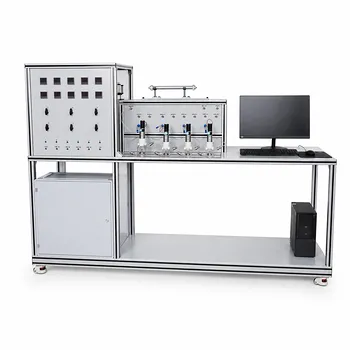
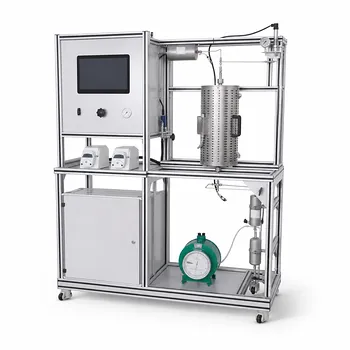
The most direct way to study multifunctional reactors is to operate a pilot plant that physically integrates reaction and separation in a single unit.
Chemical engineering students can utilize a multifunctional reactor pilot plant—such as one combining a catalytic reactor with an adsorption column—to directly observe reactive chromatography. By running reactions where products are selectively adsorbed as they form, you can measure how equilibrium limitations are overcome, validate mathematical models of the combined process, and quantify the resulting improvements in conversion, selectivity, and energy efficiency. The pilot plant turns the abstract concept of process intensification into measurable, visual data.
The core insight is that unit operations pilot plants bridge the gap between textbook theory and industrial reality. By experimenting with a reactive chromatography setup, students don't just learn what a multifunctional reactor is—they experience firsthand how integrating reaction and separation reduces equipment footprint, lowers operating costs, and sidesteps thermodynamic constraints like unfavorable equilibrium constants.
Why Reactive Chromatography Changes the Game
Breaking Free from Thermodynamic Handcuffs
In a conventional reactor, a reversible reaction eventually reaches equilibrium, limiting your maximum possible conversion.
If you have an unfavorable equilibrium (low $K$), no amount of catalyst can push the reaction beyond that point.
Reactive chromatography solves this by selectively removing one product the moment it forms.
The reaction never reaches equilibrium because the product concentration in the fluid phase stays low. Le Châtelier’s principle forces the reaction forward continuously.
A pilot plant makes this invisible shift visible.
By placing an adsorbent inside the reactor zone, you can monitor the difference between the thermodynamic equilibrium conversion and the actual, far higher conversion achieved through in‑situ separation.
Seeing the Capital Cost Drop in Real Time
Multifunctional reactors are the poster child of process intensification because they collapse two or more traditional unit operations into one.
Instead of a reactor followed by a separate distillation column or chromatographic skid, you have one vessel doing both jobs.
In a pilot plant, students can run the same production rate in two configurations: a conventional reactor‑plus‑separation sequence, and the integrated reactive chromatography unit.
Comparing their physical footprint, utility consumption, and instrumentation needs directly demonstrates why companies invest in intensification—lower capital and operating costs.
How Pilot Plants Turn Theory into Measurable Insight
Moving from Blackboard Models to Physical Data
You already know the plug‑flow or axial dispersion models from your transport phenomena lectures.
A reactive chromatography pilot plant lets you feed these models real physical parameters: adsorption isotherms, reaction rate constants, mass transfer coefficients.
By injecting a tracer or a reactant pulse and measuring the effluent concentration over time using online analytical sensors, you obtain experimental breakthrough curves.
Then you can compare those curves to the predictions of a coupled reaction‑adsorption model, adjusting parameters until theory and experiment align. That process teaches model validation more deeply than any simulation ever could.
Visualizing the “Reaction+Separation” Synergy
One powerful experiment is to first run the pilot plant solely as a fixed‑bed adsorber—introducing a pre‑reacted mixture and separating the components.
Next, you run the same column with the catalyst mixed in, feeding the reactant and letting reaction and separation occur simultaneously.
The difference in outlet purity, recovery, and total processing time is striking.
Students can measure selectivity enhancements: side‑reactions are often suppressed because the desired product is quickly removed from the reactive zone, preventing it from undergoing further undesired chemistry.
Decoupling Kinetics from Design
A multifunctional reactor pilot plant lets you isolate the reaction kinetics from the separation dynamics.
You can run the catalytic reaction separately in a small CSTR to determine the intrinsic rate law. Then you can run the adsorption step in a separate column to get the isotherm.
Finally, you operate the integrated unit and see how the two phenomena interplay—using the same rate law and isotherm, but now noticing that the apparent reaction rate appears faster because product inhibition is eliminated.
This decoupling is the cornerstone of reactor design education, and the pilot plant makes it tangible.
Understanding the Trade‑offs
Increased Complexity Is Not Free
Integrating reaction and separation creates new control challenges.
Temperature gradients can cause adsorbent capacity to shift dramatically. If you regenerate the adsorbent incorrectly, you risk catalyst deactivation.
Pilot plants reveal these practical pitfalls.
Students quickly learn that a beautiful theoretical concept can fail spectacularly if heat management mismatches the adsorption enthalpy with the reaction exotherm. The lesson: process intensification demands more sophisticated instrumentation and operating discipline.
The Scale‑up Trap
Data from a lab‑scale reactive chromatography pilot unit does not scale linearly.
Mass transfer resistances, wall effects, and dispersion patterns change as diameter increases. The pilot plant provides the essential “data anchor” for larger simulations, but it also teaches humility—you can’t just multiply the column diameter and expect the same performance.
Students who grapple with these scaling lessons in the pilot plant are better prepared to question oversimplified scale‑up rules later in their careers.
Not Every Reaction Benefits
A pilot study might show that for a reaction with a very favorable equilibrium constant, the extra cost of integrated separation brings negligible conversion improvement.
This is a critical lesson in economic analysis. The pilot plant allows students to ask, “Is the gain worth the added complexity?” and back it up with numbers rather than guesses.
Making the Right Choice for Your Learning Goal
Your pilot plant experience should match what you’re trying to master. Use these priorities to guide your experimental focus:
- If you need to deeply understand process intensification: Run the reactive chromatography unit in full integrated mode and compare it with a conventional reactor‑separator sequence. Measure the reduction in equipment count, footprint, and energy per kilogram of product.
- If your goal is model validation and simulation skills: Operate the pilot plant to generate kinetic and adsorption data independently, then create a coupled model and test its predictions against the integrated run. Refine your model until the predicted breakthrough curves match reality.
- If you’re focusing on industrial cost analysis: Use the pilot plant data to perform a “like‑for‑like” capital and operating cost comparison between the intensified and non‑intensified process. Let the pilot plant’s utility consumption and yield figures anchor your economic model.
- If you want to explore reaction engineering fundamentals: Use the reactive chromatography system to see how in‑situ product removal effectively creates a system where the reverse reaction rate is negligible—a deeper demonstration of irreversible versus reversible reactor behavior.
Ultimately, a unit operations pilot plant equipped for multifunctional reaction‑separation doesn’t just teach you about reactive chromatography; it reshapes how you think about reactor design itself—from a single‑purpose vessel to an integrated, cost‑savvy system that outsmarts thermodynamics.
Summary Table:
| Feature | Traditional Process | Multifunctional Reactor | Student Learning Benefit |
|---|---|---|---|
| Equipment Setup | Separate reactor & separation unit | Single integrated vessel | Understands process intensification |
| Thermodynamic Limit | Restricted by equilibrium ($K$) | Product removed; reaction pushed forward | Visualizes Le Châtelier’s principle in real time |
| Economic Impact | Higher capital & operating footprint | Lower footprint & reduced utility needs | Teaches industrial cost & feasibility analysis |
| Control & Complexity | Standard, decoupled loops | High (thermal & adsorption coupling) | Develops advanced process control skills |
Bring Process Intensification to Life in Your Lab
Looking to equip your students or research team with hands-on experience in advanced reaction engineering? LABPARK provides state-of-the-art Educational and Vocational Unit Operations Pilot Plants in chemical engineering, bioprocess & biotech, and environmental & water treatment.
Designed specifically for universities, research institutes, and enterprises, our robust systems bridge the gap between abstract textbook theory and industrial reality—allowing learners to master complex concepts like reactive chromatography, model validation, and scale-up dynamics.
Contact LABPARK today to discover how we can customize the perfect pilot plant solution for your institution.
Related Products
- Educational Rotary Disc Liquid-Liquid Extraction Pilot Plant
- Multi Functional Catalytic Reaction and Reactor Evaluation Educational Unit Operations Pilot Plant
- 100L Continuous Loop Hydrogenation Educational Unit Operations Pilot Plant
- Internal Circulation Gradient Free Catalytic Reaction Educational Pilot Plant
- Photocatalytic Membrane Separation and Degradation Unit Operations Pilot Plant
People Also Ask
- How do density and IFT affect liquid-liquid extraction pilot plants? Optimize Column Performance
- How are ternary phase diagrams and LLE data applied in extraction experiments? Optimize Pilot Plant Scale-up
- In a liquid-liquid extraction pilot plant, how is a ternary-phase diagram utilized to determine solvent feed requirements?
- How Do Selectivity & Distribution Coefficients Influence LLE Pilot Plant Solvent Choice?
- How to Validate BIPs for LLE Pilot Plants? Steps to Align Simulations with Reality