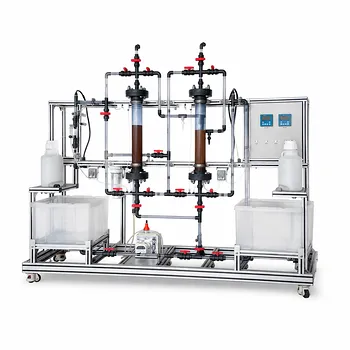
The heart of a liquid-liquid extraction pilot plant is a delicate dance between two physical forces: gravity and surface energy. A larger density difference between the two liquid phases accelerates phase separation under gravity, preventing flooding and enabling higher throughput. Interfacial tension must be carefully balanced—too high and you cannot disperse the droplets to create sufficient contact area; too low and the system forms stable emulsions that refuse to separate without mechanical aids.
Core Takeaway: Density difference is the engine that drives capacity and phase disengagement, while interfacial tension is the tunable knob that governs dispersion quality and mass transfer efficiency. Mastering their interplay is the key to running a pilot column that is both productive and scalable.
Why Density Difference is the Engine of Throughput and Phase Separation
The density contrast between the continuous and dispersed phases directly determines how fast the droplets settle or rise against the opposing flow.
The Gravity-Driven Coalescence Engine
In a pilot plant column, the dispersed phase exists as droplets moving through a continuous phase. The net gravitational force acting on each droplet is proportional to the density difference ($\Delta\rho$). A larger $\Delta\rho$ generates a stronger buoyancy or settling force, rapidly driving droplets toward the main interface where they coalesce and return to their bulk phase.
How Low Density Difference Triggers Flooding
When $\Delta\rho$ is small, the droplets are nearly neutrally buoyant. They float in the active zone much longer, increasing the dispersed phase holdup—the volume fraction of droplets inside the column. This swollen population chokes the available cross section and, at a critical flow rate, triggers flooding. The column loses a stable interface, and liquid entrainment ruins the separation.
Translating Density Contrast into Pilot Plant Throughput
A larger density difference allows you to run the column at higher continuous and dispersed phase flow rates before flooding. In pilot-scale extraction columns (pulsed, packed, or rotating-disc), this means higher throughput per unit cross-sectional area, which shrinks the column diameter required for a given production target. It also widens the safe operating envelope, giving researchers more flexibility to explore solvent-to-feed ratios.
The Dual Role of Interfacial Tension: Dispersion Versus Coalescence
Interfacial tension (IFT) sits at the crossroads of two opposing needs: creating fine droplets for fast mass transfer, and allowing those droplets to coalesce into a clean phase separation.
High Interfacial Tension: Hard to Break, Slow to Transfer
When IFT is high, the dispersed phase resists being torn into small droplets. You end up with large droplets that have a low specific interfacial area ($a$). Since the mass transfer rate is $n_A = k_{OC} a (c_A^* - c_A)$, a smaller $a$ directly throttles the extraction rate. The column may separate phases easily but will be inefficient—requiring many more theoretical stages to hit the purity target.
Low Interfacial Tension: The Emulsification Trap
If the IFT is too low, the energy input from distributors or agitation easily shatters the dispersed phase into micron-sized droplets. These form a stable emulsion that settles at a painfully slow rate. The column interface becomes ragged or completely lost, leading to severe entrainment and separation failure. In a pilot plant, this manifests as a milky, cloudy appearance where phases refuse to disengage even with large settlers.
The Operational Sweet Spot
Successful pilot operation demands an IFT that is low enough to permit fine dispersion under the chosen mixing energy, yet high enough to allow rapid coalescence once the droplets reach the interface. This sweet spot is often found by solvent screening or adjusting temperature, because IFT is highly temperature-dependent. Pilot-plant tests that vary agitation speed and measure the Sauter mean diameter ($d_{32}$) and holdup can map this balance precisely.
Understanding the Trade‐offs in Real Pilot Plant Operation
The interplay is never isolated—choosing a solvent with an ideal density difference might force you to accept a less favorable IFT, or vice versa. Here are the most common tensions you will face.
- Throughput vs. drop size. Pushing a high density difference enables higher flow rates, but the solvent you select may have an inherently high or low IFT, forcing you to recalibrate the distributor design or agitation intensity.
- Fast coalescence vs. mass transfer area. A very high density difference often correlates with a high IFT. Phase separation is then almost instantaneous, but the large droplets give you a pitiful interfacial area. You must then compensate with more stages or column height.
- Emulsion risk at scale. A low-IFT system might work perfectly in a small benchtop column, but in a pilot plant with higher throughput, the increased residence time can amplify emulsion formation. Always test at pilot-relevant holdups and flow ratios before scaling up.
- Viscosity as an amplifier. High continuous-phase viscosity reduces droplet settling velocity even with a decent density difference, and it also dampens the rupture of emulsion films. When either density or IFT is marginally acceptable, elevated viscosity can push the system into flooding.
Making the Right Choice for Your Pilot Plant Goal
Your strategy for evaluating and leveraging these properties depends entirely on what you need to prove in the pilot campaign.
- If your primary focus is maximizing throughput and preventing flooding: Favor a solvent that provides the largest achievable density difference. Screen candidates first by $\Delta\rho$, then validate IFT to ensure it does not fall into the emulsification zone.
- If your primary focus is achieving high mass transfer efficiency with a short column: Look for a solvent with an interfacial tension low enough to generate a Sauter mean diameter below your target. Then use a variable-speed agitator or pulsed column to fine-tune dispersion and confirm that coalescence remains manageable at the pilot scale.
- If your primary focus is robust, trouble-free operation over long campaigns: Select a solvent with a moderately high IFT (to avoid emulsion) and a density difference above 0.1 g/cm³. Sacrificing some stage efficiency for operational stability is often the wisest short-term choice during pilot-plant development.
Every liquid-liquid extraction pilot run is a physical experiment in balancing gravitational and interfacial forces—master those, and you master the column.
Summary Table:
| Physical Property | Primary Role in Column | Impact of High Values | Impact of Low Values |
|---|---|---|---|
| Density Difference ($\Delta\rho$) | Drives buoyancy & phase separation | Faster settling, higher throughput, lower flooding risk | Slow settling, high droplet holdup, high flooding risk |
| Interfacial Tension (IFT) | Governs droplet dispersion & coalescence | Coarser droplets, lower mass transfer efficiency | Fine droplets, stable emulsions, difficult phase separation |
Scale Up Your Chemical Engineering Lab with LABPARK
Mastering liquid-liquid extraction dynamics requires precise, reliable equipment. LABPARK designs and delivers premium Educational and Vocational Unit Operations Pilot Plants in chemical engineering, bioprocess & biotech, and environmental & water treatment.
Whether you are a university training future engineers, a research institute optimizing separation processes, or an enterprise scaling up production, our tailored pilot plants provide the scalability and operational control you need.
Contact LABPARK today to discuss your pilot plant requirements!
Related Products
- Educational Rotary Disc Liquid-Liquid Extraction Pilot Plant
- Comprehensive Liquid-Liquid Extraction Pilot Plant for Engineering Education
- Gallium and Indium Selective Extraction Educational Pilot Plant
- Ternary Liquid-Liquid Equilibrium Educational Pilot Plant
- Packed Bed Absorption Educational Unit Operations Pilot Plant
People Also Ask
- How are ternary phase diagrams and LLE data applied in extraction experiments? Optimize Pilot Plant Scale-up
- In a liquid-liquid extraction pilot plant, how is a ternary-phase diagram utilized to determine solvent feed requirements?
- How Do Selectivity & Distribution Coefficients Influence LLE Pilot Plant Solvent Choice?
- How to Validate BIPs for LLE Pilot Plants? Steps to Align Simulations with Reality
- How do students utilize triangular phase diagrams in liquid-liquid extraction pilot plants? Master Ternary Analysis