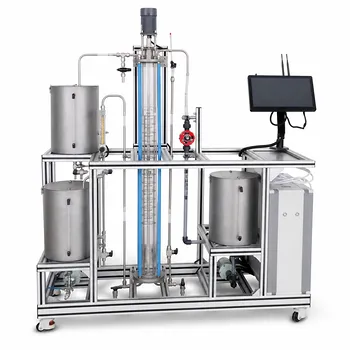
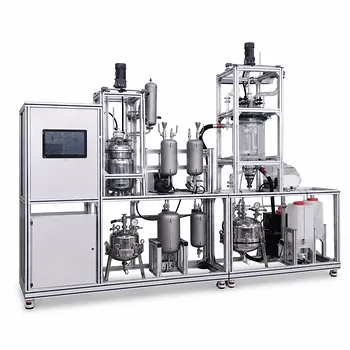
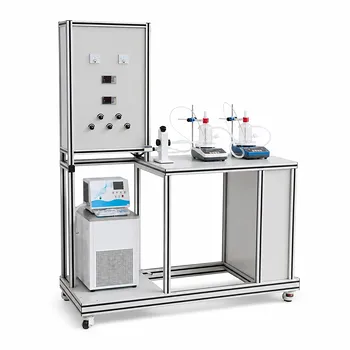
Space constraints are the first-order factor—dictating a binary choice between horizontal and vertical equipment. If your ceiling height is restricted, immediate exclusion of tall gravity or mechanically agitated columns is necessary, steering you towards horizontally arranged mixer-settlers. Conversely, if floor space is the premium, centrifugal extractors offer the most compact footprint for high-throughput duties. This initial decision then cascades into evaluating your specific process stream.
The central challenge is balancing a separation process that naturally benefits from height (gravity) against a physical space that denies it. The optimal choice hinges not just on square footage, but on whether your process stream contains solids, the number of theoretical stages required, and the settling characteristics of your liquids. A perfect footprint fit is meaningless if the equipment clogs within a week or fails to achieve separation.
Matching Equipment Geometry to Physical Constraints
The layout of your laboratory is a non-negotiable boundary condition. Understanding the geometric demands of each equipment class allows you to eliminate unsuitable options immediately.
The Height vs. Footprint Trade-off
Vertical extraction columns, including packed, pulsed, and rotating disc types, inherently require significant vertical clearance. This is not just for the column itself but for phase disengagement zones at the top and bottom.
If your ceiling is low, these are functionally nonviable. The required height for even a modest number of theoretical stages will exceed a standard ceiling. In this scenario, horizontally oriented mixer-settlers become the default choice. They spread the required stage length across the floor rather than building it upwards.
If your floor area is critically limited, look to centrifugal extractors. These devices use rotational force to multiply the g-forces acting on the liquids, drastically reducing both the physical size and the required contact time. They pack high separation efficiency into a remarkably small space.
Considering Solids: A Critical Operational Override
A pure space-based decision can fail if you ignore your feed stream’s composition. A compact mixer-settler or tall pulsed column will both fail if they become clogged.
If your process generates precipitates or contains suspended solids, you must select a self-cleaning technology. Reciprocating plate towers and rotating disc columns have an inherent mechanical action that resists fouling. In contrast, sieve plate and packed towers are highly prone to clogging in this environment, requiring frequent and often difficult maintenance shutdown cycles. This operational reality overrides footprint convenience.
Process-Driven Equipment Selection for Constrained Spaces
Once you've identified the viable equipment geometries, the separation challenge itself dictates the final engineering specification. The number of theoretical stages you need directly influences the size of the unit.
Deciding Based on Theoretical Stages and Capacity
The complexity of your separation defines how much machine you need to fit into the space. A simple separation with few stages has very different requirements than a complex one.
- 3 or fewer stages: Gravity-driven columns like simple packed or spray towers are sufficient. Their height for this duty may still be compatible with a taller lab space.
- 4 to 10 stages: Sieve plate towers or pulsed columns are recommended. Pulsed columns are particularly suited for this range when throughput is low, offering good efficiency in a single column.
- 10 to 20 stages: This complex separation requires energy-input systems. Mechanically agitated columns (like rotating disc columns) handle larger throughputs, while mixer-settlers in series provide a horizontal solution if height is the primary constraint.
Addressing Difficult Liquid Properties
The behavior of your liquids under mixing presents another operational factor that can override a footprint-based decision.
Centrifugal extractors are the ultimate problem-solver for challenging fluids. If you are dealing with high viscosity, low interfacial tension, a small density difference between phases, or a strong tendency to form stable emulsions, a centrifugal contactor is not just the compact choice—it is often the only functionally effective choice. Its intense force field forces a rapid, clean phase separation that gravity simply cannot achieve.
Understanding the Trade-offs and Pitfalls
Choosing the right equipment is an exercise in managing compromises. A decision that solves the space problem can inadvertently create a maintenance or operational one.
One common pitfall is selecting a complex mechanical system to save space without planning for its upkeep. Centrifugal extractors and mechanically agitated columns have high-speed rotating parts and seals that require specialized maintenance and are a potential failure point that simple gravity columns lack.
Another trade-off lies in solvent handling. The most effective extraction solvents for your chemistry may pose safety risks in a confined pilot plant. For example, highly efficient but volatile solvents pose fire and health risks that demand upgraded ventilation and monitoring systems, increasing the effective operational footprint and cost.
Finally, a unit’s physical height is only one part of the clearance requirement. You must account for the total packing depth and the service space above it. If a calculated bed depth nears a practical limit of 10 feet, you may need multiple packed beds with liquid redistribution, increasing the column's overall height and complexity and potentially invalidating an initial height assessment.
Making the Right Choice for Your Goal
Your specific priorities will point you decisively towards one equipment class. Begin by identifying your most inflexible constraint.
- If your primary focus is eliminating a severe ceiling height restriction: Your path is to select a series of horizontal mixer-settlers, accepting the larger floor plan requirement they bring.
- If your primary focus is compressing the floor footprint to an absolute minimum: Your investigation should focus on centrifugal extractors, while preparing a rigorous maintenance and solids-tolerance specification for the feed stream.
- If your primary focus is a feed stream with unpredictable solids or fouling potential: Your equipment selection is immediately limited to reciprocating plate or rotating disc columns, and you must then verify if their vertical height is permissible in your lab.
The goal is not to find a perfect machine, but the one whose unavoidable compromises you can best manage within your specific physical and process reality.
Summary Table:
| Equipment Type | Key Constraint Solved | Ideal Process Conditions | Physical Profile |
|---|---|---|---|
| Mixer-Settlers | Low ceiling height | High stage counts, clean liquids | Horizontal layout, large footprint |
| Centrifugal Extractors | Limited floor space | Emulsions, rapid separation, clean liquids | Ultra-compact, small footprint |
| Agitated/Pulsed Columns | Solids & fouling | Suspended solids, self-cleaning needs | Vertical layout, high clearance |
Need a space-constrained liquid-liquid extraction setup for your laboratory? LABPARK provides state-of-the-art Educational and Vocational Unit Operations Pilot Plants in chemical engineering, bioprocess & biotech, and environmental & water treatment. Designed specifically to meet the rigorous demands of universities, research institutes, and enterprises, our custom-engineered systems maximize efficiency within your physical space constraints. Contact our experts today to find the perfect pilot plant solution for your facility!
Related Products
- Educational Rotary Disc Liquid-Liquid Extraction Pilot Plant
- Comprehensive Liquid-Liquid Extraction Pilot Plant for Engineering Education
- Gallium and Indium Selective Extraction Educational Pilot Plant
- Ternary Liquid-Liquid Equilibrium Educational Pilot Plant
- Liquid-Liquid Mass Transfer Coefficient Determination Educational Pilot Plant
People Also Ask
- How do density and IFT affect liquid-liquid extraction pilot plants? Optimize Column Performance
- How to Estimate KD for Liquid-Liquid Extraction Pilot Plants Using Henry's Law when Lab Data is Limited
- How are ternary phase diagrams and LLE data applied in extraction experiments? Optimize Pilot Plant Scale-up
- How to resolve emulsion in liquid-liquid extraction? 5 ways to ensure efficient phase separation
- Why is the plait point a critical limit in liquid-liquid extraction pilot plants? Safe LLE Operation