Internal diffusion limitations can silently cripple the performance of a pilot-scale reactor, wasting expensive catalyst material and skewing scale-up predictions.
The Thiele modulus ((\phi)) and the effectiveness factor ((\eta)) are the essential diagnostic pair used to expose and quantify these limitations. By calculating (\phi) from catalyst geometry and intrinsic kinetics, then predicting (\eta) using the well‑known relationship for a first‑order reaction, researchers can immediately tell whether the observed rate is throttled by pore diffusion. Experimentally, these parameters guide decisions on pellet sizing, temperature optimization, and catalyst pore structure to maximize reactor productivity.
The Thiele modulus quantifies the competition between reaction and diffusion inside a catalyst pellet; the effectiveness factor reveals the fraction of the pellet’s capacity actually being used. Together, they let pilot‑plant operators pinpoint whether a system is kinetically controlled or diffusion‑limited, and take corrective action by altering pellet size, temperature, or pore structure.
The Theoretical Foundation: What (\eta) and (\phi) Tell You
The Thiele Modulus: A Measure of the Reaction‑Diffusion Race
The modified Thiele modulus is the dimensionless number that lies at the heart of all transport‑reaction diagnostics.
It is defined as the ratio of the intrinsic reaction rate to the rate of diffusion, and for a first‑order reaction it takes the form
[
\phi = \frac{V_p}{S_p}\sqrt{\frac{k \rho_s}{D_e}}
]
where (V_p/S_p) is the catalyst pellet’s volume‑to‑surface‑area ratio (a characteristic length), (k) is the rate constant, (\rho_s) the catalyst density, and (D_e) the effective diffusivity of the reactant inside the pores.
A small (\phi) (< 0.3) means diffusion is fast enough to supply reactant uniformly throughout the pellet—the reaction is kinetically controlled.
A large (\phi) (> 10) indicates that the reaction consumes the reactant much faster than diffusion can replenish it, creating a steep concentration profile and leaving the pellet’s deep interior vastly underused.
The Effectiveness Factor: From Ideal to Actual Rate
The internal effectiveness factor (\eta) translates this physical picture into a practical metric.
It is defined as
[
\eta = \frac{\text{actual observed rate}}{\text{rate if the entire pellet was at surface conditions}}
]
For a first‑order reaction in a spherical pellet, theory gives the well‑known relation
[
\eta = \frac{1}{\phi}\left(\frac{3\phi \coth(3\phi) - 1}{3\phi}\right)
]
When (\eta \approx 1), diffusion resistance is negligible—every catalyst site is working at its full potential.
As (\phi) grows, (\eta) falls toward zero, signaling that only a thin outer shell of the pellet is doing any chemistry.
Diagnostic Approaches in the Pilot Plant
Manipulating Catalyst Geometry to Vary (\phi)
The most intuitive way to probe internal diffusion limitations in a pilot unit is to change the length of the diffusion path.
By running experiments with catalyst pellets of different sizes—i.e., different (V_p/S_p)—while keeping all other conditions constant, the Thiele modulus changes proportionally.
If the observed rate per unit catalyst mass drops with larger pellets, the system is clearly under diffusion control, and the measured (\eta) values can be compared directly with the theoretical curve.
This simple geometry sweep is one of the most powerful teaching tools in a unit operations lab because it makes the concept tangible.
The Wheeler‑Weisz Modulus: A Purely Experimental Check
Often the intrinsic rate constant (k) is not known a priori; this is where the Wheeler‑Weisz modulus becomes indispensable in pilot‑plant work.
Defined as
[
M_w = \phi^2 \eta = \frac{r_A L^2}{c_{AS} D_e}
]
(M_w) can be computed entirely from measurable quantities: the observed reaction rate (r_A), the pellet characteristic length (L), the surface concentration (c_{AS}), and the effective diffusivity (D_e).
The resulting value then acts as a direct diagnostic:
- If (M_w < 0.15), internal diffusion resistance is negligible, and (\eta \approx 1).
- If (M_w > 7), strong internal diffusion limitations dominate the process.
This calculation requires no knowledge of the intrinsic kinetics, making it a clean, model‑free way to determine whether you need to shrink the pellet or enlarge the pores.
Graphical Validation with Theoretical Curves
Beyond a single number, pilot‑plant data enable a richer verification.
Researchers measure conversion at varying temperatures or pellet sizes, calculate an experimental (\eta) at each condition (by comparing the rate to one measured on a very fine powder where (\eta \approx 1)), and plot the points against the theoretical (\eta !-! \phi) curve.
The closeness of the fit confirms that internal diffusion is the controlling factor and that the simple first‑order model is adequate for scale‑up.
Deviations from the curve immediately flag additional resistances—external mass transfer, non‑isothermal effects, or catalyst deactivation—that need to be addressed before the pilot data can be trusted.
Understanding the Trade‑offs and Common Pitfalls
When Effectiveness Factors Exceed Unity
The standard analysis assumes isothermal pellets and a single reactant, but reality is often more complex.
In strongly exothermic reactions, the pellet interior can become significantly hotter than the surface, causing a local rate acceleration that can push the effectiveness factor above 1.
In such cases, the simple Thiele‑modulus treatment is insufficient; a coupled heat‑ and mass‑balance model is required.
However, in a pilot plant the onset of this behavior is easy to spot by monitoring the pellet’s temperature profile or observing anomalously high conversion when diffusion is apparently slow.
The Danger of Ignoring External Transport
All the internal‑diffusion diagnostics assume that the reactant concentration at the pellet surface (c_{AS}) is equal to the bulk fluid concentration.
If Stagnant film resistance is significant—as can happen at low flow rates in a packed bed—the calculated (\eta) will be an apparent value that includes the influence of external mass transfer.
To isolate internal diffusion, pilot‑plant experiments must be run at sufficiently high velocities to eliminate the interphase gradient, or the Biot numbers for mass transfer must be checked separately.
Non‑Ideal Catalyst Deactivation
Catalysts in pilot plants often foul or sinter over time, effectively reducing the active surface area.
This changes the intrinsic rate constant (k) and therefore re‑scales the Thiele modulus.
Comparing (\eta) values from fresh and aged pellets can actually help diagnose whether deactivation is poisoning the pore mouths (severe diffusion limitation) or uniformly blocking sites, but it demands a careful, time‑resolved experimental protocol.
Making the Right Choice for Your Goal
The way you deploy the Thiele‑modulus‑effectiveness‑factor framework depends entirely on what you need to achieve with your pilot‑scale experiments.
- If your primary focus is fast catalyst development: Use the Wheeler‑Weisz modulus to screen a large matrix of pellet sizes and pore structures without needing intrinsic kinetics. Eliminate any formulation that gives (M_w > 7) under realistic process conditions; this will keep you in the kinetically efficient regime and save months of scaling effort.
- If your primary focus is reliable scale‑up: Fit the entire experimental (\eta)‑vs‑(\phi) curve to validate your kinetic model. Pay particular attention to the transition zone ((0.3 < \phi < 10)) where small errors in diffusivity or pellet geometry can lead to large errors in predicted productivity at the full‑scale reactor.
- If your primary focus is student education: Design a layered laboratory exercise that starts with pellet‑size variation to visualize the diffusion barrier, then moves to the Wheeler‑Weisz calculation for a blind prediction, and finally lays the data on the theoretical curve. This progression turns an abstract equation into a physical intuition that sticks.
When used correctly, the Thiele modulus and effectiveness factor transform a pilot‑scale catalytic reactor from a simple rate‑recording box into a powerful, model‑guided diagnostic tool that reveals exactly why a catalyst is over‑ or under‑performing—and what to do about it.
Summary Table:
| Parameter | Physical Meaning | Key Relation | Key Thresholds & Diagnostics |
|---|---|---|---|
| Thiele Modulus ($\phi$) | Ratio of intrinsic reaction rate to diffusion rate | $\phi = \frac{V_p}{S_p}\sqrt{\frac{k \rho_s}{D_e}}$ | $\phi < 0.3$: Kinetically controlled $\phi > 10$: Strong diffusion limitations |
| Effectiveness Factor ($\eta$) | Ratio of actual rate to rate at surface conditions | $\eta = \text{actual rate} / \text{ideal surface rate}$ | $\eta \approx 1$: No diffusion resistance $\eta \to 0$: Severe diffusion limitation |
| Wheeler-Weisz Modulus ($M_w$) | Experimental diagnostic using observable quantities | $M_w = \phi^2 \eta = \frac{r_A L^2}{c_{AS} D_e}$ | $M_w < 0.15$: Negligible resistance ($\eta \approx 1$) $M_w > 7$: Strong diffusion control |
Optimize Your Chemical Engineering Labs with LABPARK
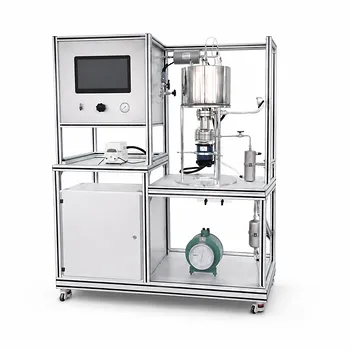
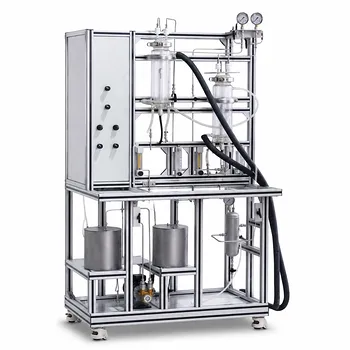
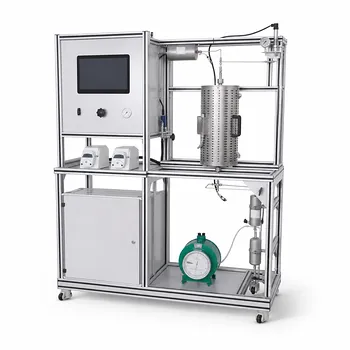
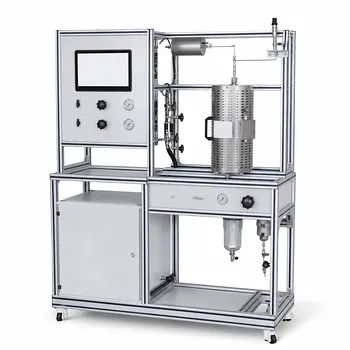
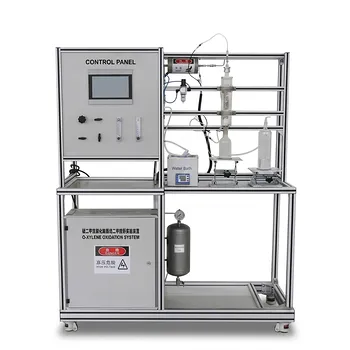
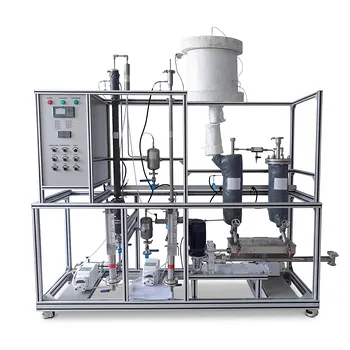
Bridging the gap between theory and industrial reality requires reliable, high-performance equipment. LABPARK provides premium Educational and Vocational Unit Operations Pilot Plants in chemical engineering, bioprocess & biotech, and environmental & water treatment. Designed specifically for universities, research institutes, and enterprises, our pilot plants enable hands-on study of reaction kinetics, diffusion limitations, and reactor scale-up.
Ready to elevate your research and training capabilities? Contact LABPARK today to find the perfect pilot plant solution for your facility!
Related Products
- Micro-Scale Gas-Solid Catalytic Reaction Educational Pilot Plant
- Fixed Bed Gas Solid Catalytic Reaction Educational Pilot Plant
- Fluidized Bed Gas Solid Catalytic Reaction Educational Pilot Plant
- Internal Circulation Gradient Free Catalytic Reaction Educational Pilot Plant
- Multi Functional Catalytic Reaction and Reactor Evaluation Educational Unit Operations Pilot Plant
People Also Ask
- Fluidized vs. Fixed Bed Reactors: Comparing Heat & Complexity in Pilot Plants
- Why is a multibed configuration necessary for exothermic reactions? Optimize your pilot plant trajectory.
- Why is thermal management a major challenge in methane oxidative coupling? Reactor Solutions for Pilot Plants
- How does the Mears criterion evaluate transport resistance? Key Guide to Intrinsic Kinetics
- How do reactor pilot plants safely study gas-solid reactions? Master kinetics with thermal & flow control.