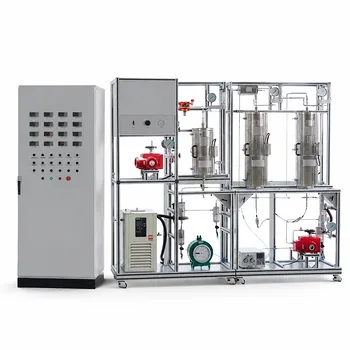
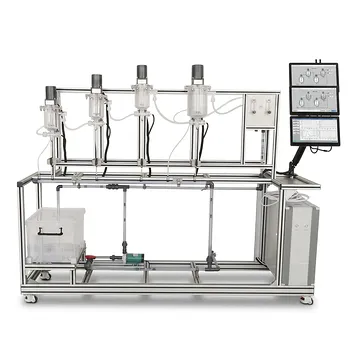
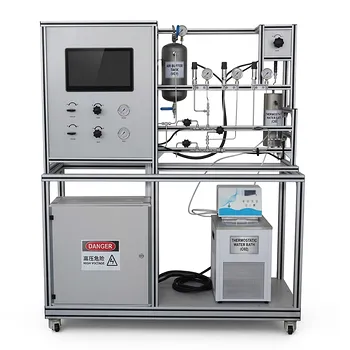
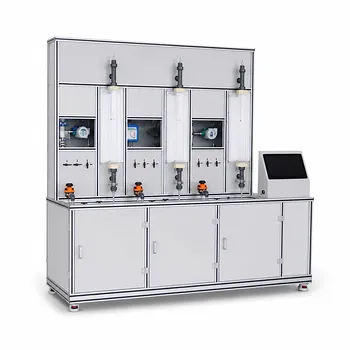
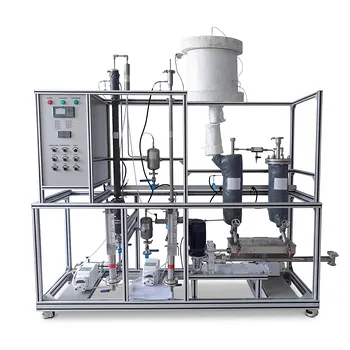
Direct calorimetry using a well-insulated vessel remains the most accessible method—students place reactants in a sealed container immersed in a liquid bath, track the temperature change, and calculate the heat released or absorbed. For reactions that cannot be run in a simple vessel, educational labs pivot to pilot-scale jacketed reactors where precise energy balances around the heating/cooling jacket offer a real-time enthalpy measurement. Both approaches are then verified against theoretical calculations using Hess’s Law or tabulated heats of formation.
In educational chemical engineering labs, reaction enthalpies (ΔHr) are measured through direct calorimetry (temperature tracking in an insulated vessel) or via energy balances on jacketed pilot reactors, then verified by cross-checking with Hess’s Law. The true goal is to connect a raw temperature trace to the fundamental thermodynamic principles that govern energy release or absorption.
Direct Measurement: The Calorimeter at the Lab Bench
How a Simple Calorimeter Works
A calorimeter is a sealed, well-insulated reaction vessel submerged in a known mass of liquid (often water). The setup minimizes heat loss so that any energy released or absorbed by the reaction is almost entirely transferred to the surrounding bath.
The core observation is the liquid’s temperature change. A precise thermometer or thermocouple records the initial and final temperatures, and the difference becomes the foundation of the ΔHr calculation.
Calculating the Heat of Reaction
The energy balance simplifies to Q = mcΔT, where m is the mass of the bath liquid and c its specific heat capacity. For an exothermic reaction, the temperature rises; for an endothermic one, it falls.
Students then convert this absorbed heat (Q) into the molar enthalpy change by factoring in the amount of reactant consumed: ΔHr = -Q / n. The negative sign accounts for the system-versus-surroundings perspective, teaching a critical sign convention early on.
Scaling Up: Pilot-Plant Reactors as Calorimeters
Jacketed Reactors and Real-Time Energy Balances
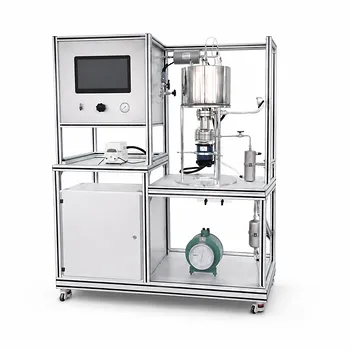
Educational pilot plants often feature jacketed batch reactors that function as large-scale calorimeters. Here, the heat exchange medium flowing through the jacket becomes the observable—not just a static bath.
By monitoring the jacket fluid’s inlet and outlet temperatures and its flow rate, students perform a dynamic energy balance. The enthalpy change is extracted from the amount of heat the jacket must remove or supply to maintain the reactor at a set temperature. This bridges the gap between a theoretical ΔHr value and the tangible heat duty of an industrial unit.
Data-Rich Verification Through Process Monitoring
These units log temperature variations, reactant feed rates, and jacket flow rates over time. Students can integrate the heat flow data over the course of the reaction, directly observing how heat release or absorption peaks and then diminishes. This hands-on experience connects abstract thermodynamic properties to measurable process variables, verifying that the calculated ΔHr holds true under mixing and heat transfer constraints.
Theoretical Verification: Closing the Loop with Hess’s Law
Algebraic Combination of Known Reactions
When direct calorimetry is challenging—perhaps due to a hazardous intermediate or an extremely slow reaction—Hess’s Law becomes the verification tool. Students algebraically combine standard heats of reaction that share the same reactants and products. The calculated ΔHr is then compared to the experimental value from a calorimeter or pilot reactor, confirming measurement accuracy or revealing systematic errors.
Leveraging Standard Heats of Formation
A more universal verification uses tabulated standard heats of formation (ΔHf). The overall enthalpy change is calculated as the sum of the stoichiometric coefficients times the heats of formation of products minus the same for reactants. This provides an independent, literature-based benchmark. Discrepancies between this value and the experimental ΔHr become an educational moment, prompting students to examine assumptions like complete conversion or perfect insulation.
Understanding the Trade-offs and Potential Pitfalls
The Limits of Simple Calorimetry
A basic calorimeter assumes all energy stays in the bath. In reality, heat leaks, losses to the vessel, and uneven mixing introduce errors. Students learn that a poorly insulated setup will systematically underestimate the enthalpy change, a powerful lesson in the importance of engineering assumptions.
The Hidden Complexity of Pilot-Plant Energy Balances
While a jacketed reactor feels more “real,” its enthalpy measurement depends on accurate flow and temperature sensor data. Fouled heat transfer surfaces, fluctuating coolant temperatures, or neglecting the heat capacity of the reactor itself can produce a ΔHr that drifts from the true thermodynamic value. Verifying the sensor calibration and accounting for all energy terms are part of the educational challenge.
Over-Reliance on Theoretical Benchmarks
Hess’s Law and formation tables are only as good as their source data. Using tabulated values from different phases or states of matter—or assuming all components are at standard temperature and pressure when they aren’t—can create a misleading verification target. An experiment that “fails” to match theory might actually reveal a non-ideality, not a measurement error.
Designing a Robust Educational Experiment to Measure ΔHr
Use these goal-oriented approaches to structure a lab that teaches both technique and thermodynamic reasoning.
- If your primary focus is mastering fundamental calorimetry: Start with a simple, rapid neutralization reaction in a basic coffee-cup calorimeter; the quick temperature signal and well-known literature value make it the cleanest introduction to Q = mcΔT and molar conversion.
- If your primary focus is understanding scale-up and industrial relevance: Move to a jacketed batch reactor system, tasking students with logging jacket flow and temperature profiles to compute a cumulative heat of reaction and then comparing it to the theoretical value.
- If your primary focus is building robust verification skills: Require that every experimentally measured ΔHr be accompanied by a Hess’s Law calculation from formation data, and use any discrepancy as a prompt to audit the experimental energy balance for heat losses or incomplete conversion.
- If your primary focus is exposing students to data uncertainty: Deliberately introduce a known heat leak (e.g., remove insulation) and have students quantify how the calculated ΔHr degrades, then discuss how industrial reactors manage energy accountancy under non-ideal conditions.
A well-crafted educational measurement of ΔHr succeeds not when a number matches a textbook, but when students can articulate exactly why it might differ.
Summary Table:
| Method | Equipment Used | Key Calculation / Principle | Educational Focus |
|---|---|---|---|
| Direct Calorimetry | Insulated vessel, thermometer | Q = mcΔT | Fundamental thermodynamics & heat loss analysis |
| Pilot-Scale Energy Balance | Jacketed batch reactor | Jacket flow rate & dynamic temperature change | Industrial scale-up & real-time heat duty |
| Theoretical Verification | Reference data, Hess's Law | Hess's Law & Heats of Formation | Data validation & identifying systematic errors |
Bring Industrial-Scale Thermodynamics to Your Lab
Teaching thermodynamic concepts like reaction enthalpy requires robust, reliable equipment that bridges the gap between theory and practice. LABPARK provides premium Educational and Vocational Unit Operations Pilot Plants in chemical engineering, bioprocess & biotech, and environmental & water treatment.
Designed specifically for universities, research institutes, and enterprises, our systems offer precise data logging and real-time process monitoring to give your students hands-on experience with dynamic energy balances.
Ready to upgrade your laboratory? Contact LABPARK today to find the perfect pilot plant solution for your curriculum.
Related Products
- Multi-Reactor Educational Pilot Plant for Reaction Engineering Unit Operations
- Educational Unit Operations Pilot Plant for Intraparticle Diffusion Effective Factor Measurement
- Fixed-Bed Chemical Reaction and Gas Dust Tar Removal Unit Operations Pilot Plant
- Micro-Scale Gas-Solid Catalytic Reaction Educational Pilot Plant
- Fixed Bed Gas Solid Catalytic Reaction Educational Pilot Plant
People Also Ask
- How can pilot plants help students understand critical process parameters? Hands-On Extraction & Filtration
- How can unit operations pilot plants research source reduction for waste minimization? Key Methods
- How Do Pilot Plants Teach Limiting Reactants, Yield, & Selectivity? Real-World ChE Practice
- Why is purity vs potency crucial for pilot plant mass balances? Learn how to avoid costly scale-up errors.
- How does polyphosphate hydrolysis affect scale and corrosion in pilot plants? Essential Monitoring Guide